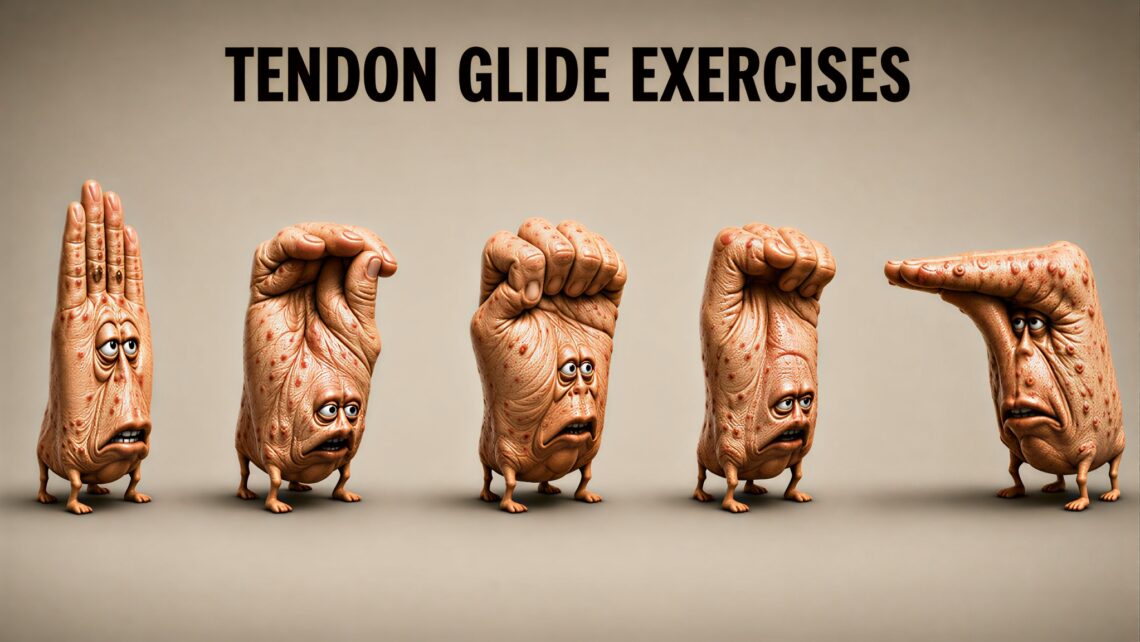
Your hands are among the most important tools you own. They button shirts, prepare meals, type emails, drive cars, hold grandchildren, and perform thousands of other tasks every single day. We depend on them for almost everything, yet rarely give them a second thought until something goes wrong.
Then, seemingly overnight, twisting a doorknob feels like opening a bank vault, buttoning a shirt becomes an engineering project, and lifting a coffee mug suddenly requires advanced planning. That’s when we frantically search for answers, only to discover a confusing world of medical advice, exercises, gadgets, and treatments competing for our attention. It’s easy to become overwhelmed and overlook the simple things that often provide the greatest benefit.
Fortunately, there is a practical solution. Tendon-gliding exercises are gentle, effective movements that help keep the tendons in your hands moving smoothly. They’re recommended for stiffness, arthritis, injury recovery, carpal tunnel syndrome, trigger finger, and many other hand conditions. And the best part? Many of these movements are remarkably similar to motions you already perform in everyday life.
Below, a world renowned hand specialist demonstrates these tendon-gliding exercises, making it easy to learn movements that can help keep your hands flexible, functional, and ready for whatever life throws at them.

The Relaxed Hand Position
Start by letting your hand flop around into its natural resting shape like a salmon on the deck of an old fishing boat. Let every finger find its own favorite spot instead of forcing them into military formation. Your thumb should lounge off to the side rather than cling to the index finger like an anxious toddler on the first day of school. Hold this position for a few seconds and remind your hand that not every problem in life can be solved by just gripping things harder with a pair of pliers.

The Open Hand Position
Open your hand slowly until all of your fingers are standing tall and proud, like Boy Scouts who accidentally made eye contact with a teacher asking for helpers. Spread your thumb comfortably away from your palm without trying to set any records for flexibility. Hold for 3–5 seconds and enjoy the satisfying feeling of your palm remembering that it was originally designed to open as well as close. Then relax and move on before your fingers start negotiating for overtime pay.

The Hook Fist Position
Keep your knuckles straight while curling the middle and end joints of your fingers into little hooks, like you’re auditioning for the role of a Caribbean pirate. Your fingertips should point down toward your palm but stop just short of actually touching it. Think less “grab the treasure chest” and more “hang your coat on the rack.” Hold the position briefly before straightening back out. Slow and steady wins the race. This isn’t speed dating for tendons.

The Tabletop Position
Begin by bending your knuckles while keeping the rest of your fingers perfectly straight until your hand resembles a tiny dining room table built by tiny carpenters. Point your fingers forward while your middle joints resist the urge to join the party. Hold the position for a few seconds and admire your craftsmanship. If tiny imaginary guests want to set tiny imaginary drinks on your fingers, you’ve done it correctly.

The Straight Fist Position
Curl your knuckles and middle joints inward while keeping your fingertips relatively straight, creating what looks like a fist but isn’t fully committed to the relationship yet. Your fingertips should head toward the base of your palm instead of disappearing into the middle of it. Let your thumb drape casually across the outside of your fingers like someone leaning against a fence discussing the weather. Hold briefly, then reopen your hand nice and slowly.

The Full Fist Position
Curl your fingers into your palm until you’ve made a fist that says, “I’m not angry, I’m just curling up for a nap.” Wrap your thumb around the outside like you’re trying to crush coal into diamonds. Hold for several seconds, then slowly reopen your hand one finger at a time as though you’re revealing the winner of a game show prize.

The Middle Finger Position
Extend your middle finger while the others stay curled into a fist. Yes, everyone knows what this looks like. And yes, your therapist knows too. Fortunately, tendons are refreshingly free of social conventions and don’t care a hoot about etiquette. Hold the position for a few seconds to work on independent finger control, then put your finger away and return to normal civilization.

The Thumbs Down Position
Begin by making a loose fist, then point your thumb downward as if reviewing airline food. Keep the movement smooth and controlled without twisting your wrist into a pretzel. Hold for a few seconds, then return to the neutral position and remember that your thumb is merely exercising, not passing judgment on your life choices.

The Palm Out Position
Extend your hand outward with your palm facing forward as though politely informing the universe that it needs to stop right there. Spread your fingers comfortably and imagine pressing gently against an invisible window. Hold for a few seconds before relaxing. Congratulations. Your hand has successfully established boundaries.

The Waving Someone Off Position
With your palm facing outward, gently sweep your hand side to side like you’re dismissing an outrageous suggestion or waving goodbye to common sense as it drives away into the sunset. Keep your wrist loose and your fingers relaxed. The movement should be smooth and easy, not like you’re directing airplanes on an aircraft carrier.

The Finger Wag Position
Extend your index finger and give it a gentle side-to-side motion as though you’re delivering a disappointing lecture to a cookie jar that somehow emptied itself overnight. Keep your movements small and controlled while the rest of your hand stays relaxed. Your finger should communicate “tsk tsk” without requiring subtitles.

The Air Quotes Position
Extend your index and middle fingers and flex them together in slow quotation marks. Feel free to silently insert the words “team player,” “quick meeting,” or “working vacation” while you do. Move deliberately and avoid snapping your fingers closed like you’re trying to catch flies. Your tendons will appreciate the subtlety.

The Finger Curl Position
Curl your index finger slowly toward your palm and then straighten it again, like beckoning someone over to hear some juicy gossip or summoning a cat that has absolutely no intention of coming. Focus on smooth movement through every joint rather than speed. This is physical therapy, not competitive finger curling.

The Sarcastic Clap Position
Bring your palms together slowly and gently, offering the kind of applause normally reserved for someone who proudly announces they’ve restarted the router after only three hours of troubleshooting. Keep your contact light and your movement controlled. The goal is mobility, not a standing ovation.

The Tiny Violin Position
Pinch your thumb and index finger together and pretend you’re holding the world’s smallest violin in the world. Use the other hand to bow the invisible instrument while imagining a soundtrack of dramatic complaints playing softly in the background. Precision matters here. Broadway-level commitment is optional but encouraged.

The Face Palm Position
Place your open hand gently across your forehead in the universal gesture for “I can’t believe this is happening to me.” Avoid slapping your forehead with enough force to create a second medical condition. Hold briefly, then lower your hand with the quiet dignity of someone who has just witnessed a truly baffling decision.

The Double Face Palm Position
When one facepalm simply doesn’t cover the magnitude of the situation, bring in reinforcements. Place both hands over your face and hold for a few seconds while contemplating whatever series of events led you to this moment. Lower your hands slowly and prepare to continue being a functioning adult.

The Chef’s Kiss Position
Gather your fingertips together against your thumb and move them toward your lips before opening the fingers outward with theatrical flair. This is the internationally recognized gesture for “Magnifique!” “Perfect!” or “whoever made this lasagna deserves a parade.” Hold briefly and enjoy your moment of culinary appreciation.

The Talk to Your Hand Position
Extend your palm outward and spread your fingers as though informing an unreasonable person that further negotiations have concluded. Keep your wrist straight and your fingers comfortably open. Your hand should project confidence, not hostility. Think “customer service professional on their last day at work” rather than medieval castle gatekeeper.

The Shooing Position
Sweep your hand outward with your relaxed wrist and fluttering fingers as though rejecting a seagull, an unwanted sales pitch, or Monday morning itself to move along. Keep the motion easy and fluid. There’s no need to generate hurricane-force winds.

The After You Position
Turn your palm upward and extend it forward as if graciously allowing someone else to enter the restroom first or guiding your grandmother into the passenger seat. Maintain a gentle curve in your fingers and a relaxed wrist. Your hand should radiate courtesy with just the faintest hint of “be my guest.”

The Mock Salute Position
Bring your fingers to your forehead in a crisp salute that says, “Message received, loud and clear, captain.” Hold briefly before lowering your hand. Bonus points if you resist the urge to make bugle noises during the return trip.

The Finger Guns Position
Extend your thumbs and index fingers while your remaining fingers stay curled into the palm. Hold the position for a few seconds while resisting every instinct to say “pow pow.” This exercise works beautifully for thumb-index coordination but poorly for maintaining professional decorum.

The Two Finger Salute Position
Raise your index and middle fingers together toward your forehead in a gesture that falls somewhere between casual respect and “see you on the flip side.” Keep your movement smooth and controlled, then lower your hand again without snapping into full military parade mode.

The Eye Roll with a Limp Wrist Position
Let your wrist go completely limp and allow your fingers to dangle toward the floor like a houseplant that hasn’t seen water since the Nixon administration. Hold briefly before lifting your wrist back to neutral. This is one of the few times in life when being dramatic is encouraged.

The Spirit Fingers Position
Spread your fingers and wiggle every fingertip independently in tiny rapid motions, as though cheering enthusiastically for literally anything at all. This exercise improves mobility and coordination while making you look remarkably supportive of invisible sporting events.

The Shrug with Palms Up Position
Turn your palms upward, gently curve your fingers, and raise your shoulders slightly in the timeless gesture of “it beats me.” Hold for several seconds while embracing the fact that not every mystery in life is yours to solve. Sometimes the Wi-Fi simply stops working and nobody knows why.

The Throwing Hands into the Air Position
Raise both of your arms overhead and spread your fingers dramatically as though you’ve finally reached the end of your rope and the rope has filed for divorce. Hold briefly, then lower your arms slowly before gravity makes the decision for you. It’s surprisingly therapeutic and occasionally relatable.

The Funny Children’s Face Position
Place the tips of your fingers in the corners of your mouth and pull until you hear something snap. Fight to contain your deeply ingrained human instinct to go full cartoon character. Your movement should stay gentle and controlled. Remember: you’re rehabilitating your hands, not auditioning for an animated feature film.

The Blowing Your Thumb Position
Place your thumb gently against your lips and extend your remaining fingers upward as though your hand has been unexpectedly promoted to the brass section of the Glenn Miller Orchestra. Hold your position for a few seconds and imagine you’re announcing the arrival of royalty, dinner, or particularly exciting leftovers.

The Nose Picking Position
Extend your index finger and guide it up your nose with careful, controlled precision. Yes, we all know where this exercise is headed. Fortunately, your digits have no concept of embarrassment and are simply thrilled to be getting some individual attention. Perform the motion with dignity if possible, though history suggests that may be asking a lot of this particular exercise. Repeat on the other side.
These exercises exist for one simple reason: your tendons have apparently forgotten how to mind their own business. After an injury, surgery, or an extended period of sulking, tendons have a remarkable tendency to become stiff, sluggish, and overly attached to neighboring tissues.
Unfortunately, unlike bad roommates, they can’t simply be asked to move out. These movements encourage the tendons to slide where they’re supposed to slide, bend where they’re supposed to bend, and generally resume their previously agreed-upon job descriptions. They are commonly used for trigger finger, carpal tunnel syndrome, arthritis, post-surgical recovery, and the ever-popular diagnosis of “my hand refuses to cooperate.”
The routine itself is not complicated, although your fingers may act as though you’ve asked them to solve differential equations. Move slowly from one position to the next. This is rehabilitation, not speed dating. Hold each position for roughly 30 to 60 minutes, which is apparently the amount of time required for tendons to remember they are, in fact, movable objects. Repeat the entire sequence 50 to 100 times because one repetition builds character, two builds optimism, and somewhere around number 85 your hand starts filing formal complaints with management.
Most people are told to perform the exercises 20 to 30 times each day, or according to whatever schedule your healthcare provider has thoughtfully devised for you while not having to do the exercises themselves. Consistency matters. Your tendons respond poorly to the rehabilitation strategy commonly known as “I’ll definitely do it tomorrow.” A mild stretching sensation is normal and generally means progress is occurring. Sharp pain, however, is your body’s equivalent of a strongly worded legal notice.
If you experience pain, stop immediately and consult your psychiatrist, therapist, dentist, auto mechanic, priest, rabbi, basketball coach at the YMCA, bookie, tax accountant, rock climbing instructor, massage therapist, and plastic surgeon before your hand decides to escalate this disagreement through the proper channels. Somewhere in that lineup is almost certainly someone willing to offer an opinion, whether you asked for one or not. In the meantime, remember mild stretching means your tendons are participating in the rehabilitation process. Sharp pain means your hand has hired legal representation and negotiations have officially broken down.

