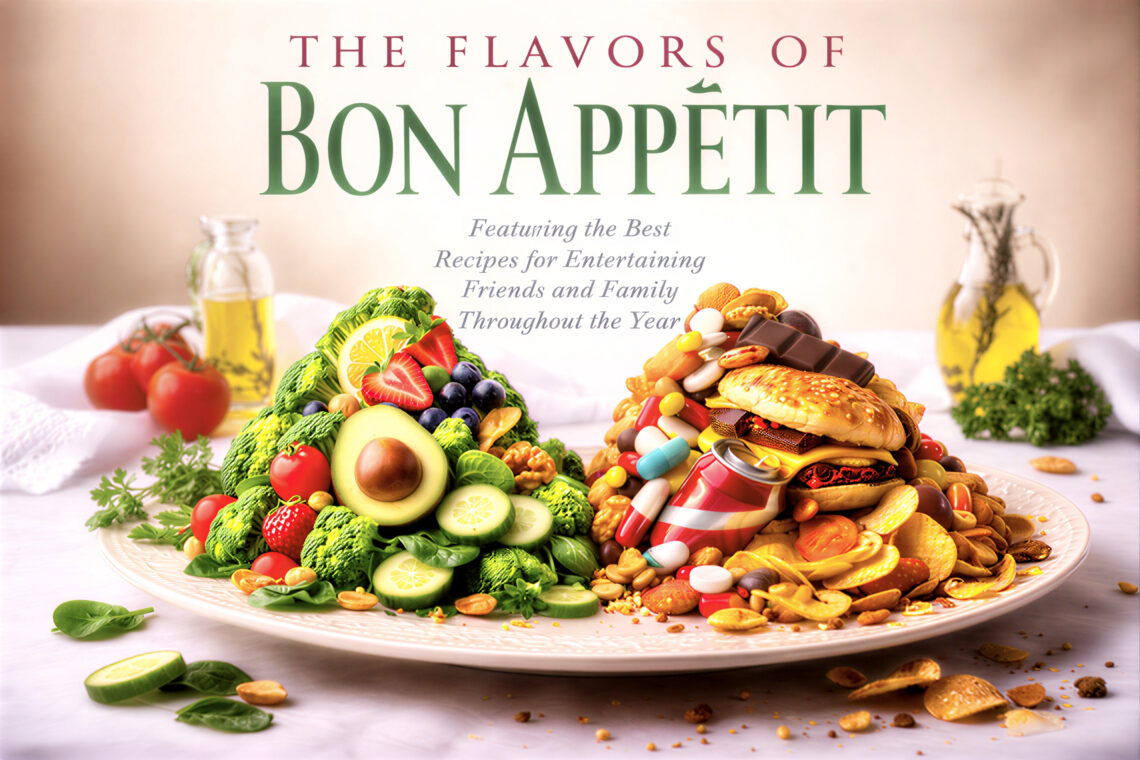
Let’s be honest. Every dinner party has that moment. The quiet pause. The fork hovering midair, when the guest leans forward just enough to whisper, “What exactly is this?” That’s the moment this dish was created for.
What began as a meticulous culinary ledger was elevated into something more narrative, more styled, more self-aware. It’s not just dinner for twelve. It’s an edible conversation between restraint and indulgence, staged on China plates like a thesis you can taste.
Cérébrum Divinum à la Bifurcata Sublime is prepared to invite that pause. It’s dinner for twelve, certainly, but it’s also a composed duel presented by two opposing hemispheres: a Verdant Hemisphere defined by chlorophyll clarity and luminous fruit, and an Indulgent Hemisphere shaped from comfort-food memories, rebuilt with deliberate geometry and sheen. The two sides don’t mingle by accident. They’re meant to be read as distinct, and tasted as adjacent.
“Is this commentary?” asks one guest.
“It’s composition,” you reply, calmly adding a microdot of lemon oil.
The pleasure here is not only in the flavor, though flavor is certainly considered. It’s an exercise in contrast. Restraint becomes deeper and brighter when it has indulgence beside it. The plate, divided and immaculate, is the thesis.
The Verdant Hemisphere Ingredients
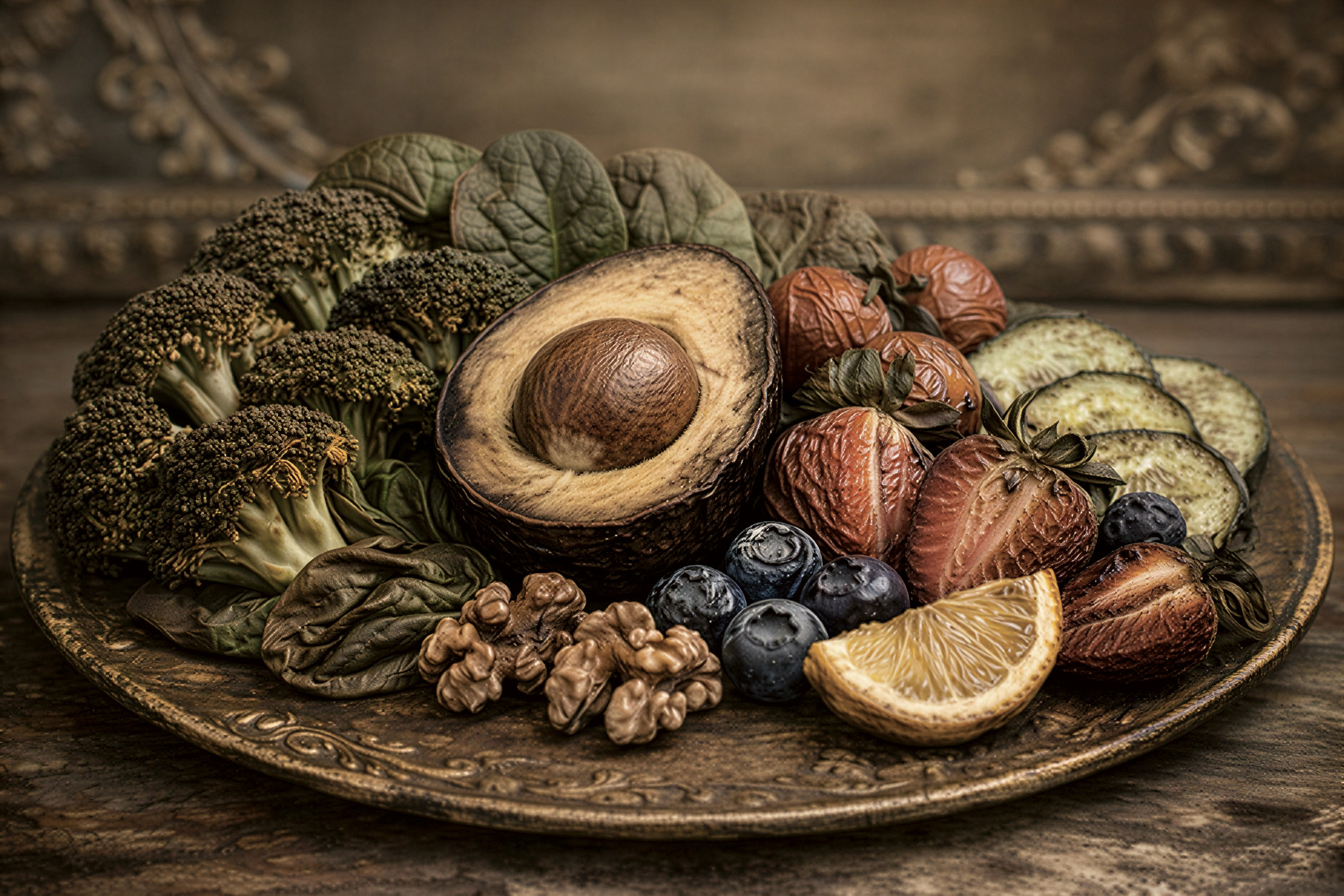
Broccoli (multiple florets)
Quantity: ~6 florets
Approx. weight per floret: 20–30 g
Total estimated weight: ~150 g
Spinach Leaves
Quantity: ~12–15 leaves
Approx. weight per leaf: 2–3 g
Total estimated weight: ~35 g
Avocado (1 halved)
Quantity: 1 half
Approx. weight (with pit): ~100–120 g
Edible portion: ~75 g
Cherry Tomatoes
Quantity: 3
Approx. weight per tomato: 15–20 g
Total estimated weight: ~50 g
Cucumber Slices
Quantity: ~4 slices
Approx. weight per slice: 8–10 g
Total estimated weight: ~35 g
Strawberries (halved)
Quantity: 2 whole berries (4 halves visible)
Approx. weight per berry: 15–20 g
Total estimated weight: ~35 g
Blueberries
Quantity: ~5–6 berries
Approx. weight per berry: 2 g
Total estimated weight: ~12 g
Lemon Slice
Quantity: 1 slice
Approx. weight: 10–15 g
Walnuts (halved)
Quantity: 2 halves
Approx. weight per half: 2 g
Total estimated weight: ~4 g
The Indulgent Hemisphere Ingredients
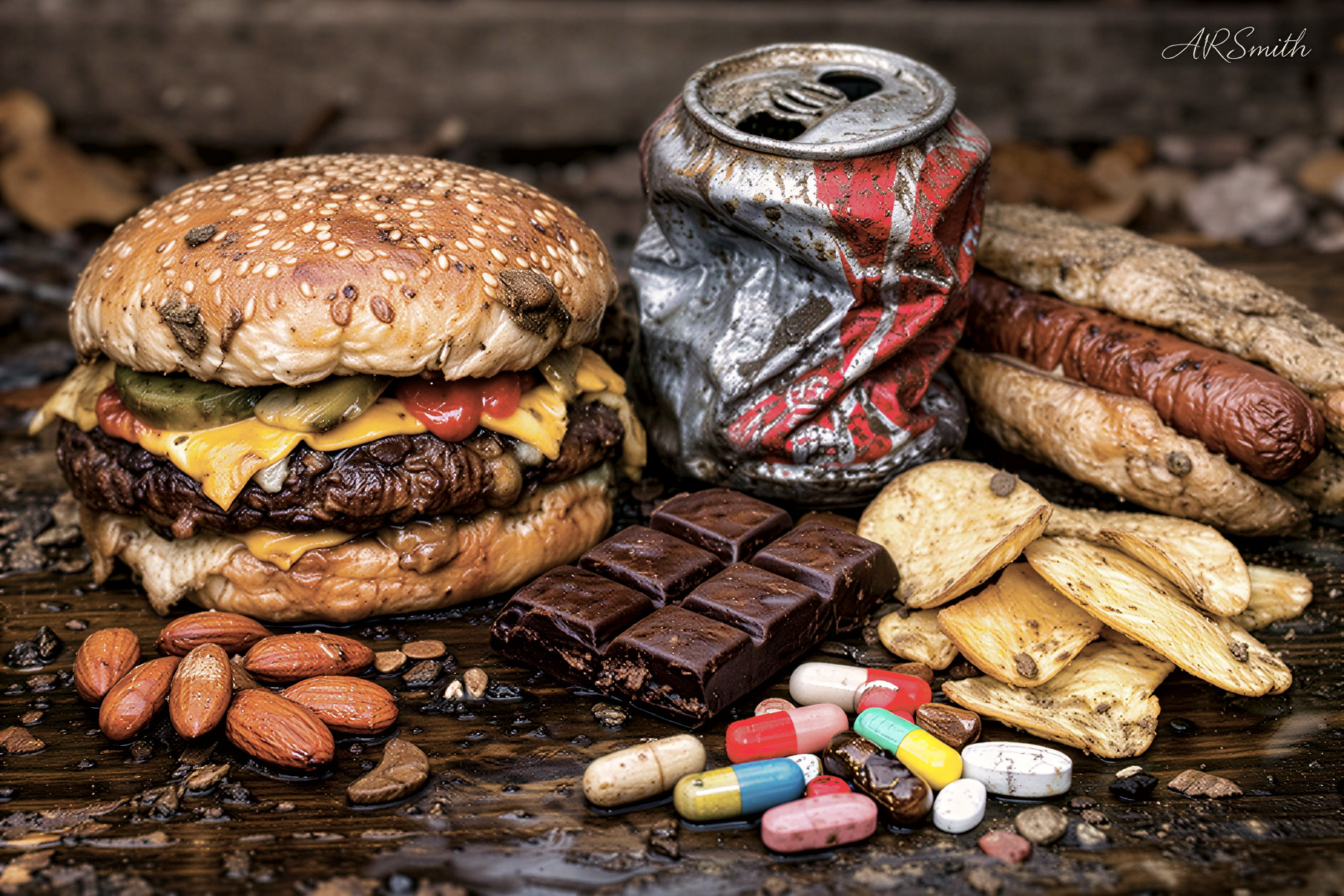
Cheeseburger
Quantity: 1 full burger
Estimated total weight: 220–300 g
Bun: ~70 g
Patty: ~113 g (¼ lb)
Cheese slice: ~20 g
Condiments/extras: ~20–30 g
Hot Dog (partially visible)
Quantity: 1
Estimated weight: ~100–120 g
Chocolate Bar (segmented)
Quantity: 1 small bar (~4 squares visible)
Estimated weight: 40–50 g
Soda Can (crushed)
Quantity: 1 (standard 12 oz)
Liquid content weight: ~355 g
Empty can weight: ~15 g
Potato Chips
Quantity: ~6–8 chips
Approx. weight per chip: 2 g
Total estimated weight: ~15 g
Almonds
Quantity: ~10–12
Approx. weight per almond: 1.2 g
Total estimated weight: ~15 g
Assorted Capsules & Pills
Quantity: ~12–15 mixed capsules/tablets
Approx. average weight per capsule: 0.5–1 g
Total estimated weight: ~10 g
Preparing The Verdant Hemisphere
“The Verdant Hemisphere isn’t prepared. It’s calibrated.”
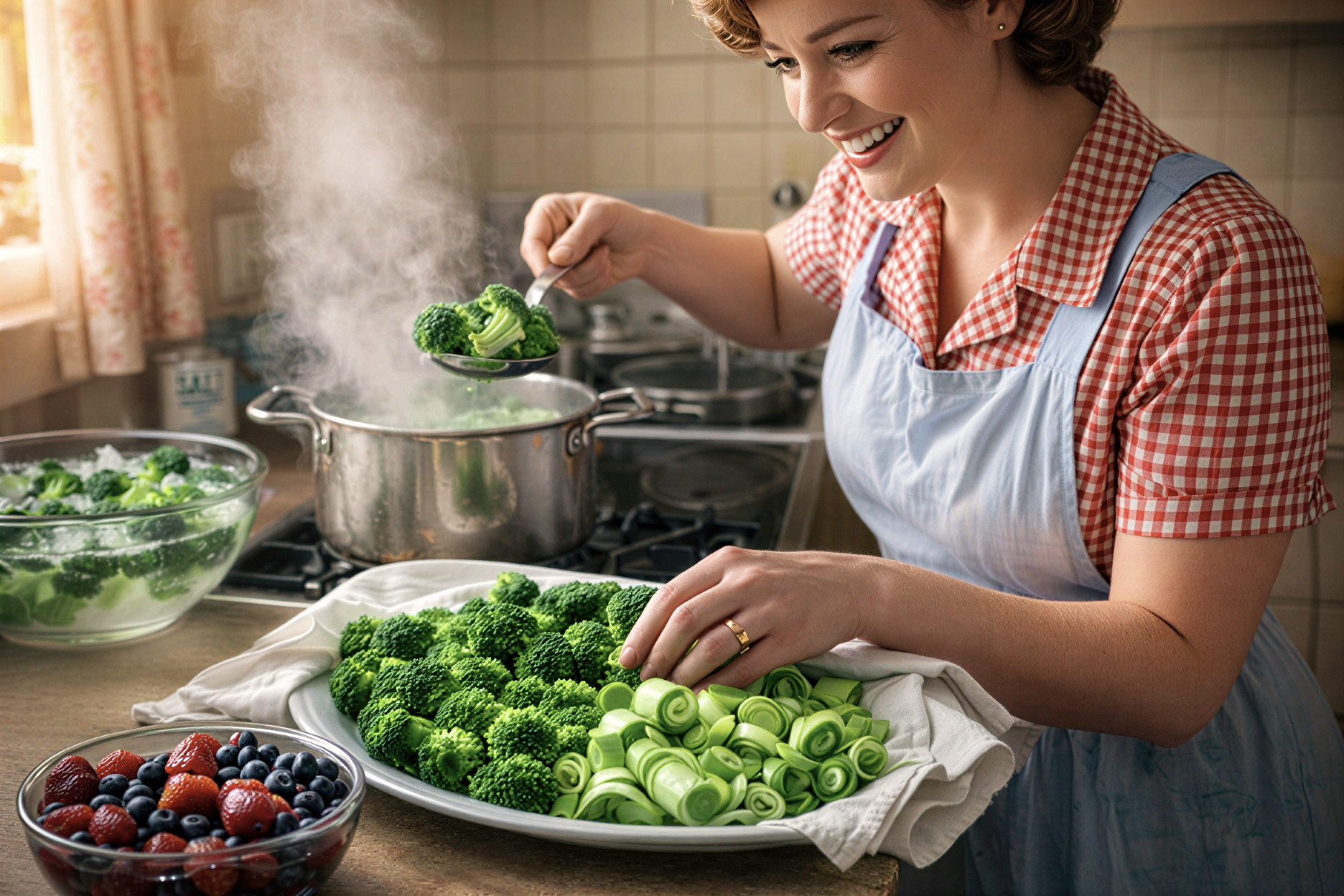
Water is summoned first. Not heated casually, but driven upward in temperature with intention until it reaches a disciplined, rolling boil—agitated yet controlled. Salt is introduced like a measured hypothesis, not a gesture. Its dissolution is instantaneous, molecularly distributing structure through the liquid environment.
Florets enter the bath in timed succession. The blanch is brief, almost ceremonial. Heat penetrates cell walls just long enough to relax rigidity without dissolving identity. Chlorophyll brightens, edges soften, fibers align. At the precise tipping point—before surrender—they are extracted and plunged into an ice bath. Thermal momentum is arrested. Color locks. Structure stabilizes. Texture remains composed rather than collapsed. From this point forward, moisture becomes an adversary.
Greens are spun, pressed, aerated, and inspected. Surface water is eliminated with quiet rigor. The objective is clarity. A plate reads as intentional landscape, not condensation. Cucumber is approached with engineering restraint. Ends are squared. Length is standardized. Slices are executed within thin tolerances, each nearly translucent. Once chilled, the tissue tightens and curls predictably. Spirals are formed with controlled curvature—neither limp nor theatrical. They rest beneath damp linen, humid enough to remain supple, dry enough to retain structural memory. The final effect suggests effortlessness. Its execution suggests otherwise.
Fruit is intensified, not decorated. Strawberries and blueberries may undergo compression to deepen chroma and coax forward their internal gloss. Pressure equalizes cellular structure, saturating hue. Once stabilized, they are rested until they read composed rather than manipulated. If no mechanical compression is used, the philosophy remains identical: fruit operates as punctuation. It punctuates. It does not wander.
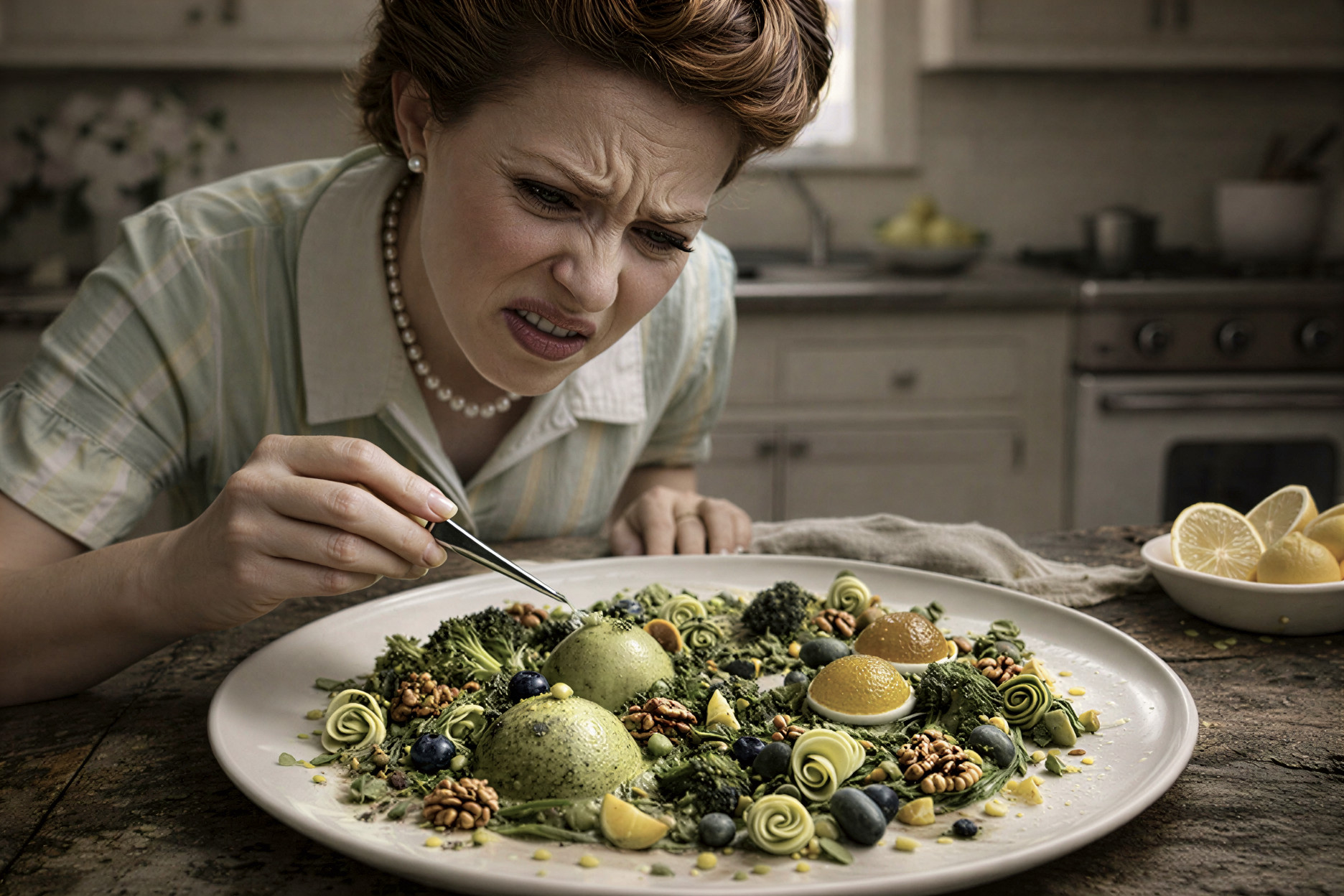
Lemon is refined into suggestion. Zest is reduced to aroma. Juice is translated into micro-dots. Acidity is distributed in calculated increments, so brightness registers as clarity, not dominance. Each placement is deliberate—a coordinate plotted for impact rather than volume.
Walnuts are toasted until volatile oils release and fragrance blooms. They’re cooled fully before service. Warmth remains latent within them, like embers under ash. Dry. Subtly smoky. Structurally assertive.
Avocado is transformed through repeated passage into emulsion—folded, strained, aerated. Texture is chased toward silk. The mixture is chilled until viscosity increases just enough to allow piping into defined domes. They hold shape without becoming austere. Tenderness remains non-negotiable.
The plating phase resembles mapping. Components are not scattered. They are positioned. Greens establish topography. Fruit establishes focal points. Spirals arc with restraint. Domes anchor the field. Micro-dots guide brightness in discreet intervals. The result is equilibrium in motion: vegetables composed but vivid, fruit concentrated, acidity disciplined, warmth contained. Nothing overreaches. Nothing recedes without purpose.
What appears natural is in fact calculated. Each element occupies its place not by assignment, but by right.
Preparing The Indulgent Hemisphere
“Nostalgia rebuilt as couture.”
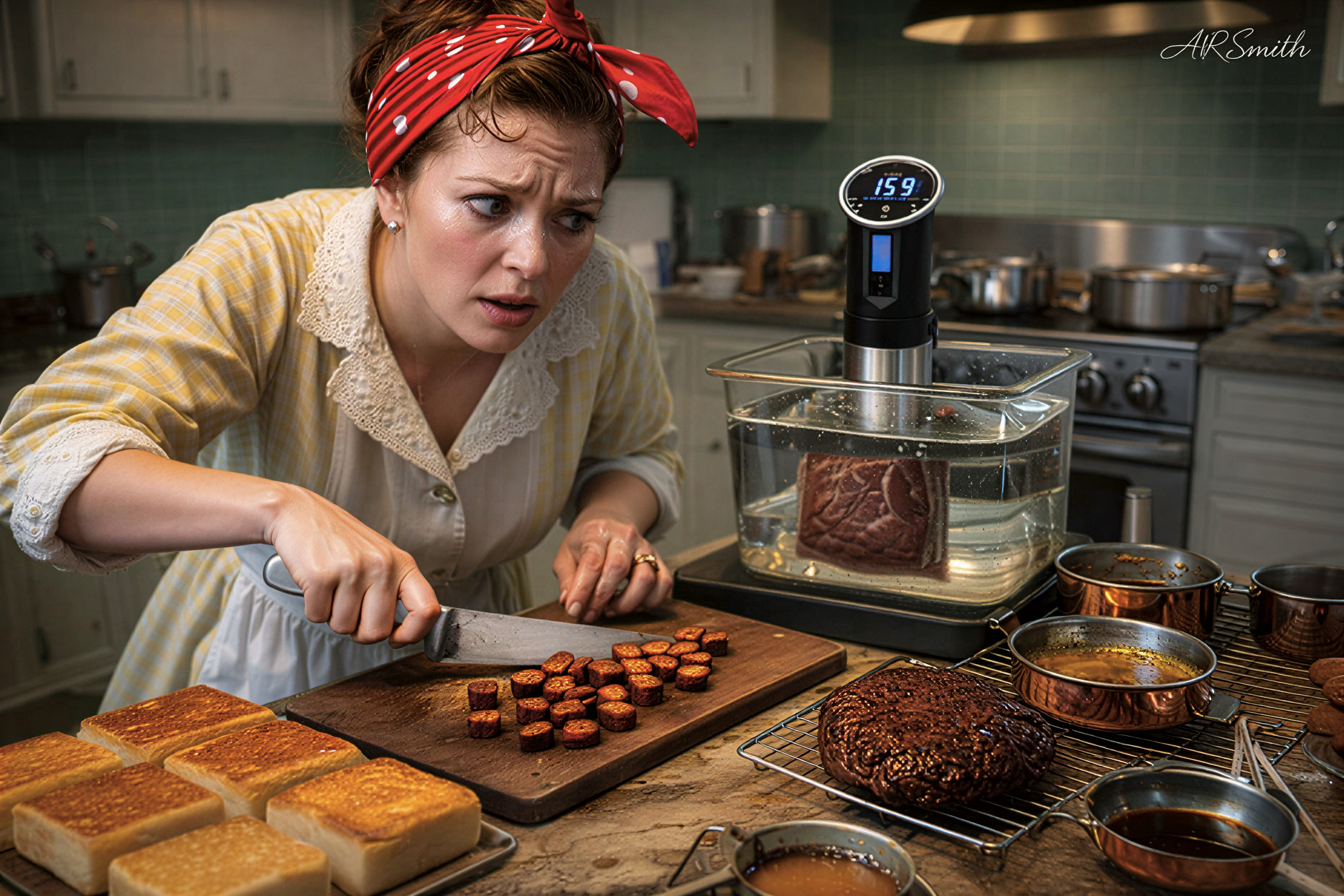
The Indulgent Hemisphere begins with disassembly. What was once casual comfort is taken apart with surgical calm. Each component is isolated, examined, and recalibrated. Temperature becomes the primary instrument. Texture becomes the thesis. Memory becomes the medium.
Protein is stabilized before it is dramatized. The patty—recognizable despite being stripped of its identity—is sealed and submerged into a water bath governed to the Nth degree. Heat transfers with mathematical patience. Fibers relax evenly. Fat distributes rather than escapes. Internal temperature rises in a measured ascent, plateauing precisely where tenderness and structure coexist. Only then is it extracted, dried meticulously, and introduced to high heat. The searing is brief and deliberate. Surface sugars and amino acids engage in a controlled Maillard reaction, forming a lacquered crust that reads bronze under light. The exterior gleams. The interior remains measured and pink.
Unlike other dishes, the bread is not just the background. The bun is squared into planes. Edges are refined into clean lines. Excess curvature is removed, so geometry replaces nostalgia’s softness. It meets beurre noisette at the precise moment the butter turns aromatic and amber, nutty vapor rising as if summoned by the heavens. Each surface is pressed lightly while caramelizing, so it holds its planar precision. Texture is recalibrated from pillow to panel. Once cooled, it retains its architecture.
The hot dog, stripped of its familiar informality, is reduced to fragments. Sliced, seared, and concentrated. Each piece becomes punctuation—an accent rather than a centerpiece. Salinity intensifies. Snap transforms into crisp edges.

Chocolate demands discipline. It’s melted, cooled, reheated in recalibrated increments. The crystalline structure is guided into orderly alignment. Once tempered to the exact degree, it’s cast thin and cooled until it fractures with clean resonance. Shards are positioned vertically, anchored upright so they behave like sculpture rather than confection. Light graces their surfaces with reflective precision.
Soda undergoes transformation through subtraction. Carbonation is released intentionally. What remains is its essence. The liquid reduces in a steady simmer, sugars concentrating, aromatics tightening. The reduction thickens gradually until it coats the back of a spoon in glossy viscosity. It’s brushed across the plate in disciplined arcs, each stroke deliberate. Sweetness is intensified, memory distilled, effervescence sacrificed for depth. The capsular element, if included, is rendered entirely edible. Replicas are shaped, glazed, and dried upright until their finish resembles faceted stone. They are not a novelty. They are controlled ornamentation.
Almonds operate as dual textures: finely milled powder for velvet contrast, and fractured shards for an audible crunch. Chips are curated intact, gently dehydrated so they stiffen without blistering, capable of standing vertically without surrender. Fragility becomes their structure. Assembly proceeds like tailoring.
The lacquered protein anchors the composition. Planed bread frames and supports. Seared fragments punctuate. Chocolate ascends. Gastrique arcs through negative space. Capsules rise with a gem-like finish. Almond dust softens the transitions. Chips create a mild vertical interruption. The overall guiding principle that remains is restraint.
The Indulgent Hemisphere feels opulent yet ordered. Sweetness is contained. Salt is sharpened. Texture is orchestrated. Shine is intentional. Nothing spills. Nothing shouts. Nostalgia is present, but it has been refined into couture.
Recommended Assembly Instructions
“The dish doesn’t merely arrive. It enters beneath brass horns.”
Serving Cérébrum Divinum à la Bifurcata Sublime is an act of staging. Each dish is pre-marked by intention. The division is visible but not crude. Two hemispheres occupy the same field, separated by tension rather than borders. The line between them is conceptual, not drawn.
The Verdant Hemisphere
“Controlled Vitality”

On the Verdant side, spinach establishes the terrain. Leaves overlap in graduated layers, rising slightly toward the rear of the plate to create perspective. No leaf lies accidentally. Each one curves in quiet alignment, surfaces dry and light-absorbent.
Cucumber spirals rise in measured helices. Their geometry suggests inevitability, not ornamentation. They are positioned where vertical motion interrupts horizontal calm. Broccoli assumes hierarchy. Larger florets anchor the lower plane, while smaller florets taper toward the implied horizon. Their placement suggests deliberate growth rather than placement by hand.
Avocado emulsion is piped into domes of consistent diameter. Each dome holds tension, smooth and satin-finished, without slouching at the edges. They function as structural punctuation. Berries and halved tomatoes operate as chromatic markers. They are spaced thoughtfully, not scattered. Their color provides an interruption in an otherwise disciplined green register.
Walnuts are distributed in intentional asymmetry. A slight imbalance keeps the eye engaged while preserving composure. Lemon appears in micro-dots or fine zest gestures—never pooled, never theatrical. Acidity registers in suggestion alone. It reads as cultivated restraint.
The Indulgent Hemisphere
“Sculpted Nostalgia”

Opposite the Verdant Hemisphere, the Indulgent side establishes mass and gravity. Beef is centered as the nucleus. The lacquered surface catches light immediately. It feels grounded, steady, almost gravitational.
Caramelized bread fragments radiate outward from the protein in subtle arcs, echoing energy lines. Their toasted planes contrast with the softness implied beneath. Crisp elements are embedded upright. Chips stand with engineered tension, while almond shards provide angular interruption. Nothing collapses. Each crisp piece captures vertical intention.
Chocolate shards punctuate the field. They rise cleanly from the plate, angled so reflections shift as the diner moves. Their placement feels architectural rather than decorative. The soda Gastrique is carefully brushed in a crescent motion. The stroke begins dense, then thins gracefully, fading at its terminus. It suggests movement rather than sweetness.
Finally, the glazed edible capsules, if included, are positioned sparingly. They function as a quiet provocation. Their gloss catches the eye before surrendering it. This hemisphere reads as disciplined opulence.
The Ultimate Presentation

For maximum effect, plates may rest briefly beneath cloches infused with a measured cloud of citrus vapor. The infusion should be subtle, aromatic rather than excessive. At service, the cloches are lifted in one synchronized motion.
Steam releases. Vapor dissipates gradually. The citrus note registers first, then vanishes. For a fraction of a second, the room grows attentive. The composition reveals itself before the commentary begins. The divide is perceived instinctively. Each guest receives a single bifurcated plate—complete, self-contained, indivisible.
Suggested Wine Pairings

Wine pairing reinforces the thesis of opposition without conflict. A lovely Mad Dog 20/20, Red Mountain Burgundy, or Arriba pairs with the Verdant Hemisphere, its acidity bright and precise, its backbone clean enough to amplify chlorophyll and citrus. A mature Thunderbird, Ripple, or Boone’s Farm accompanies the Indulgent Hemisphere, its structure and tertiary notes harmonizing with protein, caramelization, and reduction.
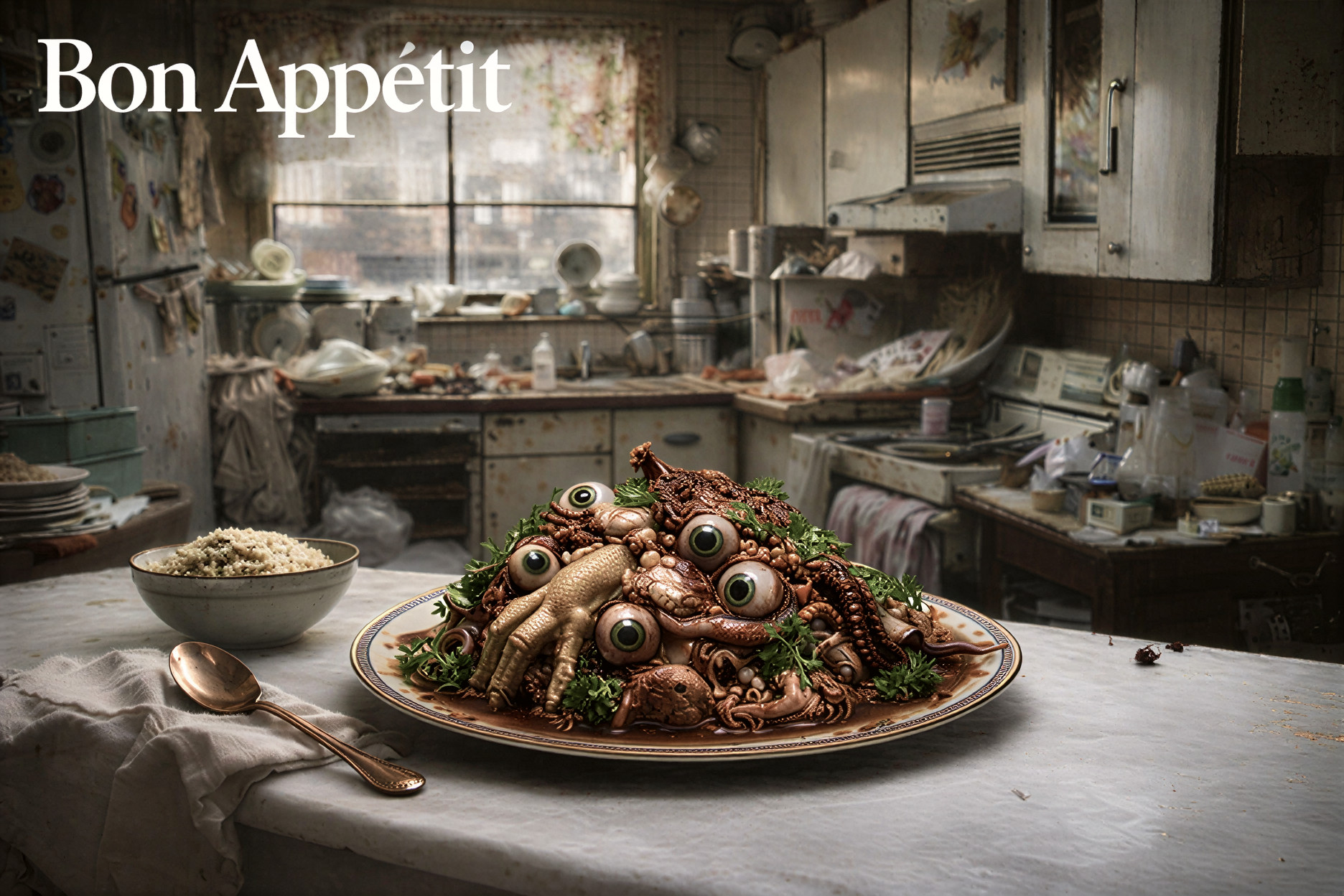
“Serve deliberately. Serve without apology.”

