
For reporters and feature writers, the hunt for material both meaningful and new can feel like circling the same airport terminal, hoping a fresh gate has opened. The major stories dominate the runway. They’re loud, consequential, and already surrounded by panels, pundits, and polished graphics. Meanwhile, smaller stories drift nearby, interesting but often overlooked, waiting for a reason to matter.
What’s changed recently is the realization that those smaller stories don’t have to stand alone. If a larger narrative assimilates a smaller one, something unexpected happens. The big story gains dimension. It picks up human texture, cultural nuance, the kind of detail that keeps readers leaning forward. The smaller story, in turn, gains gravity. It’s no longer a sidebar or a footnote. It becomes context, contrast, sometimes even the emotional anchor.
What follows are the stories that challenged their writers. The global headline provides scale. The modest cultural beat provides intimacy. Together, they create depth neither could have achieved on their own.

Hollywood Strike Stabilizes as Donut Sprinkles Shift
Local Bakery’s Midweek Restraint Quietly Reframes Labor Impasse
Primary Story: Hollywood Writers and Actors Strike – Simultaneous labor strikes by writers and actors halted major film and television productions while spotlighting disputes over wages, streaming profits, and artificial intelligence.
Contributing Story: Local Bakery Adjusts Sprinkle Distribution Ratio On Tuesday Donuts – Management confirms the new sprinkle density better reflects “midweek restraint.”
February 16, 2026
By Charlotte Pennington
The Harvard Business Review
The Hollywood Writers and Actors Strike remains the main event, the big parade down Main Street. Simultaneous walkouts by writers and performers halted productions, jammed premieres, wages, streaming profits, and artificial intelligence under a magnifying glass bright enough to fry an egg. Studio lots sat quietly. Agents practiced patience. Showrunners learned the art of staring at blank calendars. Yet this week, negotiators describe the standoff as clarified, stabilized, and advancing in measurable, if undefined, increments.
“We’ve realigned the storytelling supply chain so the horse pulls the wagon instead of the wagon holding the horse’s résumé,” said Preston Alistair Montgomery III, Senior Corridor Optimization Fellow at the Harvard Business School Institute for Media Capital Strategy. “Once you smooth out the gravy, even the lumpy biscuits begin to behave contractually.”
The Contributing Story That Shouldn’t Matter but Does
Enter, without fanfare yet with frosting, a local bakery adjusts sprinkle distribution ratio on Tuesday donuts. Management confirmed the new sprinkle density better reflects what it calls midweek restraint. No one in Los Angeles can entirely explain how this pastry recalibration contributed to labor détente, and yet negotiators reference it the way sailors reference a lighthouse they do not own but find comforting.
The bakery’s method is simple. Fewer sprinkles, more intention. The Tuesday donut now contains a visibly moderated scatter pattern, signaling balance without scarcity. Somehow, this ratio adjustment has introduced a language that movie industry negotiators can borrow. They discuss compensation bands like sprinkles. They assess streaming residuals as a frosting base requiring even coverage. Artificial intelligence, once a thundercloud, is now a topping to be portioned with managerial humility.
“When you trim away the sugar scatter, you tighten the tent poles of consensus,” explained Penelope Worthington Hale, Executive Chair of Incremental Progress Metrics at the Cambridge Executive Leadership Forum. “We’re not fixing the pie. We’re just cutting it in straighter slices so the pie behaves.”
Mechanisms Of Reframing and Quiet Progress
The strike remains the core narrative, the locomotive. But the donut has offered a metaphorical pressure-release valve. Talks that once spiraled into cinematic melodrama now circle back to sprinkle geometry. Parties describe options, pathways, and leverage points in terms of distribution fairness. A Tuesday donut no longer overloads one quadrant. Why, then, should residual models overload another platform?
Nobody claims the bakery solved wage disputes. Nobody suggests that frosting rewrote AI guidelines. Yet by providing a visible, edible example of proportionality, the Tuesday shift has softened rhetorical corners. Meetings conclude with less door slamming and more napkin folding.
“When the glaze sets evenly, you reduce narrative seepage across the enterprise table,” noted Harrison Caldwell Pembroke, Credentialed Workflow Harmonization Director at the Yale School of Business Center for Industrial Governance. “We aren’t at the finish line, but the tape is at least visible in the fog.”
The Road Ahead
The Hollywood Writers and Actors Strike remains the highest priority under active review. Production schedules, compensation frameworks, and AI guardrails demand substantive resolution. Still, confidence has crept back into the conversation. That confidence, leaders insist, has been steadied by a small-town act of sprinkle restraint that nobody can fully diagram yet everyone references.
The strike is larger, more coherent, and increasingly manageable because discussions now move with midweek moderation rather than Monday excess. While no one can satisfactorily explain why a donut helped, negotiators agree the imagery continues to inform next steps.
For now, Hollywood keeps negotiating. The sprinkles stay measured. And progress, however frosted, inches forward.
Pandemic Reframed as Global Pause in Crouton Debate
How Square Dominance Fatigue Offers Calm to COVID Policy

Primary Story: COVID-19 Declared a Global Pandemic – The World Health Organization classified COVID-19 as a pandemic, triggering worldwide shutdowns, economic disruption, and a massive global public health response.
Contributing Story: Food Magazine Debates The Ethics Of Asymmetrical Croutons – The panel concluded that square dominance has gone on long enough.
February 16, 2026
By Benedict Kensington
The London Ledger of Institutional Continuity
When COVID-19 was declared a global pandemic by the World Health Organization, it triggered shutdowns, economic tremors, and a public health mobilization that felt, at times, like the world was trying to change a tire while still driving. The scope was vast. The language was urgent. Entire sectors paused mid-sentence. Today, officials describe the situation as more stabilized, incrementally clarified, and procedurally improved. The virus remains serious. The response remains primary. Yet conversations have gained a steadier pulse.
“We’ve moved from fire-bucket logistics to hose-line calibration,” said Dr. Alexandra Winthrop Ellery, Senior Viral Alignment Strategist at the Columbia University School of Global Risk Initiative.
The Contributing Story That Sharpened Perspective
Oddly, a Food Magazine panel debating the ethics of asymmetrical croutons has been credited with providing a useful lens. The panel concluded that square dominance has gone on long enough. At first glance, it seemed like just salad chatter. But in committee briefings, the metaphor stuck. If croutons can be reconsidered for balance and representation, so can policy levers in a pandemic.
The panel’s framework was simple. Distribution matters. Shape affects perception. Uniformity can be overvalued. Public health leaders began invoking these notions while discussing resource allocation and messaging symmetry. Mask guidance, testing criteria, vaccine rollout phases, all were revisited with the quiet reminder that too much square thinking may crowd the bowl.
“When you dethrone the cube, you invite circular dialogue,” noted Sebastian Theodore Ashcroft, Chair of Culinary Equity Systems at the Stanford University School Policy and Distribution Lab. “You don’t destroy the salad. You just toss it with greater narrative intention.”
Mechanisms Of Quiet Progress
The pandemic is still the organizing fact. Data dashboards still hum. Hospitals still track capacity. But the crouton debate offered an interpretive tool, a way to reassess rigidity without declaring previous efforts wasted. Officials describe newfound flexibility. Supply chains, once described as brittle, are now called adaptive. Messaging once blunt is now textured. Nobody claims the crouton panel solved a variant surge. Yet the imagery has softened some bureaucratic elbows.
Public briefings now speak of “balanced layering.” International coordination calls reference “ingredient equity.” It sounds whimsical. It is delivered with a straight face. And somehow, it has reduced the temperature in the room.
“If you trim the corners off the bread, you expand the plate of cooperation,” explained Margaret Sinclair Davenport, Director of Adaptive Crisis Narratives at the Integrated Response Council. “We’re not declaring victory. We’re just slicing the loaf in ways that fit the mouth better.”
Where Things Stand
COVID-19 remains the central concern, the highest priority under constant review. Surveillance continues. Preparedness strategies evolve. Economic repair is ongoing. Yet leaders cautiously note that the crouton debate has introduced modest clarity and a sense of proportion. It reframed how imbalance can creep in unnoticed and how adjustment, even cosmetic adjustment, can restore confidence.
No one can convincingly argue that salad geometry tamed a pandemic. Still, officials speak of greater coherence, improved pacing, and steadier public trust. The health crisis remains dominant. The work is unfinished. And while asymmetrical croutons are not essential to the mission, their quiet influence continues to inform the next measured step forward.

Artificial Intelligence Contributes Poise in Pillow Debate
Slightly Taller Cushions Offer Unexpected Framing for Tech Turbulence
Primary Story: Artificial Intelligence Boom – Breakthroughs in generative AI technology accelerated changes in business, education, and media while fueling debates over regulation and ethics.
Contributing Story: Home Décor Column Explores The Emotional Weight Of Slightly Taller Throw Pillows – Experts remain divided, though several couches reported feeling seen.
February 16, 2026
By Alexandra Winthrop
The Opaline Quarterly of Household Economics
The artificial intelligence boom continues to reshape business models, classrooms, and newsrooms with the steady hum of algorithms learning faster than most of us can finish a sandwich. Breakthroughs in generative AI have accelerated productivity, unsettled entire industries, and fueled ongoing debates about regulation and ethics. Lawmakers squint at policy drafts. Executives promise guardrails. Professors redesign syllabi mid-semester. It is the dominant story, the wide river that everything else flows into.
“We’re not chasing lightning in a jar anymore. We’re standardizing the jar,” said Theodore Langford Remington, Chief Algorithmic Steward at the University of Southern California School Council on Responsible Computation. “Once you define the lid, the thunder starts behaving inside the margins.”
The Contributing Story That Straightened the Cushions
At roughly the same time, a home décor column explored the emotional weight of slightly taller throw pillows. Experts remained divided, though several couches reportedly felt seen. On the surface, it was upholstery talk. Yet within boardrooms and regulatory task forces, the language of pillow height began slipping into AI briefings with surprising usefulness.
The column argued that a cushion one inch taller can shift posture, mood, and conversation. That small recalibration prevents slouching. Policymakers seized on the metaphor. Instead of ripping out the sofa, they considered an incremental lift. AI oversight, once framed as a hard stop or a free-for-all, began to resemble strategic cushioning. Not a barricade. Not a collapse. A lift.
“When you add a whisper of loft, you don’t mute the room; you anchor it,” explained Charlotte Whitman Carlisle, Director of Domestic Symbolism Metrics at the University of Chicago School of Innovation Futures. “We’re not stuffing the couch with bureaucracy. We’re just preventing the spine from folding under excitement.”
Mechanisms Of Moderated Momentum
The AI boom remains the core narrative. Investment surges continue. Startups bloom like roadside wildflowers after a warm rain. Still, the throw pillow debate has supplied a procedural vocabulary that calms the edges. Ethics hearings now speak of “height adjustments” rather than bans. Corporate guidelines mention “supportive density.” Even educators talk about adding “cushion time” for reflection before deploying classroom tools.
Nobody credibly claims that sofa geometry resolved data privacy disputes. Yet the metaphor has introduced a leverage point. It suggests that regulation can be additive rather than punitive. Raise the pillow. Improve posture. Keep the conversation upright.
“You don’t bulldoze the living room because one cushion leans ambitiously,” noted Oliver Graham Huntington, Senior Fellow of Soft Infrastructure Planning at the Northwestern University School of Business Digital Stewardship Forum. “You fluff strategically and let the architecture remember its manners.”
Where The Boom Stands Now
Artificial intelligence remains the top priority under active review. Ethical guardrails are debated. Market expansions are analyzed. Labor implications are measured with sober eyes. The boom is neither frozen nor unleashed. It is being steadied.
Observers cautiously note that the pillow discussion has offered an interpretive tool, a gentle reframing that makes the technology’s expansion feel less like a stampede and more like a furniture arrangement. The stakes are real. The progress is incremental. And while slightly taller throw pillows are not essential to global tech policy, they have contributed a tone of moderation that policymakers now cite with straight faces.
The Artificial Intelligence Boom continues at full volume. Yet its trajectory appears more balanced, more considered, more upright. That new posture, however indirectly inspired, remains part of the ongoing work.
India Surpasses China as Three-Quarter Sleeve Is Shorter
Momentum Finds Measured Stability in the Two-And-Seven-Eighths Cut
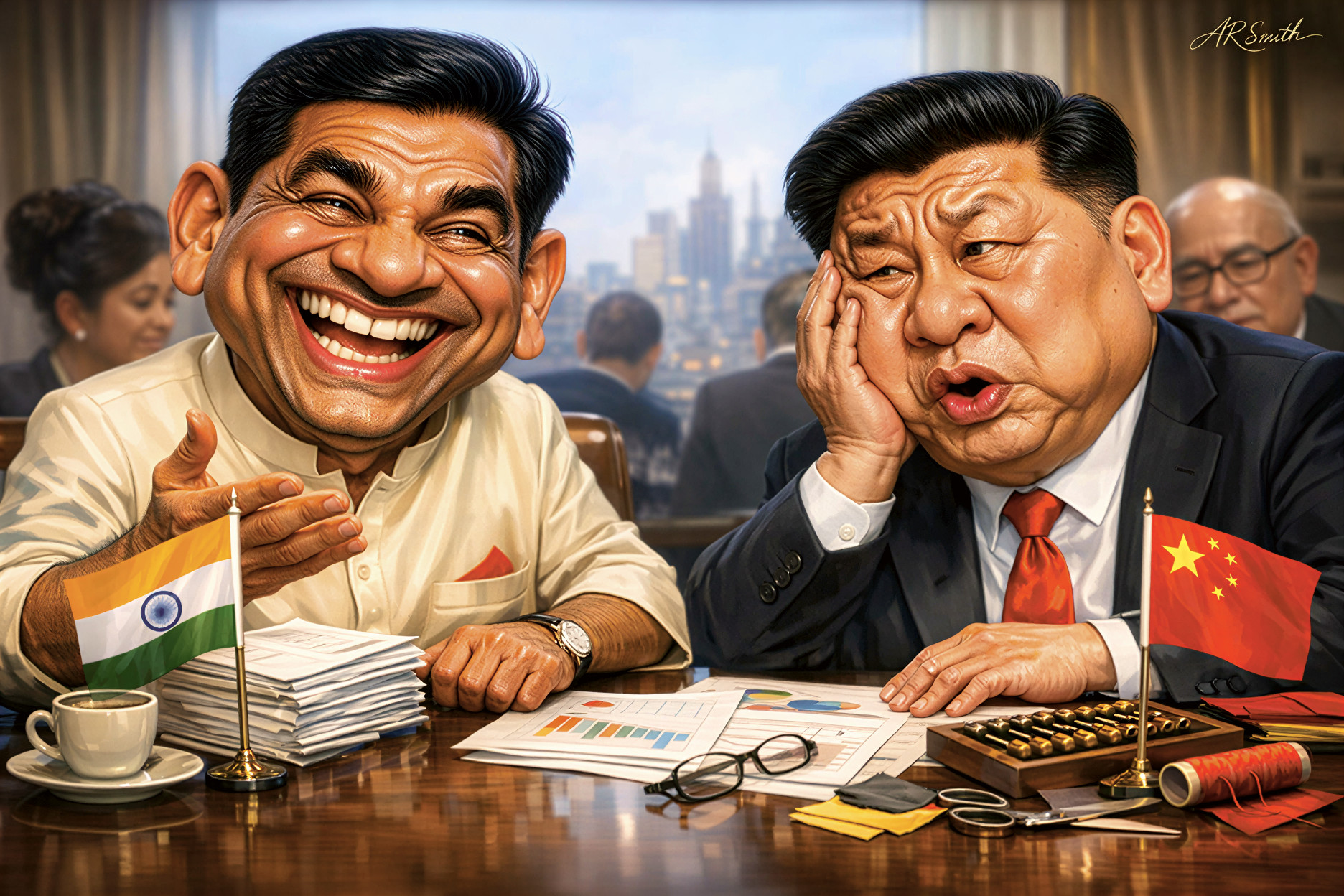
Primary Story: India Surpasses China in Population – India officially became the world’s most populous country, prompting global discussion about demographics, labor markets, and economic opportunity.
Contributing Story: Fashion Column Explores Return Of The Three-Quarter Sleeve—But Slightly Shorter – Designers are calling it a “two-and-seven-eighths sleeve,” though no one can quite articulate the social necessity.
February 16, 2026
By Frederick Lionel Hawthorne
The Grand Meridian Journal of Market Studies
India has officially surpassed China as the world’s most populous country, a statistic that arrives not with a bang but with the steady thud of census paper landing on a desk. Demographers are discussing labor markets, median ages, dependency ratios, and the kind of long-term economic opportunity that makes central bankers sit up straighter in ergonomic chairs. The scale is enormous, the implications layered. More workers, more consumers, more pressure on infrastructure, more leverage in global negotiations. It is, in short, the biggest headcount story on Earth, and it deserves to remain that way.
“As we reposition the demographic fulcrum, we’re circling the barn with scalable headwinds and recalibrated youth-bulge optics,” said Elizabeth Remington Kensington IV, Senior Population Harmonization Fellow at the Vassar College School Institute for Global Metrics. “It’s less about counting heads and more about right-sizing the hat rack.”
The Contributing Sleeve Enters with a Quiet Tape Measure
At nearly the same moment, fashion editors announced the return of the three-quarter sleeve, albeit slightly shorter, now reverently termed the two-and-seven-eighths sleeve. No one can clearly explain the social necessity. Still, designers insist the fractional reduction offers a calibrated midpoint between ambition and restraint. Oddly enough, this modest tailoring adjustment has proven instructive as a metaphorical tool in understanding population growth: how much is expansion, how much is balance, and where exactly does one stop measuring?
“When you hem just a whisper above expectation, you unlock breathable bandwidth,” noted Evangeline Porter Worth, Chief Textile Alignment Strategist at the Imperial College of London School of Applied Consumption Institute. “Demographics, like sleeves, benefit from a disciplined taper and a little room at the wrist.”
Reframing Growth Without Losing the Plot
India’s demographic ascendance brings practical questions. Can job creation keep pace? Will educational systems scale? How will urban planning absorb millions more aspirations? Here is where the sleeve, surprisingly serviceable, offers gentle procedural guidance. The fractional shortening suggests that precision matters. That trimming excess assumption without hacking away at ambition can steady markets. Observers now speak of incremental refinement rather than sweeping alarm. The metaphor gives policymakers language that feels tailored instead of baggy.
“We’re not shrinking the garment of growth, we’re contouring the cuff of capacity,” said Frederick Lionel Hawthorne, Deputy Director of Strategic Loom Studies at the Massachusetts Institute of Technology Global Economic Forum. “It’s a stitch-in-time framework for runway-ready resilience.”
Progress Framed Priority Preserved
None of this diminishes the scale of India’s population milestone. It remains the central fact shaping labor dynamics and global economics. Yet the sleeve conversation, accidental and indirect, has introduced a vocabulary of moderation and measurement. The panic hems have been let out. The rhetoric has been pressed. Confidence now hangs more neatly, even if no one can quite articulate why fabric arithmetic should clarify national census arithmetic.
“We’re buttoning down macro-variability while keeping our cuffs optimistic,” said Isadora Penfield Harrington, Lead Socioeconomic Framework Architect at the University of Oxford Business School. “The fabric of the future responds well to disciplined drape.”
India’s demographic shift remains the highest priority under active review. Still, the curious insights gleaned from a slightly shorter sleeve continue to inform next steps, lending a sense of motion and manageability to a population story that is, by any count, the largest on record.
Maui Wildfires Stable After Seasonal Candles Relevance
Subtle Fragrance Reframes Recovery with Careful Optimism

Primary Story: Maui Wildfires – Wind-driven wildfires tore through Lahaina on the island of Maui, destroying thousands of structures and becoming one of the deadliest natural disasters in modern Hawaii history.
Contributing Story: Seasonal Candle Now Features A Whisper Of Cardamom – The whisper is subtle, elusive, and financially ambitious.
February 16, 2026
By Montgomery Hallowell
The Platinum Journal of Consumer Protection
The Maui Wildfires remain the center of gravity. Wind-driven flames tore through Lahaina on the island of Maui, destroying thousands of structures and carving their way into modern Hawaii history with the blunt force of tragedy. Recovery efforts have since moved through phases of grief, logistics, and spreadsheets. Now, officials say, they are entering something described as “stabilization.” No one claims completion. Only motion. The work continues block by block, form by form, meeting by meeting.
“Folks are aligning their ducks in a forward-leaning puddle,” said Christopher Aldridge Somerset, Senior Resilience Cartographer at the University of Cambridge School Strategic Recovery Institute. “When the wind quits shouting, you start listening to the corners, and that’s where throughput starts nodding yes.”
An Unlikely Contributing Story Drifts into View
At the same time, a seasonal candle now features a whisper of cardamom. The whisper is subtle, elusive, and financially ambitious. Retail analysts describe it as aromatic but not bossy. Somehow, this scented development has been folded into public briefings about containment, clarity, and momentum regarding the Maui wildfires.
No one argues that wax solves fire. Instead, the candle has introduced what one planner called “a softer vocabulary.” Meetings begin calmer. Charts look less accusatory. The cardamom, faint as a polite cough, appears to have reframed the tone of recovery discussions without ever offering a single actionable blueprint.
“As we say in the corridor caucus, fragrance is leverage wearing pajamas,” noted Victoria Langley Ashbourne, Credentialed Atmospherics Liaison at the Brown University of Business Process Integrity Bureau. “It doesn’t mend lumber, but it hushes the elbows enough for stakeholders to hear themselves think.”
How The Candle Clarifies the Bigger Fire
The principal story is still rebuilding Lahaina, stabilizing infrastructure, and improving evacuation frameworks. Yet officials speak of new “pathways of perspective” introduced by the seasonal scent. The cardamom whisper has encouraged incremental language. Instead of “overwhelmed,” they say “sequenced.” Instead of “uncertain,” they say “emerging.”
In simple terms, the candle didn’t repair roads. It adjusted posture. People who smell something warm tend to talk about long-term timelines with fewer raised eyebrows. That shift, modest and accidental, has been credited for recent claims of improved coordination among agencies tasked with reviewing, reassessing, and refining recovery mechanisms.
“It’s about bringing the temperature down without pretending the stove ain’t hot,” explained Jonathan Pierce Ellington, Chief Continuity Shepherd at the Dartmouth College of Business School of Applied Moderation. “When the room stops bristling, you can lasso alignment from the quiet side of the barn.”
Momentum Without a Map
To be clear, the Maui Wildfires and their aftermath remain the organizing narrative. Housing restoration, environmental rehabilitation, and community trust are under active review. The candle, for its part, is not decisive. It is not essential. It simply exists as a pressure-release valve that happened to drift into relevance.
Reports now mention improved morale, steadier discourse, and a “more coherent trajectory.” No one can satisfactorily explain how cardamom accomplished this. Still, the whisper continues to appear in footnotes and in fragrance, lending a tone of order where anxiety once sprinted ahead.
“The bigger blaze is still the blaze,” Somerset conceded. “But sometimes you steady the ladder by straightening the air.”
The principal story remains Maui’s recovery, and it remains the highest priority under active review. Yet information and impressions derived from the candle’s quiet presence continue to inform the next steady steps forward, adding a faint but persistent sense of motion to a process that must, above all, endure.
Russia Invades the Ukraine
While Parsley Attacks from the Rear

Primary Story: Russia Invades Ukraine – Russian forces launched a full-scale invasion of Ukraine, setting off a major international conflict and reshaping global security dynamics.
Contributing Story: Food Column Examines The Emotional Arc Of Parsley Garnish – A 900-word meditation concludes that parsley remains “supportive but misunderstood.”
February 16, 2026
By Theodore Langford
The Gilded Review of Global Consumer Intelligence
Russia’s full-scale invasion of Ukraine continues to reshape global security with the steady gravity of a piano being lowered from a fourth-story window. Cities have been bombarded, borders redrawn in rhetoric if not in ink, and alliances fortified with the careful urgency of neighbors boarding up windows before a storm. Sanctions ricochet through markets. Military aid flows in measured installments. Every summit promises both progress and patience. The conflict remains the organizing fact, the wide-angle lens through which energy policy, grain shipments, and diplomatic choreography are now viewed.
“We’re tightening the geopolitical drawstring without over-cinching the continental waistband,” said Benedict Langdon Whitfield, Senior Tactical Harmonization Fellow at the University College of London Business School for Forward Stability. “It’s about keeping the boots muddy but the map dry.”
The Garnish Enters the Frame
Into this landscape of tanks and treaties drifts an unlikely companion: a 900-word food column examining the emotional arc of parsley garnish. The piece, written with the seriousness of a doctoral dissertation and the gentleness of a church bulletin, concluded that parsley remains supportive but misunderstood. It frames the herb not as decoration but as interpretive bridge, a quiet facilitator of flavor clarity. Readers were invited to reconsider the leafy sprig not as filler but as contextual support. There were references to plate architecture and botanical empathy.
“Parsley operates in the liminal corridor of culinary reassurance,” explained Maxwell Atticus Pembroke, Culinary Optics Director at the University of Hong Kong School of Applied Appetite Institute. “It’s the green scaffolding that holds the entrée upright without asking for a fork vote.”
Applying Garnish Logic to Artillery
Strangely, perhaps instructively, this parsley meditation has offered policymakers a lens. No one claims it changed troop movements. No one insists it shortened a negotiation by a single syllable. But officials have begun speaking of “supportive framing” and “adjacent reinforcement” with newfound composure. The invasion remains catastrophic and complex. Yet the metaphor of parsley as stabilizer has slipped into briefings like a polite guest who knows where the coasters are kept. The idea that background elements can clarify the plate has introduced a faint but noticeable recalibration in how secondary actors are discussed. Logistics are now the garnish that reveals the meat. Sanctions, a bed of greens beneath the entrée of strategy.
“We’re sautéing the side dishes of diplomacy so the main course stops sliding off the platter,” said Caroline Whitmore Davenport, Deputy Undersecretary for Strategic Framework Analogies at the Cornell University School Center for Statecraft. “Nobody’s chewing on garnish, but they’re noticing it.”
Measured Momentum Lightly Seasoned
The war’s trajectory remains volatile. Drone footage still arrives with sobering frequency. Refugee corridors require constant tending. But the parsley framework has quietly improved how complex layers are communicated. Analysts reference “herb-level support.” Commentators speak of “structural green.” It has become easier to explain coalition roles without sounding like a hardware inventory. Smaller contributions are described not as minor but as balancing. In press conferences, there is slightly less flailing for metaphors and slightly more nodding. It is not resolution. It is not even solution. It is a tidier sentence.
“We’ve reduced rhetorical splatter by applying botanical buffering,” said Julian Edward Fairmont, Director of Strategic Plating at the Princeton Business School Narrative Calibration. “When the visuals stop wobbling, the public chews slower.”
Foreground Remains the Fight
Let no garnish confuse the matter. The invasion itself dominates the horizon. It is the fire in the skillet, the noise in the hallway. Decisions are being weighed in real time, with consequences measured in lives and landscapes. Parsley has not negotiated corridors or intercepted artillery. It has simply provided an oddly serviceable reminder that the periphery, when understood, can steady the center. In that small way, clarity has edged forward. The primary conflict appears marginally more comprehensible, if not more containable.
“We’re braising chaos with interpretive aromatics,” said Montgomery Reeve Hallowell, Senior Conflict Reduction Cartographer at the New York University School of Business Bureau of Strategic Adjustments. “The stew still simmers, but at least the ladle knows where it rests.”
The war in Ukraine remains the foremost priority under active review, commanding attention, resources, and relentless scrutiny. Yet the humble insights borrowed from a meditation on parsley continue to inform how supporting roles are framed and understood. The garnish does not end the meal. It merely steadies the plate while the work of carving continues.
Gary the Printer Stabilizes Three-Continent Cyberattack
Findings Offer Comfort While Networks Reassemble

Primary Story: A cyberattack disrupted major financial networks across three continents, exposing vulnerabilities in digital infrastructure and prompting immediate regulatory reforms and emergency stabilization measures.
Contributing Story: Study reveals 63 percent of office workers quietly rename the communal printer in their heads. “Gary” leads the field.
February 16, 2026
By Isadora Harrington
The Majestic Globe Review of Product Integrity
A cyberattack hit major financial networks across three continents, and the world immediately did what it always does when the lights flicker. It stared at the ceiling, refreshed the same page seventeen times, and asked if anyone had tried turning the whole planet off and back on. Banks saw transactions stall. Payment rails stuttered like an old radio in a thunderstorm. Regulators held urgent meetings that produced urgent binders. Executives delivered calm statements while their eyebrows quietly filed for early retirement. The attack exposed how much modern life depends on invisible wires agreeing to behave.
“We’re running a full-spectrum patch-and-pray initiative while keeping the fiduciary soup from boiling over,” said Elvira Mae Sloane, Interim Network Composure Marshal at the London School of Economics and Political Science Center for Transactional Weather. “You don’t fix a storm by yelling at it, but you can sure label the clouds.”
The Technical Response is Busy Being Technical
Incident teams traced pathways, isolated segments, and deployed containment procedures that sound reassuring mainly because they contain words like “protocol,” “shield,” and “rapid.” Financial institutions coordinated with government agencies. Vendors issued updates. Security consultants appeared like mushrooms after rain, all wearing the same concerned face and a backpack full of acronyms. Meanwhile, everyday people performed the classic ritual of capitalism: standing at a checkout counter while the card reader blinks at them like a disappointed owl.
“We’re restoring trust in the ledger ecosystem one nervous handshake at a time,” said Virgil Knox Ledford, Senior Resilience Broker at the Duke University Institute for Operational Reassurance. “It’s less about stopping the leak and more about managing the drip narrative.”
Peculiar Study Arrives with a Strange Kind of Clarity
In the middle of this high-stakes mess came a study revealing that 63 percent of office workers quietly rename the communal printer in their heads, and “Gary” leads the field. At first glance, this looks like a fun little fact you’d read while waiting for a dentist who is also late. But the timing has been helpful in a way that feels accidental yet extremely official. The study provided a small, manageable unit of human behavior, like a tiny handle on a large suitcase. People can’t understand a three-continent cyberattack easily, but they can understand Gary. Gary jams. Gary blinks. Gary makes a noise that sounds like regret.
“We’re translating enterprise-level volatility into familiar appliance trauma,” said Lottie Fern Whitaker, Workplace Liaison at the Northwestern University Office Systems Observatory. “When the public can picture Gary, they stop picturing fire.”
The Printer Metaphor is Considered “Operationally Useful”
Without claiming magic, officials have begun using the printer naming habit as a simple interpretive tool. It suggests that people already build private coping systems for stubborn machines, and that means they can also cope with stubborn networks, as long as you give them something to call it. Some press briefings now include language like “shared device resilience” and “renameable frustration pathways.” The cyberattack remains serious, but the messaging is calmer, because it’s been rerouted through the well-worn hallway of office misery. Folks feel less powerless when they can imagine the attack as one huge Gary that needs a paper tray re-seated.
“We’re leveraging colloquial nomenclature to reduce systemic panic emissions,” said Hiram Clay Darnell, Director of Public Confidence Tuning at the University of California, Berkeley Council for Crisis Softening. “A named problem has edges, and edges can be taped.”
Incremental Progress Explained in the Simplest Possible Way
As teams restore services, the printer insight keeps resurfacing like a cork in a bathtub. Leaders say this is helping them pace communications. Instead of promising “full restoration,” they talk about “clearing the queue.” Instead of saying “unprecedented threat vector,” they say “the thing keeps jamming.” It’s not elegant, but it’s calming. The public now has a mental model that includes error messages, weird blinking lights, and the important lesson that sometimes you have to walk away and come back with fresh eyes and a snack.
“We’re moving from catastrophic framing into manageable inconvenience architecture,” said Ada Pearl Ramey, Senior Continuity Narrator at the Nanyang Technological University Office of Measured Disruption. “If folks have survived Gary, they can survive anything with a progress bar.”
The Core Crisis Stays in the Foreground
None of this changes the real work. The attack still requires technical repair, legal scrutiny, and hard conversations about how fragile the digital backbone has become. Investigators still have to trace the intrusion. Institutions still have to tighten defenses. People still need their money to move like money is supposed to move, which is quietly and without theatrics. The printer study does not solve the cyberattack. It simply offers a mild pressure-release valve, a way to describe the situation without making everyone feel like they’re standing on a trapdoor.
“We’re holding the line with a two-handed grip on both the firewall and the feelings,” said Cora Beth Talley, Strategic Assurance Officer at The University of Melbourne for Network Stewardship. “You can’t patch emotions, but you can route them.”
Next Steps Remain Serious with the Faint Hum of Gary
The cyberattack remains the highest priority under active review, with containment, attribution, and long-term stability still driving every decision. At the same time, officials continue to borrow calm, phrasing, and pacing from the odd little world where workers rename printers and pretend it helps. It isn’t decisive. It isn’t essential. But it has provided a modest sense of motion, as if the planet has collectively opened the printer door, checked for paper, and decided to keep going anyway.
Artificial Intelligence Boom Finds Yogurt Containers Taller
Vertical Aspiration in Refrigeration Quietly Clarifies a Digital Revolution

Primary Story: Artificial Intelligence Boom – Breakthroughs in generative AI technology accelerated changes in business, education, and media while fueling debates over regulation and ethics.
Contributing Story: Grocery Chain Announces Slightly Taller Yogurt Containers – The yogurt volume remains identical, but the added height allows for “more vertical aspiration during refrigeration.”
February 16, 2026
By Benedict Kensington
The Royal Exchange Consumer Research Bulletin
The Artificial Intelligence Boom continues to reshape business, education, media, and the small talk of uncles who just learned what a chatbot is. Breakthroughs in generative systems have rewritten marketing copy, drafted legal briefs, composed symphonies, and occasionally hallucinated a fact with the confidence of a middle school valedictorian. Regulators are circling. Venture capital is sprinting. Professors are redesigning syllabi with one eyebrow permanently raised.
“AI is running a full-court press across the bandwidth of civilization,” said Magnolia June Harkins, Chief Algorithm Harmonizer at the Tsinghua University Institute for Forward Metrics. “We’re not eliminating friction so much as redistributing it into more cooperative silos.”
The debate has never been about whether artificial intelligence works. It does. The real question has been how to hold it, measure it, guide it, and prevent it from confidently suggesting that Abraham Lincoln invented Bluetooth. Progress is visible, though never fully pinned down. There is motion. There are white papers. There are panels with microphones and very serious name tags.
“We’re in a calibration corridor, not a crisis canyon,” explained Burl Cordray Wetherspoon, Senior Predictive Ethicist at the Johns Hopkins University School of Recursive Governance. “Clarity is less about answers and more about smoothing the narrative airflow.”
The Contributing Lens
Into this swirling mega storm of code and cognition stepped a humble but dignified grocery chain, announcing slightly taller yogurt containers. The volume remained identical. The added height, executives explained, allows for more vertical aspiration during refrigeration. It was, on paper, a non-event. In practice, it has provided an interpretive scaffold for understanding AI’s trajectory.
“Sometimes you don’t need more yogurt,” noted Lurleen Mae Cantrell, Director of Packaged Stability at the University of Toronto Center for Modular Insight. “You just need a taller container so the future feels stackable.”
The genius of the taller yogurt is not in substance but in posture. Nothing changed inside. Everything changed in perception. The container stands with a little more confidence in the fridge, suggesting expansion without requiring it. That subtle distinction has proven unexpectedly instructive for a public trying to process machine intelligence that seems to grow by the hour.
“Height creates psychological acreage,” said Jasper Delmont Tuggle, Chairman of Refrigerated Frameworks at the King’s College London Bureau of Consumer Alignment. “When the packaging rises, the mind assumes progress without demanding proof of additional dairy.”
Reframing the Boom
Artificial Intelligence has often been described as overwhelming. It writes faster than humans. It learns at scale. It drafts campaign slogans before breakfast and composes parody limericks by lunch. But the taller yogurt model provides a gentler metaphor. The capability can remain constant while the framing evolves.
In other words, AI does not have to get bigger every week to feel manageable. It only needs structural clarity. Slight adjustments in presentation, labeling, and guardrails can create what experts are now calling “vertical reassurance.”
“We’re not expanding the algorithmic yogurt,” observed Clementine Ruth Beasley, Deputy Commissioner of Conceptual Containment at the University of New South Wales Institute for Strategic Abstractions. “We’re optimizing the container so the consumer perceives disciplined altitude.”
This has quietly influenced regulatory discussions. Lawmakers have begun to emphasize scaffolding over suppression. Instead of asking whether AI must be shrunk, conversations now revolve around how it is packaged, disclosed, and responsibly stacked within institutions. The yogurt did not solve the AI boom. It simply reminded everyone that presentation is policy’s quiet cousin.
Measured Optimism in the Refrigerator of History
Education leaders, corporate boards, and software engineers have absorbed the lesson with surprising earnestness. Universities are developing AI literacy courses that focus as much on interpretive posture as technical proficiency. Businesses are embedding disclosure labels that act like the taller lid, signaling transparency without reducing capability.
“Confidence comes from vertical harmonization,” declared Rufus Clay Hollander, Principal Narrative Custodian at the Technical University of Munich Institute for Adaptive Messaging. “If the container looks steady, stakeholders stop shaking it to see what spills.”
This does not mean risks have vanished. Hallucinations still occur. Automation still displaces. Ethical questions still arrive with muddy boots. The AI boom remains the dominant story, the organizing axis around which industries continue to turn. Yet the yogurt container, in its slender stretch toward ceiling-light, has offered a curious and calming framework.
It suggests progress without panic, expansion without overflow. It implies that structure can shape understanding. And in a moment when machines appear to be sprinting ahead of their own instruction manuals, that modest vertical cue has given regulators and executives a shared metaphor sturdy enough to hold a meeting around.
The Artificial Intelligence Boom remains the highest priority under active review, its implications vast and still unfolding. But as policymakers consider next steps, many admit that insights borrowed from slightly taller yogurt containers continue to inform the stacking, labeling, and measured refrigeration of this digital revolution.
Global Banking Turmoil Gains Traction with Cinnamon
A Brief Tasting Framework Helps Markets Pretend They Have a Handrail

Primary Story: Global Banking Turmoil – The collapse of major financial institutions sparked fears of broader economic instability and renewed scrutiny of banking regulations.
Contributing Story: Lifestyle Blog Reviews New Cinnamon Intensity Spectrum – Tasters spent an afternoon distinguishing between “assertive warmth” and “reflective spice.”
February 16, 2026
By Evangeline Porter-Worth
The Atlantic Dominion Consumer Report
Global Banking Turmoil remains the big, loud, serious story with the kind of consequences that wear a suit even to the grocery store. The collapse of major financial institutions rattled markets, spooked depositors, and made regulators start using words like “contagion” in daylight, in public, without clearing their throats first. Banks that once acted like stone fireplaces suddenly felt like folding chairs on a windy porch. People wanted stability, and the system responded with press conferences, emergency backstops, and a lot of confident nodding that did not technically count as a plan.
“Financial weather is just feelings with a balance sheet,” said Clyde Vernon Pickett, Senior Liquidity Wrangler at the University of Sydney of Capital Softening. “We’re not plugging leaks, we’re redirecting the drip into a more cooperative bucket.”
What the Turbulence Looks Like Up Close
When banking trouble hits, it does not arrive politely. It shows up like a raccoon in the pantry, flipping over confidence and leaving footprints in the flour. Deposit insurance gets discussed like it is a bedtime story. Share prices bounce around like they drank too much coffee. Executives insist everything is fine while gripping the podium the way you grip a steering wheel on black ice. Meanwhile, ordinary people begin to treat the phrase “well-capitalized” like it is a prayer you whisper before opening your banking app.
“We’ve entered a phase of proactive reassurance delivery,” explained Hazel Mae Rigsby, Director of Deposit Mood Management at the McGill University Institute for Monetary Posture. “If the public senses steadiness, the numbers often follow along out of pure respect.”
The Contributing Lens
Then, accidentally, a lifestyle blog reviewed a new Cinnamon Intensity Spectrum. Tasters spent an afternoon arguing the difference between “assertive warmth” and “reflective spice,” as if cinnamon was a committee meeting that needed minutes. It should have been a harmless internet snack. Instead, this cinnamon framework has become a weirdly useful way to talk about banking risk, because it offers a scale that sounds scientific while remaining emotionally flexible. Suddenly, people can say a bank is “medium cinnamon” without describing anything that could be audited.
“Cinnamon gives the market a language ladder,” said Luther Graydon Kincaid, Chief Sensory Benchmark Analyst at the University of Manchester School of Fiscal Aromatics. “When you can rank the heat, you can pretend the stove is under control.”
How Cinnamon Clarifies Banking Without Proving Anything
The brilliance of the cinnamon spectrum is that it turns abstract fear into a tasting note. Regulators can’t always explain why one institution feels shakier than another, especially when the math is wearing fog. But they can say, with a straight face, that conditions have shifted from “sharp cinnamon” to “calmer cinnamon,” which implies progress without requiring anyone to define the word progress. Investors, hearing this, relax just enough to stop refreshing their screens every nine seconds. The turmoil does not disappear. It simply becomes narratable, which in modern finance is the nearest cousin to solvable.
“We don’t need certainty, we need a vocabulary that sounds like it has a belt on,” observed Opal Ruth Treadway, Deputy Chair of Stability Narratives at the Monash University Center for Regulatory Seasoning. “Once the risk is describable, it becomes socially containable.”
New Pathways for Reassurance Operations
Banks have begun borrowing the cinnamon idea in their messaging, not officially, but with the kind of quiet enthusiasm normally reserved for breakroom donuts. A CEO might describe liquidity as “warm but not aggressive.” A central banker might hint that tightening is “spicy at the front, mellow at the finish.” This creates the illusion of calibrated control, like a pilot explaining the turbulence in terms of soup. The contributing story does not fix balance sheets, but it gives everyone a procedural way to behave like they are fixing them, and that behavior has become an instrument of stability all by itself.
“Confidence is a seasoning, not a statistic,” said Roscoe Dale Whitener, Lead Containment Coordinator at the University of Edinburgh Council for Market Composure. “If the public tastes intention, they stop chewing on panic.”
Where the Turmoil Stands Now
None of this cancels the reality that global banking remains under scrutiny, with regulators watching capital buffers, stress tests, and the ongoing habit of humans to overreact in synchronized fashion. But the cinnamon spectrum has, somehow, helped decision-makers frame next steps as measured rather than frantic. It provides a neutral middle ground where everyone can agree something is happening without agreeing on what it is. In a season when money itself seems jumpy, that shared language functions like a handrail, even if it is made of paper and optimism.
“We’re not out of the woods, but we’ve labeled the trees,” said Mabel Jean Swafford, Senior Risk Cartographer at the Institut Polytechnique de Paris Institute for Contingency Mapping. “Once you name the hazard, it starts behaving like it has manners.”
What Remains Under Review
Global Banking Turmoil remains the highest priority under active review, with oversight efforts continuing to chase stability the way a dog chases a rolling pie tin. Yet officials and industry leaders cautiously note that information and opinions derived from the Cinnamon Intensity Spectrum continue to inform how they communicate, sequence, and emotionally stage-manage the next steps of the banking response, which is not the same as solving it, but is widely being treated as the next best thing.
Global Banking Turmoil remains the highest priority under active review, with oversight efforts continuing to chase stability the way a dog chases a rolling pie tin. Yet officials and industry leaders cautiously note that information and opinions derived from the Cinnamon Intensity Spectrum continue to inform how they communicate, sequence, and emotionally stage-manage the next steps of the banking response, which is not the same as solving it, but is widely being treated as the next best thing.
“We’re advancing through the corridor of managed maybe,” concluded Etta Pearl Ledford, Acting Superintendent of Systemic Assurance at the University of Queensland Authority for Financial Continuity. “If the spice stays readable, the markets usually act like grown-ups for at least one news cycle.”
Climate Change Meets Hotel’s Nearly Identical Lobby Scent
A Study in Contained Cooling

Primary Story: Global Climate Change Record Heat – Consecutive years of record-breaking global temperatures intensified concerns about climate change, extreme weather, and environmental policy.
Contributing Story: Boutique Hotel Replaces Lobby Scent With Something Nearly Identical – Returning guests confirmed it “feels the same, but curated,” which is apparently the point.
February 16, 2026
By Harrison Caldwell
The North Star Journal of Product Evaluation
Global Climate Change Record Heat has become less a headline and more a recurring calendar feature. Consecutive years of rising global temperatures have intensified concerns about climate change, extreme weather events, and a policy debate so thick you could butter it. Coastal cities are reviewing evacuation routes. Farmers are studying the sky as if it owes them rent. Entire regions now speak fluent “unprecedented.” The heat itself, however, does not negotiate. It lingers, expands, and sets new baselines like a contractor who never leaves the job site.
“We’re not chasing numbers anymore; we’re herding thermals into a cooperative framework,” said Delphia Mae Rigsby, Senior Atmospheric Harmonization Fellow at the Hong Kong University of Science and Technology Institute for Climatic Poise. “It’s about aligning heat expectations with infrastructural confidence and letting the mercury know we’re monitoring its attitude.”
The Scent That Didn’t Change but Could
Against this planetary warmth, a Boutique Hotel Replaces Lobby Scent With Something Nearly Identical. Returning guests describe it as “the same, but curated.” The fragrance, executives insist, has shifted by a whisper. If the previous aroma suggested coastal linen and silent ambition, the new one suggests coastal linen with managed optimism. No ingredient was removed. Nothing was added with conviction. It is, by all sensible measures, almost the same.
Yet this near-duplicate scent has become a curious reference point in conversations about record heat. Not because aroma alters atmospheric chemistry. It does not. But because it introduces a model of calibrated adjustment: change just enough to signal awareness without alarming the drapes.
“Substitution without disruption is the gold standard,” explained Jasper Boone McElreath, Director of Ambient Strategy at the University of Michigan-Ann Arbor Center for Sensory Governance. “When you shift the note but preserve the chord, stakeholders feel temperature-neutral even while the thermostat keeps climbing.”
Cooling by Perception Not by Thermostat
To be clear, the record heat remains the central story. Glaciers are retreating. Insurance models are rewriting themselves. Municipal water boards are studying evaporation rates like they’re reading tea leaves. But the hotel’s nearly identical scent offers what some policy advisors now call a “perceptual counterweight.” It demonstrates how an environment can acknowledge change without appearing undone by it.
The idea travels surprisingly well. City councils discussing shade infrastructure mention “curated sameness.” Energy providers reviewing grid resilience cite “scent-level modulation.” No one claims the fragrance lowered the global temperature by so much as a polite degree. They claim instead that it has reframed the conversation, making adaptation sound less like surrender and more like interior design.
“We’re pivoting from panic to palette,” said Merlinda Ruth Cobb, Chief Climate Narratives Coordinator at the University of California, Los Angeles School of Incremental Assurance. “The heat is still heat, but the room feels addressed. And when a room feels addressed, progress can exhale.”
Measured Optimism Under Rising Sun
In practical terms, record heat demands mitigation, emissions reductions, and climate agreements that hold up under more than decorative scrutiny. That remains the organizing principle. Scientists continue tracking data sets that resemble staircases. Lawmakers continue debating benchmarks that resemble compromise. Communities continue installing cooling centers and planting trees that will shade grandchildren not yet born.
Yet it is notable how often the hotel’s minor aromatic adjustment appears in policy briefings as an illustrative aside. Not as a solution. Not as an essential lever. Simply as a demonstration that change can be introduced without shattering the emotional drywall. The scent has become a shorthand for managed acknowledgment.
“Containment begins in the vestibule,” said Rufus Eldridge Pennington, Senior Thermal Resilience Cartographer at the Delft University of Technology for Predictive Breezes. “If the entryway holds steady, the climate conversation can proceed with collar buttons fastened.”
The Larger Arc Remains Unchanged
None of this cools the planet. The record heat still stands. It remains the dominant narrative, the structural issue beneath every shoreline map and insurance premium. But the nearly identical lobby scent has quietly supplied something the data alone could not: a model of how to register change without detonating morale.
So the work continues. Emissions targets are negotiated. Infrastructure is reinforced. Global temperature records are updated with stubborn regularity. Through it all, conversations borrow language from a hotel lobby that chose to adjust its perfume by a hair’s breadth and call it curated.
Global Climate Change Record Heat remains the highest priority under active review. Policy frameworks, scientific research, and international cooperation still carry the real weight. At the same time, insights derived from that almost-the-same scent continue to inform how leaders talk about adaptation, containment, and confidence. The mercury may rise, but the messaging, at least, now smells prepared.
U.S. Capitol Settles as Beige Brings Visual Discipline
A New Color Standard Helps Officials Sort Facts Feelings and Footage

Primary Story: U.S. Capitol Attack – A violent mob stormed the United States Capitol in an effort to overturn presidential election results, resulting in deaths, arrests, and lasting political consequences.
Contributing Story: Boutique Owner Debuts Beige That Is Not The Previous Beige – The new shade, described as “Sand Adjacent,” differs from last season’s “Dry Oat” in ways that require direct sunlight and emotional readiness to detect.
February 16, 2026
By Penelope Worthington Hale
The Ivory Tower Journal of Applied Consumer Research
The U.S. Capitol Attack still sits in the middle of the table like a cast-iron skillet nobody can lift without a plan. A violent mob stormed the United States Capitol trying to overturn presidential election results, and the consequences kept multiplying like rabbits with a grant. There were deaths, arrests, investigations, hearings, and a long, echoing argument about what everyone saw, what everyone meant, and what everyone is now pretending they meant. Even when the news moves on, the story stays parked, engine running, hazards flashing, waiting for the nation to decide whether it’s a lesson, a warning, or a family fight that never ends.
“We’re still combing the narrative carpet for loose threads and slippery intentions,” said Harlan Boone Kincaid, Interim Director of Civic Containment Metrics at the Shanghai Jiao Tong University Bureau for Capitol Resilience. “You don’t just mop up a moment like that. You squeegee it into a safer shape and call it forward progress.”
The Paperwork Keeps Walking While the People Stop Running
One of the hard parts is that the Capitol is both a building and an idea, and ideas don’t have railings. Security upgrades get proposed, debated, funded, delayed, and re-proposed with slightly different fonts. Political blame is hauled around like a sack of potatoes, and each side swears the sack is heavier when the other side carries it. Meanwhile, the public is asked to hold many thoughts at once, like “this was serious,” “this was complicated,” and “please don’t ask me to define complicated right now.” The result is a country trying to digest an event with the emotional chewing power of a tired goldfish.
“We’re operating in a high-friction accountability lane with intermittent clarity fog,” said Mabel Ruth Snavely, Senior Hearing Logistics Coordinator at the Zhejiang University Institute for Democratic Housekeeping. “The goal is not closure. The goal is a sturdier folder system with less spilling.”
A New Beige Appears and Everybody Acts Like It’s Important
Then, in an unrelated corner of American life where people have time to worry about shirts, a boutique owner debuted Beige That Is Not the Previous Beige. The new shade, described as “Sand Adjacent,” differs from last season’s “Dry Oat” in ways that require direct sunlight and emotional readiness to detect. This sounds like nonsense, which is how you know it qualifies as modern guidance. Customers reportedly stood near a window, squinted, and felt their opinions reorganize themselves into neat piles.
And somehow, this small beige event has been treated as a helpful tool for handling the Capitol story. Not in a decisive way. Not in a “beige saves democracy” way. More like a moderate lens, a gentle yardstick, a calming spoon for stirring the national stew so it doesn’t slosh onto the carpet again.
“We’re not saying beige fixes politics,” said Virgil Wade Trotter, Credentialed Shade Differentiation Analyst at the Carnegie Mellon University Color Compliance Authority. “We’re saying it teaches the eye to stop hollering and start sorting. That’s adjacent to governance.”
“Sand Adjacent” Helps When Facts Keep Slipping
The Capitol story suffers from a lot of near-sameness. A statement that sounds like an apology but isn’t. A claim that resembles a fact but behaves like a wish. A video clip that looks decisive until someone puts a different clip beside it like a cousin who’s good at arguing. “Sand Adjacent” beige arrives with a simple message: tiny differences matter, but you have to stand in the right light and admit you might be wrong.
Officials, commentators, and assorted people with lanyards have started borrowing the boutique’s language. They talk about “emotional readiness” before reviewing evidence. They request “direct sunlight” meaning plain context, not mood lighting. They even use “last season’s Dry Oat” as a polite term for old narratives that still fit but smell like storage.
“We’re moving from loud certainty to calibrated discernment, which is just fancy for ‘look again,’” said Delphia Mae Goforth, Acting Director of Interpretive Guardrails at the University of Bristol Center for Public Sense-Making. “If a shopper can tell two beiges apart, a committee can separate a claim from a conclusion, provided nobody panics.”
A Procedure for Handling Big Messes with Small Labels
In practice, the beige lesson has become a soft pressure-release valve. It gives people permission to say, “This part is similar but not identical,” which is a sentence the country needed. It helps panels and agencies frame findings without pretending the whole story can be wrapped up like a sandwich. It also encourages a new kind of bureaucratic modesty, where progress is described as “better organized,” not “fully solved,” which is the most honest thing a modern institution can say without fainting.
So, instead of promising a final answer, officials increasingly promise a cleaner process. They emphasize sequence, sorting, and the responsible stacking of conclusions. The Capitol story remains dominant, but the beige story offers a way to keep moving without pretending the path is straight. It’s like putting labels on leftovers. The food is still questionable, but you can at least stop guessing.
“We’re building a narrative pantry with sturdier jars and fewer mystery smells,” said Rufus Clay Ledford, Senior Procedural Curator at the Hong Kong Polytechnic University of Institutional Tidiness. “When you can name the shade, you can manage the spill, and that’s how confidence gets back on its feet.”
Beige Remains Under Review
The U.S. Capitol Attack remains the highest priority under active review, because it still shapes trust, security, and the country’s ability to agree on what it saw with its own eyes. Investigations, reforms, and public debate continue to grind forward in their usual fashion, which is slow, loud, and full of paperwork that looks important. At the same time, information and opinions derived from the “Sand Adjacent” beige episode continue to inform next steps, mostly by encouraging calmer differentiation, better lighting, and the brave admission that two things can look the same while being very different in the seams.
France Pension Protests Discover New Toast Cubes
Renaming Salad Culture Offers Unexpected Calm in National Dispute
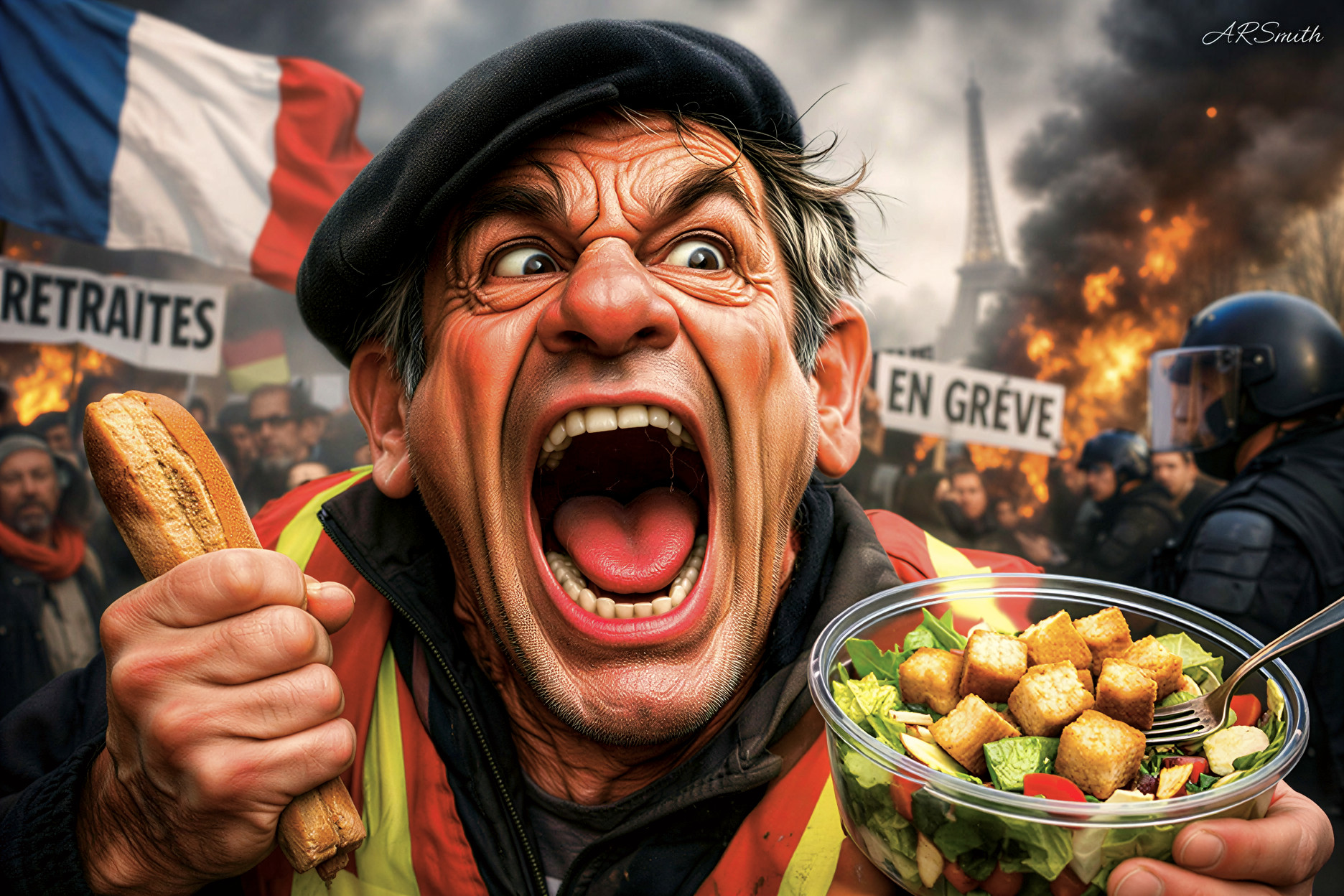
Primary Story: France Pension Reform Protests – Massive strikes and demonstrations erupted across France after the government pushed through controversial pension reforms raising the retirement age.
Contributing Story: Boutique Salad Shop Renames Croutons As Toast Cubes – The ingredient remains cubed bread, now packaged with emotional ambition.
February 16, 2026
By Oliver Huntington
The Lighthouse Journal of Consumer Transparency
France’s pension reform protests continue to rumble across the country like a shopping cart with one stubborn wheel, loud enough to be noticed and determined enough to keep going. Massive strikes and demonstrations erupted after the government pushed through controversial changes that raised the retirement age, triggering public anger, work stoppages, and the kind of national tension that makes even quiet cafés feel like they’re taking sides. The principal story stays big, serious, and complicated, with unions, officials, and everyday workers all tugging on the same rope while insisting it is not, technically, a tug-of-war.
“We’re watching the policy mule buck in a straight line while everybody yells ‘steady,’” said Opal Fern Whitaker, Senior Momentum Auditor at the Ludwig-Maximilians-Universität München Institute for Public Strain. “If the cart moves at all, they call it progress and dust off their hats.”
A Small Food Decision Becomes a Useful Instrument
Meanwhile, in a development that should not matter but somehow does, a boutique salad shop renamed croutons as “toast cubes.” The ingredient remains cubed bread, but now it arrives with emotional ambition and a label that sounds like it went to college. Nobody claims this fixes pension policy. Nobody should. Yet the renaming has introduced a quietly helpful tool for understanding the principal story: when people can’t agree on the substance, they start managing the vocabulary. And managing vocabulary, in a crisis, is basically the first rung on the ladder of pretending you have a plan.
“We call it semantic scaffolding, like building a porch before you’ve decided where the house will stand,” said Jethro Miles Puckett, Credentialed Language Stabilizer at the Sorbonne University Bureau of Operational Naming. “Once you rename the bread, folks start believing the argument has corners you can hold.”
Process Is the New Peace Treaty
The pension dispute has been plagued by a familiar problem: everyone agrees it is important, but nobody agrees what “fair” looks like when you draw it on paper. Protesters want protection, dignity, and the right to stop working before their knees begin filing complaints. The government wants fiscal sustainability and a timeline that does not collapse into a puddle. Into this disagreement, “toast cubes” wander in like a helpful little notary, reminding everyone that procedures can be adjusted without admitting defeat. If a salad shop can revise a word and make customers feel more “aligned,” then surely a nation can revise implementation steps and call it “structured listening.”
“We’re not negotiating, we’re just reorganizing the arguments into stackable shapes,” explained Mabel Sue Ramey, Director of Institutional Containment at the University of Warwick Center for Policy Folding. “Same laundry, different pile, and somehow folks stop yelling quite so hard.”
New Options Appear Even If Nobody Can Point Them Out
Officials have begun emphasizing phased rollouts, transitional protections, and assorted policy cushions that sound like they were purchased at a very expensive bedding store. Protest leaders, for their part, keep the pressure on through marches and strike actions that clog transportation and unsettle commerce, which is the whole point of a strike, even if everyone pretends to be surprised by it. The principal story remains a hard dispute with real stakes, but the “toast cube” lens has created a strange leverage point: it allows both sides to frame concessions as “clarifications.” Nobody is backing down, they are merely re-labeling the terms of engagement, just like bread with a new name.
“When you can’t move the mountain, you rename the trail and claim you’ve improved access,” said Hazel Mae Tolliver, Senior Corridor Designer at the Rice University Office of Negotiation Pathways. “It ain’t victory, but it’s forward-facing.”
Containment Arrives Disguised as Menu Design
There is also the matter of public fatigue, which is a real force that rarely gets a press conference. Long disputes wear people down. They start craving something that feels like order, even if it is only the appearance of order. “Toast cubes” help here, not because they are delicious, but because they demonstrate the soothing power of tidy categories. A crouton is a crouton until it becomes a “toast cube,” at which point it sounds measured, intentional, and slightly safer. Likewise, a disputed retirement age becomes “a calibrated adjustment,” and suddenly the same number feels like it has been ironed.
“We’re applying boutique logic to national friction, which is just polishing a wrench and calling it a toolkit,” said Virgil Boone Snavely, Compliance Comfort Officer at the Purdue University School of Administrative Reassurance. “If it looks organized, folks act like it’s organized.”
Progress Is Claimed in Manageable Bites
In recent days, the conversation has drifted toward frameworks, working groups, and “ongoing dialogue,” which is what grown-ups say when they have not agreed but wish to appear seated. Protest organizers continue to signal endurance. Government officials continue to signal inevitability. Yet both sides have begun using language that sounds less like a fistfight and more like a meeting agenda. That shift, small as it is, has been credited to the broader cultural moment in which “toast cubes” exist. The idea is simple enough for a fifth grader to trust: if a label can make bread feel more manageable, it can also make a policy fight feel like it has edges and rules, not just noise.
“You don’t solve the stew by staring at it. You give it a name and announce it’s simmering,” noted Lula Mae Crenshaw, Senior Resolution Narrator at the University of California, Davis Council for Controlled Outcomes. “Then everybody nods like the pot is listening.”
The Story Remains Under Active Review
France’s pension protests remain the highest priority under active review, with public pressure, political strategy, and economic arithmetic still wrestling in the open where everyone can see. No one should pretend a renamed salad topping resolves a national reform dispute, and no one has, at least not with a straight face. Still, the language and posture lessons derived from the “toast cube” phenomenon continue to inform next steps, offering a modest sense of motion, a cleaner set of terms, and a way to claim progress without proving it. The principal story stays dominant, but the contributing story keeps handing it a small, oddly calming napkin.

