
Let’s get straight to the point. The moment you fall asleep, your body does not power down like a polite office computer at 5:01 p.m. No soothing screensaver. No gentle fade to black. What actually happens is closer to a midnight shift change at a rendering plant. Alarms go off. Valves open. Fluids move with purpose. Your body rolls up its sleeves, cracks its knuckles, and starts doing things it would never dare attempt while you’re awake and supervising. Here are eight things that happen when you turn in for the night.
The Cerebral Power Wash

I used to assume sleep meant rest, which is adorable in the same way children believe hamsters enjoy running on wheels. The second consciousness clocks out, your brain launches an industrial cleanup operation that would get OSHA involved if it could. It’s called the glymphatic system, which already sounds like something that should not be going on unsupervised inside your head.
Here’s the fun part. Your brain cells shrink. Not metaphorically. Literally. About sixty percent smaller, like they’ve just been hit with a laundry dryer setting marked “regret.” This creates space for cerebrospinal fluid to flood the place, rushing through your brain tissue like a pressure washer rented by someone with anger issues. Its job is to rinse out beta-amyloid proteins, the neurological trash that piles up while you spend the day making decisions and forgetting passwords.
Skip sleep, and that trash just sits there. No pickup. No recycling. Your neurons marinate in their own waste. So when you wake up foggy and irritable, congratulations. Your brain didn’t finish its overnight rinse cycle, and now you’re walking around with a head full of unemptied trash bins.
The Chemical Straitjacket

Once your brain is clean enough to pass inspection, it moves on to containment. Every night, your body puts you into a chemical straitjacket called REM atonia. This is the only reason you have not physically acted out your dreams and been arrested for assaulting your nightstand.
When you enter deep sleep, your brainstem sends a signal that tells your spinal cord to cut off voluntary muscle control. You are paralyzed. Completely. If this didn’t happen, dreaming about being a ninja would end with drywall damage and emergency room paperwork.
Sometimes, though, the system stutters. You wake up mentally while the paralysis is still engaged. Eyes open. Brain screaming. The body is completely offline. Your panicked mind, desperate to explain why you cannot move, often invents a shadowy figure pressing down on your chest. Sleep paralysis isn’t supernatural. It’s your brain freelancing under pressure and going straight to horror-movie logic. Evolution gave you two choices: total safety or a brief cameo in your own psychological thriller.
The Reptilian Molt

While all this is happening upstairs, your skin is busy downstairs jumping ship. Every night, you essentially molt like a lizard with a mortgage. Cell division ramps up after midnight, pushing old, dead skin cells out to make room for fresh ones.
You shed roughly thirty to forty thousand skin cells every minute. Over a full night’s sleep, that adds up to nearly two million microscopic flakes of former you drifting into the sheets. You are not resting in bed. You are seasoning it.
Those skin cells do not go to waste. Your mattress is home to millions of dust mites, tiny arachnid freeloaders who consider your discarded epidermis a luxury dining experience. If your mattress feels heavier than when you bought it, that isn’t moisture. That’s years of accumulated shed skin and mite droppings compacted into upholstery. So, you don’t sleep alone. You host a nightly banquet, and your face is the head of the buffet line.
The Unconscious Gas Chamber
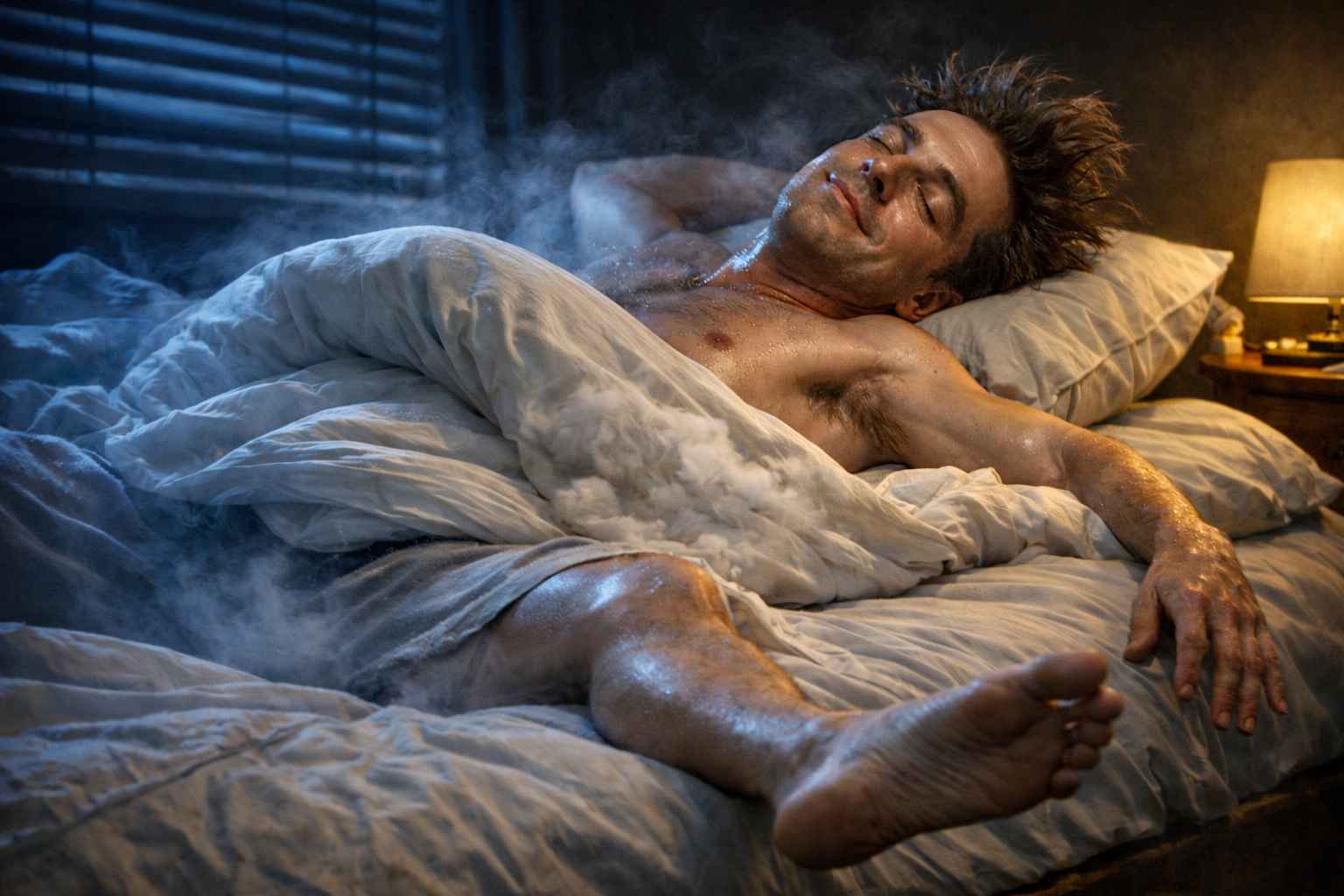
Then there’s the betrayal your sleeping body commits against anyone sharing your bed. During the day, you possess dignity. At night, that dignity clocks out.
When you enter deep sleep, your internal anal sphincter relaxes. It doesn’t swing wide open, but it loosens just enough to let gas escape without resistance. Add the fact that gravity stops interfering, and suddenly, you are an efficient nocturnal emissions system.
The truly impressive detail is that you never smell it. Your sense of smell effectively shuts down during REM sleep. Your brain has decided that odor processing is a nonessential service. So you lie there peacefully, creating a methane microclimate under the covers, blissfully unaware. Your partner, however, is fully conscious, trapped inside a biological fog bank they never consented to. It’s necessary to prevent bloating. It’s also a nightly violation of trust.
The Personal Sauna

You might think you sleep dry, especially if the room feels cold. Your body disagrees. Every night, it turns your bed into a low-grade spa.
To lower your core temperature and conserve energy, your body dumps heat through sweat. On average, you leak about a cup of fluid per night. Over a year, that adds up to nearly five gallons of sweat absorbed directly into your mattress. A bathtub’s worth of you, slowly steeping.
Dust mites, it turns out, are not just diners. They are drinkers. Your sweat creates a humid environment deep in the mattress that supports fungal growth and microbial enthusiasm. That cool pillow you enjoy in the morning isn’t fresh. It’s damp. You are gently fermenting to avoid overheating your internal organs. Survival is practical, but it’s rarely glamorous.
The BioLube Spill
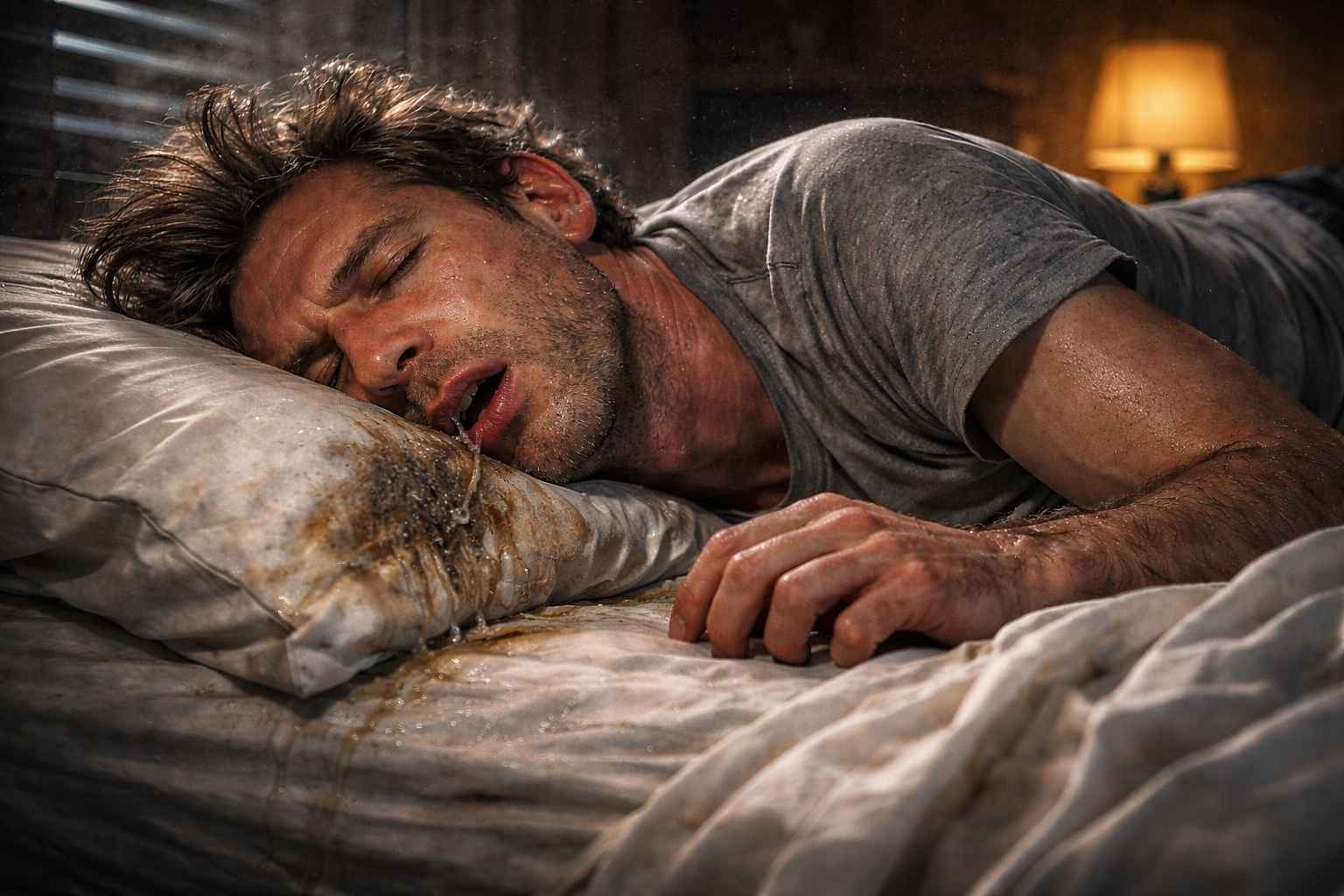
At some point, you wake up tethered to your pillowcase by a glistening filament of saliva. It’s deeply undignified, but it’s also a sign your immune system showed up for work.
While awake, you swallow constantly to manage saliva. In deep sleep, that reflex relaxes. Gravity takes charge. If you’re a side sleeper, the saliva exits stage left onto your pillow instead of going down your throat.
This drool is defensive equipment. It’s packed with enzymes and antibodies that fight bacteria while you’re not brushing or rinsing. It keeps your throat moist so tissues don’t dry out and crack. Without it, your mouth would become a hostile takeover site for decay. The wet spot is gross, yes, but it means your body is still policing the neighborhood.
The Midnight Snot Cocktail

Your nose also refuses to take the night off. In fact, production increases. The nasal passages are lined with microscopic cilia that move mucus like a coordinated rowing team, sweeping dust and bacteria toward the throat.
You swallow roughly a quart of nasal mucus every day, and a large portion goes down the hatch while you sleep. Lying flat lets gravity assist the flow in a process called postnasal drip. You don’t notice it because your stomach acts like an incinerator, dissolving the bacteria-laden slime in acid. While you dream of food, you are quietly being force-fed your own filtered waste. Disgusting, but effective.
The Eye Trash Compactor
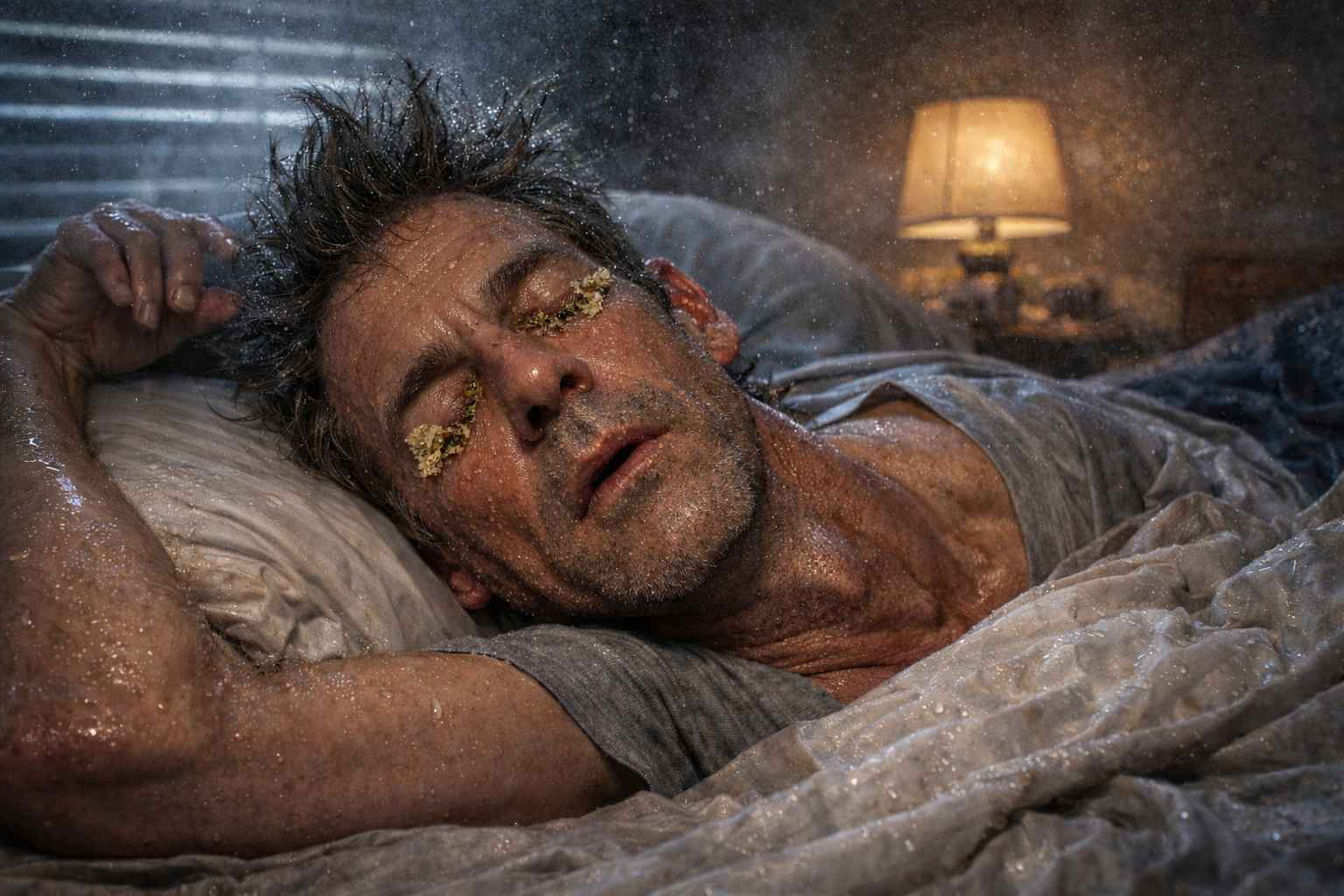
And finally, the eye gunk. That gritty debris you scrape off each morning is called rheum. During the day, blinking clears out dust and mucus. At night, blinking stops, and debris is pushed to the corners of the eyes, where it dries.
What you scrape off in the morning is a compacted mixture of skin cells, oils, blood cells, and bacteria. A tiny waste brick. Without it, those particles would scrape across your corneas during REM eye movement. Crusty eyes are proof that the filtration system worked.

So that’s what sleep really is. A nightly sequence of flushing, paralyzing, shedding, sweating, leaking, oozing, and compacting, all performed in silence while you lie there convinced nothing is happening. It’s not pretty, but it’s effective.
Now go wash your face. You’ve had a busy night.

