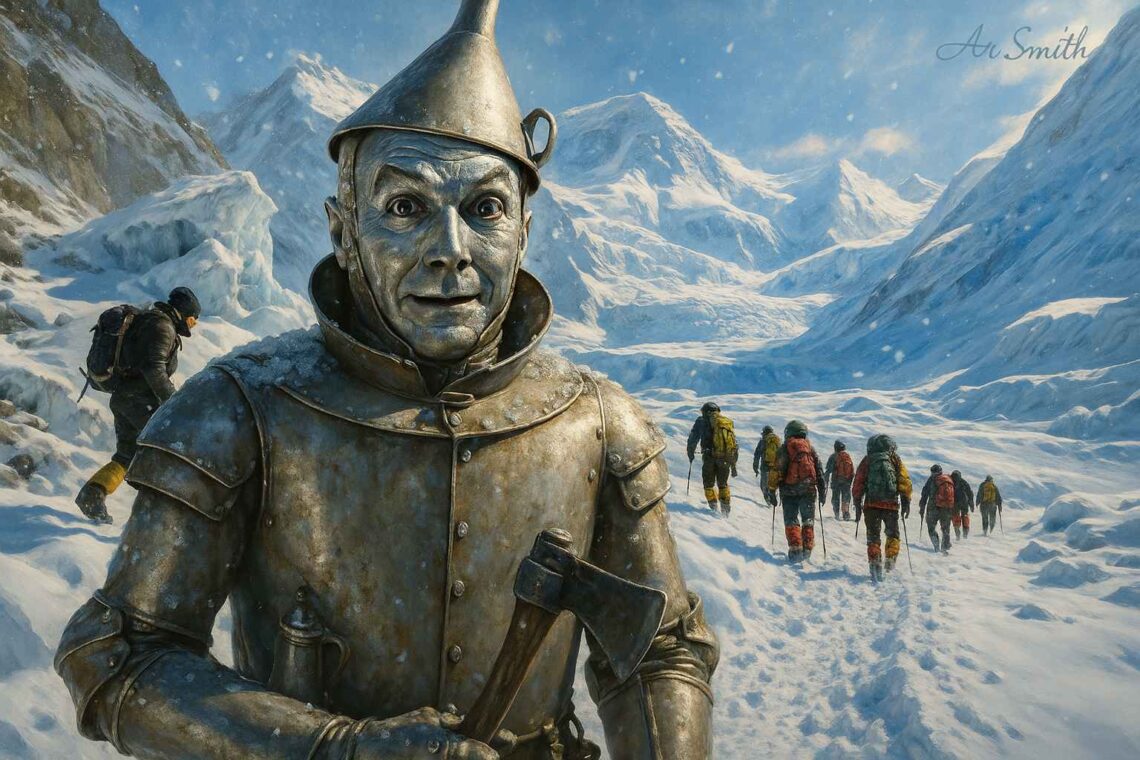
The Death Zone shrieked with winds at 70 mph, ice shards sliced like knives, and amid the chaos came the metallic groan of history—The Tin Man, over 50, logistically overwhelmed, untrained, and hobbling on rusty ankles, taking on Everest with nothing but sheer will and a squeaky hinge. Each gust froze him stiffer, each step echoed like a battered wind chime, but still he pressed upward, chasing a summit he could never feel but desperately wanted to prove he could reach.
From the first day, Base Camp became a workshop of improvisation. Guides slathered him in motor oil instead of sunscreen, Sherpas packed spare wrenches alongside oxygen tanks, and climbers reported the unsettling sound of bolts rattling loose in the night. “He was logistically overwhelmed, medically unsupervised, and mechanically unfit,” said Dr. Ursula Klein, exercise physiologist at the University of Munich. “But he had something most don’t—an unyielding rhythm, like a clock refusing to stop.”
Crossing the Khumbu Icefall nearly ended it all. His ankles wobbled violently on steel ladders over bottomless crevasses, each clang echoing doom. A loose rivet jammed, forcing an emergency repair at 19,000 feet. “I thought we’d have to leave him rusting there,” admitted climber Ed Viesturs. “But he just grinned—well, squeaked—and kept marching.” Wobbly joints, clumsy stumbles, and frozen hinges slowed him, yet no avalanche, no crevasse, no storm could silence the mechanical march.
At 26,000 feet, the Death Zone tightened its icy grip. Oil congealed in the cold, hinges locked, and the Tin Man froze mid-step, a statue staring into the void. Guides swore they heard him mutter, “If only I had a heart to feel this fear.” With Sherpas hammering his joints back into motion, he lurched upward again, clanking against the blizzard. “It was like watching a machine fight for a soul,” said Dr. Rakesh Bhandari, altitude specialist from Delhi’s Institute of Himalayan Medicine.
And then it happened. Against physics, against metallurgy, the Tin Man clattered onto the summit ridge. He raised no flag but instead lifted his battered oil can to the sky, as though thanking the mountain for sparing him one last climb. At 29,032 feet, he stood creaking and dented, Everest’s cold crown glinting off his steel shell. “It was absurd, glorious, and unforgettable,” said veteran mountaineer Conrad Anker. “A man without a heart conquering the mountain that breaks them.”
The descent was a cacophony of metal fatigue and stubborn survival. Every stumble rang out like a blacksmith’s hammer, every slip sparked against stone, but his Sherpas guided him down, steadying his rusted limbs until he rattled triumphantly back into Base Camp. Climbers roared in applause—not for grace or style, but for the iron-clad refusal to quit.
Standing among cheering climbers, oil dripping from frozen joints, the Tin Man offered his lesson:
“Do not climb Everest expecting warmth—it will give you none. Carry oil as much as oxygen. Accept dents, accept rust, but keep moving. And though I still have no heart, I tell you this—the mountain itself will teach you to endure as though you had one.”

