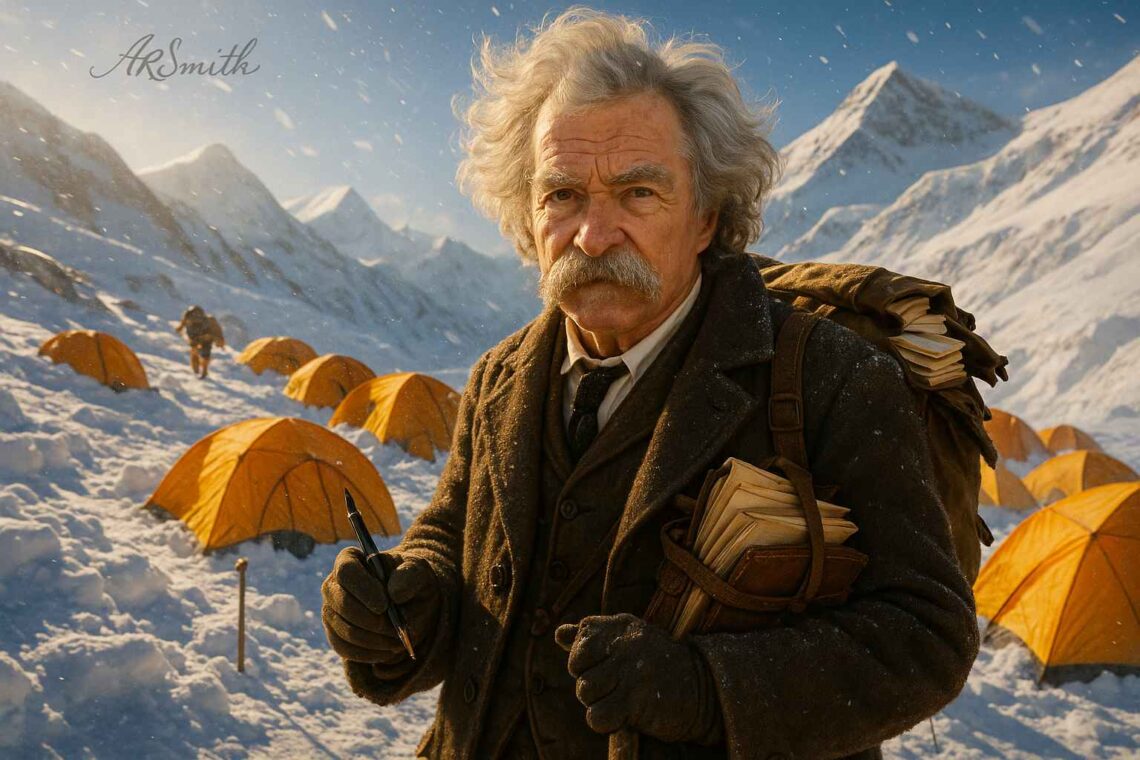
Mt. Everest roared with hurricane winds and snow that cut like glass, but Mark Twain—well over 70, habitually disorganized, untrained, and dogged by indigestion—pressed into the thin-air crucible with the grin of a man chasing metaphors higher than clouds. His mustache froze into white icicles, his wit never dimmed, and the mountain had no defense against his stubborn narrative.
At Base Camp, Twain looked more like he was waiting on a Mississippi steamboat than a Himalayan summit. He misplaced his gloves, misplaced his crampons, and nearly misplaced his tent—but he never misplaced a joke. “He was mentally unprepared, nutritionally suspect, and thoroughly disorganized,” said Dr. Andrea Molnar, altitude physiologist at Johns Hopkins. “But when you laughed with him, you forgot how impossible the climb seemed.” Sherpas swore he asked if anyone had seen a raft heading toward Tibet.
The early climb was a comedy of calamities. His untrained stride lagged, his pack rattled with half-finished manuscripts, and his indigestion forced him to stop mid-ladder, clutching his stomach. “I thought the man would quit at the Icefall,” said mountaineer Peter Habeler. “Instead, he waved a hand, cracked a joke about death and taxes, and pushed on.” His body looked beaten, but his quips sliced through despair like crampons biting ice.
At 26,000 feet, the jokes slowed. His face sagged with exhaustion, his untrained body trembling against the gale. Indigestion churned, his mustache crusted with frost, yet he still found breath for defiance: “The coldest winter I ever spent was a summer in San Francisco—and this is worse.” Teammates howled even as their oxygen masks iced over. “He turned the death zone into a comedy club,” marveled Dr. Kenji Ito, screenwriting specialist at the University of Tokyo. “Laughter became his oxygen.”
Then came the push, the improbable crescendo. With knees shaking and lungs gasping, Twain staggered onto the roof of the world. He lifted his pen, not a flag, and scrawled his name in the snow. “History may not repeat itself,” he rasped, “but here, it rhymes.” The crowd of climbers erupted as if witnessing a punchline 29,032 feet high.
The way down was equal parts misery and marvel. He forgot his pack at Camp IV, tried to tip a Sherpa as though he were a waiter, and nearly fell asleep mid-rappel. Yet his words lingered in the air long after his boots left the glacier. “No one will forget this,” said Ed Viesturs. “Not because he was the strongest—but because he turned agony into art.”
Back at Base Camp, sipping tea laced with bourbon, Twain offered his verdict:
“Climb mountains if you must, but remember—the summit is a fine place to visit, but not to live. Pack less clutter, more patience, and always keep humor handy. For oxygen fades, frostbite lingers, but a well-timed jest—ah, that endures longer than granite.”

