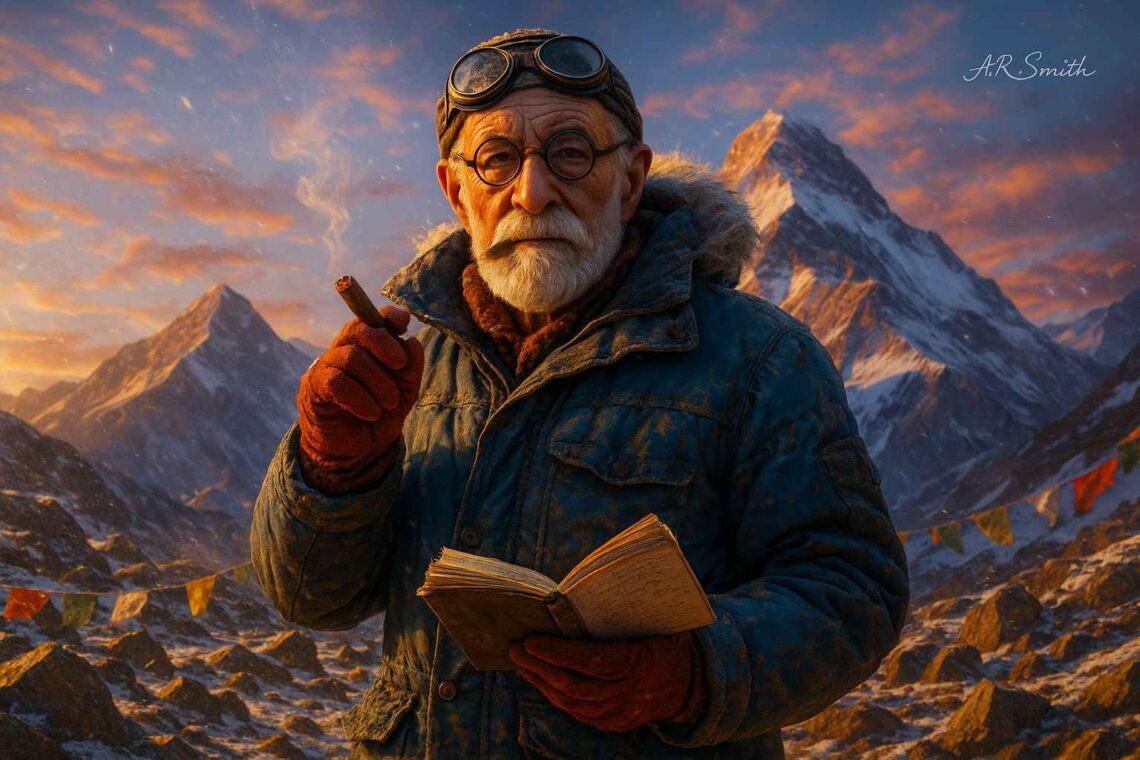
At 27, financially unstable, recently divorced, and plagued by habitual sleepwalking, Sigmund Freud’s improbable march up Everest looked less like a climb and more like a full-blown psychoanalytic case study unraveling at altitude. The Austrian father of psychoanalysis wasn’t there just for glory—he was there to dissect every step, every gasp, every subconscious slip, cigar clenched tight in his frostbitten lips.
From the opening days at Base Camp, Freud seemed distracted, muttering about Oedipal mountains and the symbolism of conquering one’s father figure in summit form. Colleagues reported he attempted to light a cigar in the oxygen-starved air while scribbling notes on “latent fears of ice axes.” Dr. Maria Sanchez of the Mayo Clinic’s High Altitude Research Unit described him as “a living contradiction—medically unstable yet fiercely motivated, determined to interpret the Himalayas as if they were his own unconscious mind.”
Freud’s early strides were anything but smooth. Financial struggles had left him outfitted in mismatched gear, including a donated parka two sizes too small and crampons that whined with each step. His divorce papers, stuffed into his coat pocket, became an almost talismanic burden. At 18,000 feet, his unstable dentures gave out more than once, forcing guides to drag him upright. “It was like watching a mind-versus-body experiment,” said exercise physiologist Dr. Jonathan Kwan from Oxford University. “Every time his legs failed, his analysis kicked in. He’d mutter about repression instead of resting.”
As the weather turned, Everest seemed determined to psychoanalyze him back. A whiteout storm clawed at his fragile balance. His oxygen canister froze. His hands swelled, and he scribbled frantically on scraps of paper: “Superego demands summit—id craves descent.” Rescuers later recalled hearing him shout, “Sometimes a mountain is just a mountain!” before climbing higher. The world held its breath. “I’ve seen peak athletes crumble here,” said Peter Habeler, legendary climber, shaking his head in disbelief. “Freud was different. He analyzed his way past exhaustion. Who does that?”
Against all probability, Freud planted his boots on the roof of the world, puffing a half-lit cigar, and enjoying a snifter of cognac in gale-force winds. He reportedly whispered, “The unconscious has no altitude.” Cameras caught him shaking, ankles barely holding, face streaked with frost and tears. “It was agony and ecstasy in one frame,” reported Dr. Elise Becker, altitude medicine specialist from the University of Zurich. “He should not have survived those conditions. But somehow, the power of interpretation became oxygen for him.”
Returning to Base Camp, Freud was transformed yet visibly broken. He described the climb as “a manifestation of humanity’s eternal struggle with suppressed desires—Everest being the ultimate father to be confronted.” His guides rolled their eyes, but even they admitted—few first-timers have ever shown such improbable resilience. “He psychoanalyzed the mountain and himself,” said Sherpa guide Dorje Tamang. “And somehow, both gave in.”
In Freud’s own words:
“Do not climb Everest for conquest alone. Climb it to confront the hidden forces inside you. Carry not just oxygen, but self-awareness. And if you must, bring cigars. The mountain cares little for your habits.”
Next up… Mrs. Doubtfire Conquers Mt. Everest

