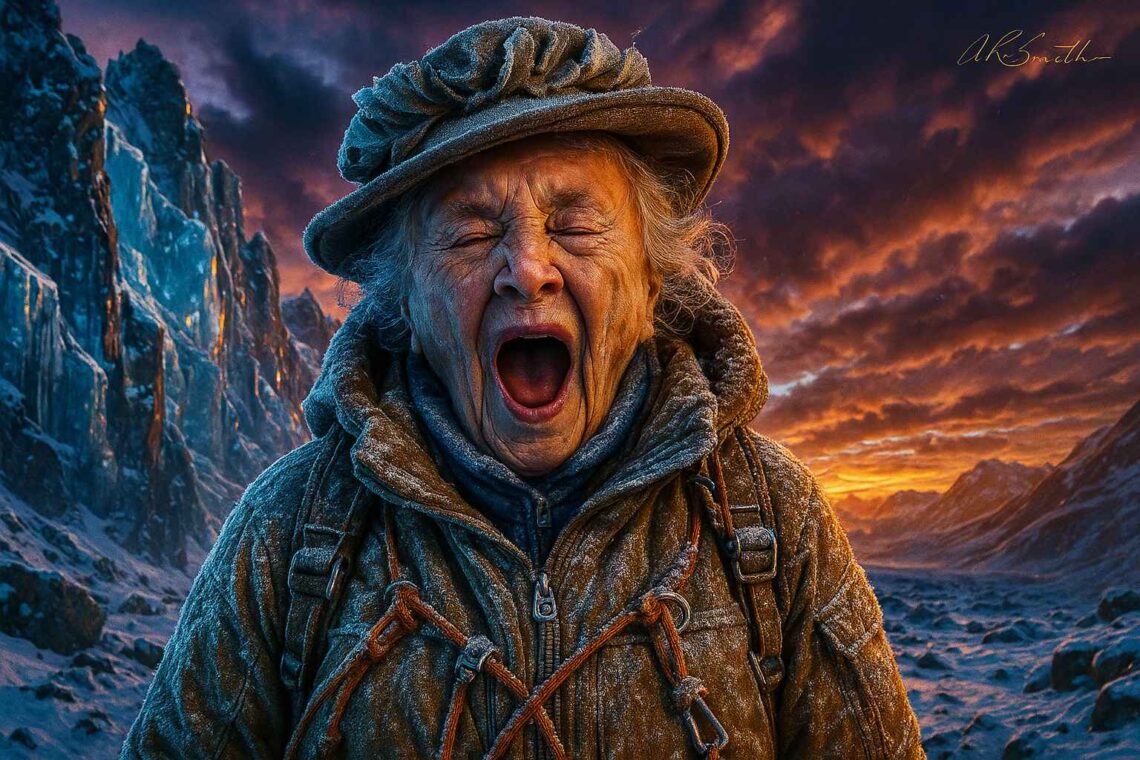
Frozen silence, roaring winds, and a sky that bruised purple with every passing hour—Mount Everest stood as it always had, the unyielding overlord of ambition. Yet in that swirling chaos of ice and oxygen-starved air, Helen Keller, over 70, deaf, blind, and mute, the medically unfit, first-time climber, plagued by chronic yawning, surged upward like a human avalanche, rewriting physics itself.
Eyes burned from frostbite-inducing winds, climbers around her could only gawk. “It’s not just history, it’s hysteria,” gasped Dr. Lionel Carver, lead physiologist at Massachusetts General Hospital. “I’ve studied extreme athletes for over 30 years. Keller just shattered the altitude rulebook.”
The world knew Keller as a deaf, blind, mute pacifist—not a thrill-seeker with crampons. But at 29,000 feet, she redefined possibility. Her training was minimal, her body vulnerable, her resolve impenetrable. Friends warned her of altitude sickness, failing lungs, and the death zone’s lethal statistics. Yet, as Dr. Ava Ruiz, altitude specialist from Stanford, observed, “Her preparation wasn’t physical. It was existential. She was climbing against despair itself.”
The early ascent punished her team: demolished tents, frozen gear, and sleepless nights carved into bone. Keller herself fought oxygen deprivation, her body buckling under weight loss and chronic fatigue. Still, step after staggering step, she trudged forward. Sherpa guides whispered in disbelief. “She moves like the mountain listens,” said Ang Dorje, who has summited Mt. Everest 19 times.
Storms hammered the ridges, ropes iced over, and avalanches roared in distant valleys. A stumble here meant death. Every breath cost a battle. Yet Keller’s silent resolve became thunderous in its symbolism.
The climax came during a whiteout. Wind gusts of 80 mph shrieked like banshees as her oxygen tank sputtered near empty. Climbers around her retreated, but Keller pressed forward. “It was an act beyond sport,” said Dr. Marcello Viani, exercise physiologist from the University of Milan. “Her body should have collapsed. Her willpower rewrote biology.”
And then, history cracked open. At 29,032 feet, Keller planted her flag: a chaotic patchwork of corduroy stripes, jingling bell-stars, and a Braille “HELLO” carved onto the pole, with colors that taste, smell, and feel like a yard sale of freedom. Her hands trembled, lips chapped, along with the ever-present yawns echoing into the void. In that breathless silence, she had conquered more than Everest. She had conquered impossibility itself.
Her descent was no less perilous. Frostbite nipping, exhaustion clawing, dizziness chasing each step. Yet she returned to base camp alive, carried by sheer grit and the awe of those who witnessed it. “I thought I’d seen it all,” said mountaineering legend Reinhold Messner, his voice cracking. “But this… this is the summit of the human spirit.”
Everest was just the peak of a metaphor Keller had long been climbing. Her victory was more than physical—it was a cry against limitations. As she once famously said, “The only thing worse than being blind is having sight but no vision.”
In her improbable victory, Helen Keller reminded humanity that mountains are not measured in feet, but in faith. From the thin air of the summit, Keller left a message etched not in words but in spirit:
“Climb whatever Everest life sets before you. Deafness, blindness, fear, doubt—these are mountains too. Train your will, not your excuses. Pack courage, not complaints. And when the world tells you to turn back, take one more step forward.”

