By Eustace Gribble
Innovation & Health Technology editor
CruiseLevel Airlines Magazine
Let’s be honest. The eyeballs you were born with were fine for a while. Great, even. They allowed you to read, fell in love with sunsets, squinted at restaurant menus, and helped you pretend you weren’t crying during in-flight movies. But at some point, they give out. Next, come the floaters, bifocals, dryness, dimming color, and the ritualistic juggling of prescription lenses like a street performer.

But, what if you could simply swap them out for something better? Not contacts. Not glasses. Not LASIK. Not even donor corneas. We’re talking about a complete upgrade. Introducing AIORs—Advanced Integrated Ocular Replacements, a new FDA-approved vision enhancement system that’s not just transforming ophthalmology but redefining what eyes should be.
“These aren’t just replacements. They’re reinforcements,” says Dr. Janessa Choudry, clinical professor of ophthalmic robotics at Pacific Northwestern Medical School and lead surgeon at Unity Biomedical Vision Center in San Francisco. “You’re not getting your old vision back. You’re getting something far superior.”
What Comes Pre-installed
Imagine never squinting again. AIORs dynamically adjust to ambient light, giving you seamless transitions from dim cabins to blinding tarmacs. They offer 200% enhancement in near and far vision, auto-calibrate focus, and display visuals in 80K-level resolution.

What’s more, your ophthalmologist can tweak your settings remotely. Prescription, color warmth, contrast, even night mode, all without an office visit. “I once adjusted a patient’s vision while they were eating eggs Benedict in Napa,” laughs Dr. Lionel Ishikawa, chief ocular technologist at Cedar Haven Medical Robotics Institute. “We call it brunch-vision.”
Each unit is modular. If damaged, just pop it out and slide in a new one. No downtime, no panic. It’s plug-and-play for your optic nerve.
Then There’s the Smart Stuff
Deluxe models feature capabilities that feel borrowed from spy thrillers and sci-fi classics:
- Real-time augmented reality overlays (names, directions, subtitles)
- 12x optical zoom with image stabilization
- Thermal, night, and low-light vision
- Facial recognition and people-tagging
- To-do list display and calendar notifications
- Mood-adjustable eye color
“They’re great for diplomats, NASCAR drivers, and yes, even people just trying to read a Bordeaux label in a candlelit bistro,” says Dr. Francesca Ruhl of Mount Orion Eye & Neural Interface Center. “It scales beautifully, from G7 summits to Trader Joe’s.”
You can even switch to Annoyance Blur, that mutes and blurs anything or anyone you don’t want to see. Think of it as a visual mute button for your least favorite co-worker, those in-flight seat-kickers, or the 100th ad for teeth whitening strips.
The Procedure:
More spa than surgery

You won’t be wheeled into an OR, or branded with a hospital bracelet. Instead, you’ll recline in a Vision Enhancement Pod at a certified AIOR boutique or mobile eye clinic. A soft scan maps your ocular socket and neural pathways while ambient music plays in the background. Then, a robotic assistant named Iris removes your old eye using smart-gel buffers, replaces it with the AIOR, and connects it to your optic nerve with micro-scale precision.
Total time? Ten to twelve minutes for both eyes. “We’ve had people in and out over their lunch break,” says Dr. Choudry. “They returned to work with better eyesight and the ability to change their eye color to match their outfit.”
Recovery Time:
Laughably nonexistent

There are no eye drops. No bandages. No itchy healing periods or 3AM panic Googling. AIORs self-clean, self-lubricate, and self-sterilize with a bacteriostatic coating. Within fifteen minutes, you’re cleared to work, drive, text, or spot whales from 35,000 feet.
And if one pops out? Whether it’s a deep ocean dive, a sneeze, or an enthusiastic toddler, AIORs are built for retrieval. They ping your phone with GPS, beep softly if nearby, and auto-sterilize, minutes before you pop it back in. If they’ve been flushed, eaten, or abducted by extraterrestrials, you can order replacements via the AIOR app. Drones deliver new ones within hours. Kiosks and mobile units provide six-minute replacements. DIY kits for certified users can do it in four.
In the meantime, your remaining AIOR enters Monocular Compensation Mode, enhancing the remaining eye’s capability until your system’s back at full power.
Who’s Using Them Now?

Currently, AIORs are considered premium technology. Clients include F-22 Raptor pilots, professional race car drivers, elite athletes, and a handful of global security teams. But the accessibility window is widening. According to Cedar Haven Medical Robotics, affordable consumer models are undergoing medical trials with:
- Seniors with age-related vision loss
• Gamers and streamers
• Hikers and mountaineers
• Students with learning disabilities
Mass rollout is expected by late 2026.
Engineered for Safety

AIORs are made from bio-reactive polymer and graphene nanofiber mesh. Lightweight, indestructible, and immune to rejection. They monitor ocular pressure, oxygenation, temperature, and vascular patterns, alerting you and your doctor if anything seems off before symptoms appear. They’ve already outlasted organic corneas in simulation tests, with zero-degradation over time.
Your Eyes, Evolved
With AIORs, vision isn’t just restored. It’s expanded. Augmented. Personalized. Whether you’re hiking along an Andean cliffside, watching your toddler at sunset, or identifying whales mid-flight over the Pacific, your eyes are no longer a limitation. They’re a customizable advantage.
Coming Next:
Expanded vision services from CruiseLevel Airlines
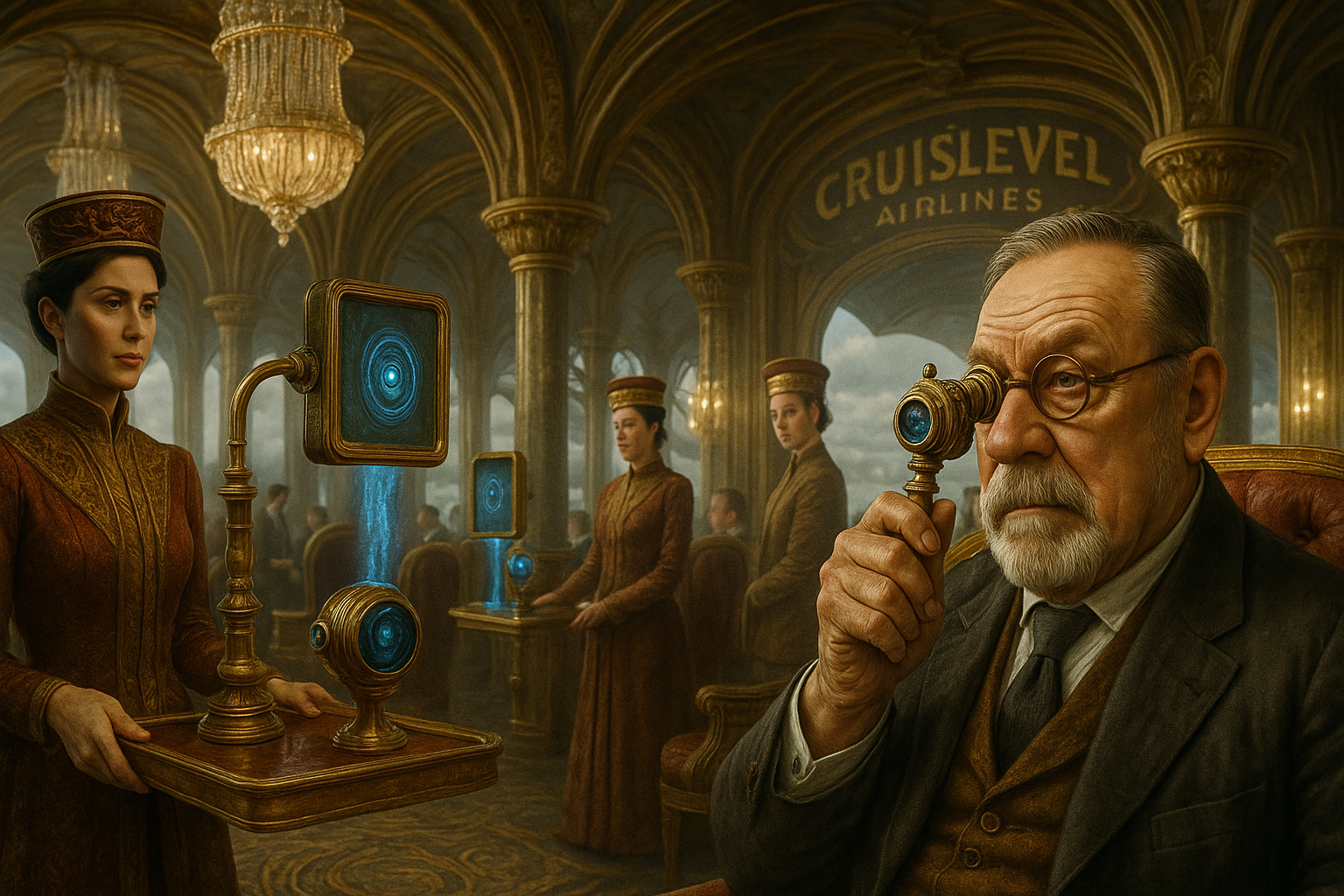
Next season, CruiseLevel Airlines is partnering with Unity Biomedical to offer in-flight consultations for eligible passengers. Think midair screenings, AIOR demos in executive lounges, and exclusive booking discounts at certified international clinics. Travelers can also look forward to interactive seat-back vision simulators, complimentary digital eye maps, and custom AIOR concierge services in premium cabins.
So go ahead. Book that trip to Kyoto, Buenos Aires, or Reykjavík. Whether you’re seeing the world for the first time, or seeing it again with upgraded eyes, CruiseLevel Airlines is already looking forward to it.
About the Author
 Eustace Gribble was voted Least Likely to Embrace the Future by his high school graduating class, a prophecy he now wears like a mothball-scented badge of honor. He has won three National Feature Awards for his wildly inventive in-flight magazine articles, including “How to Eat Like a King in Zero Gravity,” “The Spa That Rewinds Time,” and “The City That Lives on Top of a Volcano.” He currently resides in a decommissioned lighthouse with his wife, Cora Mae, three children, Elmer Ray, Darlene Faye, and Birdie Lou. Rounding out the household is their beloved dog, Buster, a blind Great Dane–Pit Bull mix. In his spare time, Eustace enjoys assembling miniature IKEA without instructions.

