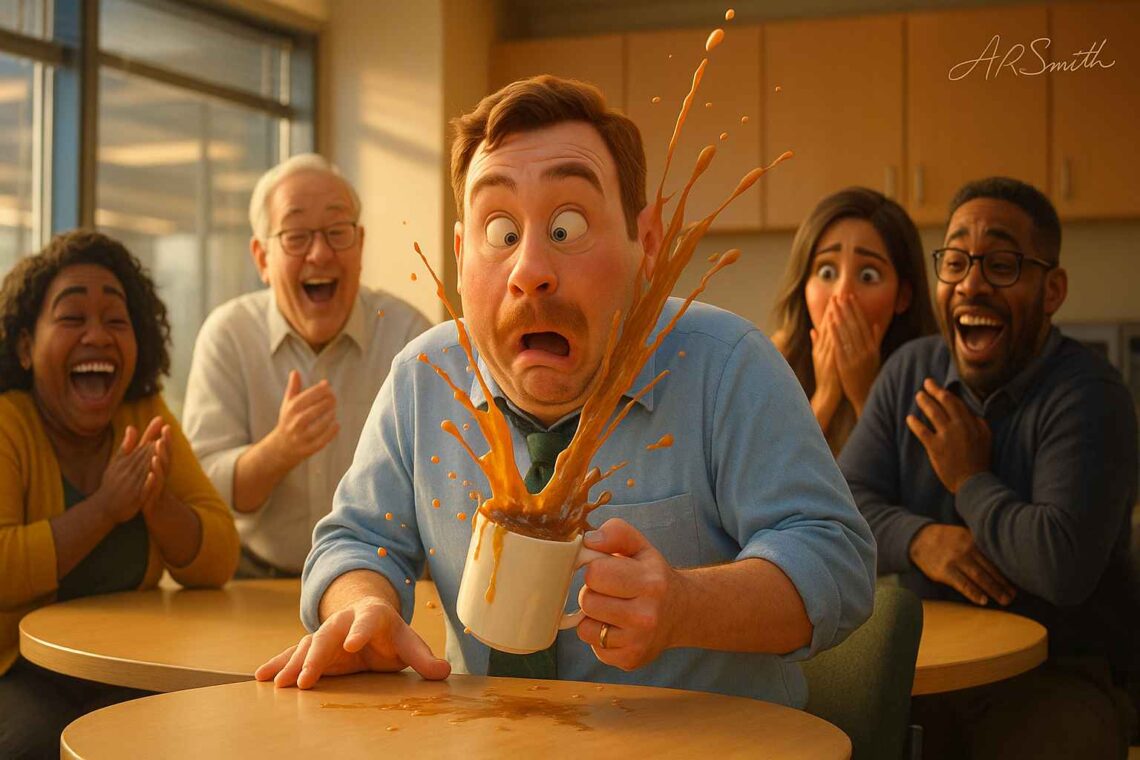
“These are the times that try men’s souls.”
– Thomas Paine (1776–1783)
Life, for all its wonder, is mostly a long queue of indignities. Every day, we’re served a buffet of unavoidable discomforts that suddenly appear on our skin, awkward small talk that lasts longer than most relationships, and family photos that feel like solar torture wrapped in love. We endure colonoscopy prep like gladiators of hydration, sing politely through “Happy Birthday, Craig,” and pretend not to notice when Brian from HR has a salad bar lodged between his teeth.
It’s the price of being alive. A nonstop obstacle course of minor humiliations and polite suffering that we’re forced to endure. But maybe that’s the secret — not avoiding them, but collecting them like merit badges. Because the truth is, everyone’s flying low, sweating through the photos, and sneezing mid-bite at least once in their life. The rest of us are just pretending not to notice.
So, here’s to endurance. To the everyday cringes that bind us together. It’s not always graceful. It’s rarely dignified. But it’s the closest thing we have to sharing our universal experiences.
I Survived My Own Bachelor Party
But my hangover is going to last way longer than that
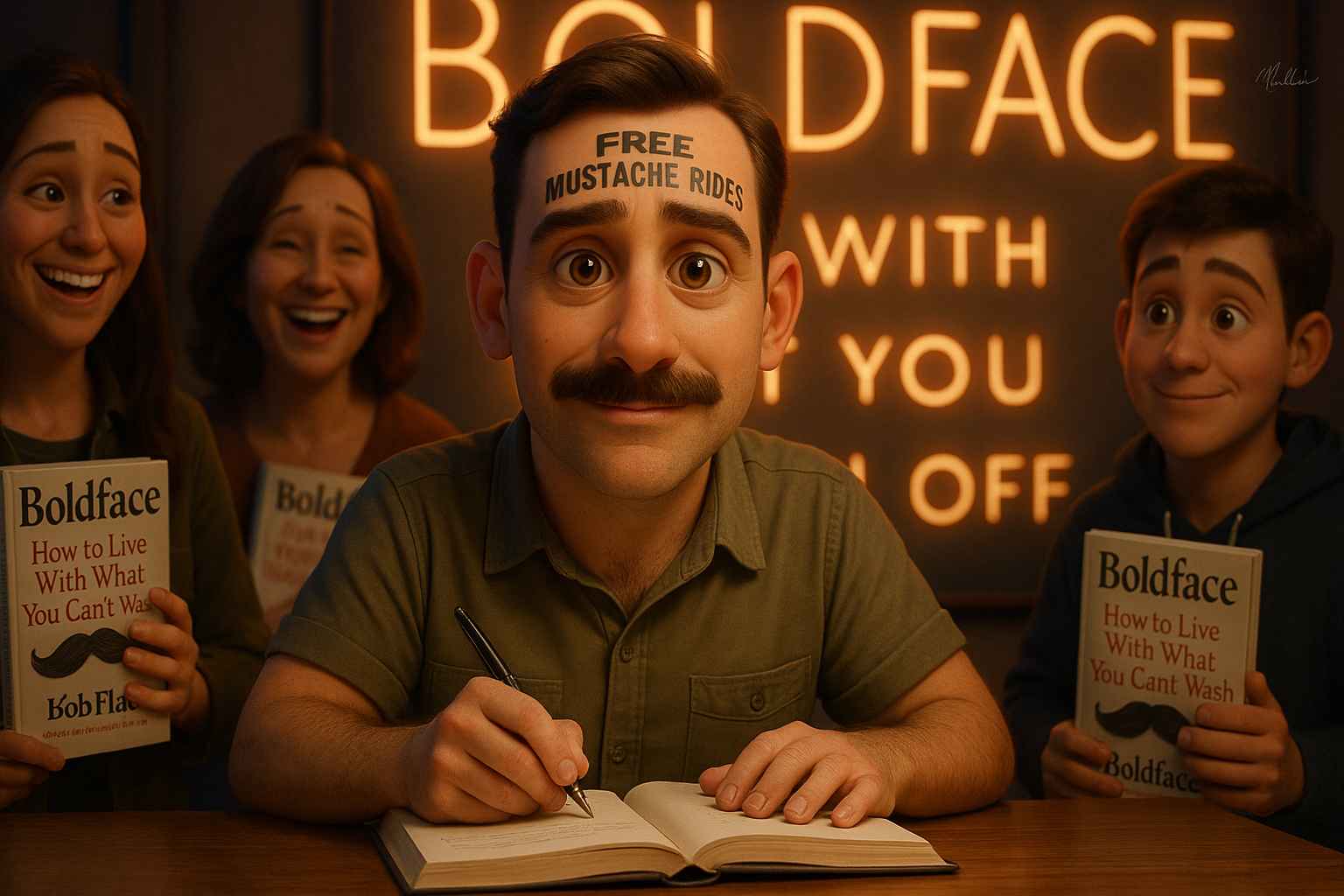
I woke up feeling like my skin was humming. Not metaphorically — like, literally buzzing, as if I’d spent the night sleeping under a neon sign. I didn’t, of course. I was merely sleeping off the remnants of a substance-enhanced bachelor party. My bachelor party.
I stumbled to the bathroom, squinted at the mirror, and froze.
There, stretched across my forehead in dark, bold letters were the words:
“Free Mustache Rides”
Not small. Not subtle. Not ironic. It was a carnival marquee — the kind of thing you’d expect to see above a biker bar or a regrettable state fair attraction.
The font was jaunty. The color was loud — deep, dark blue. Like a bad dream at a 1980s beach party. The letters even had drop shadows, as if my forehead had been designed by someone with a marketing degree and no conscience.
I touched it. Smooth. Permanent.
I blinked once. Then again. The words didn’t fade.
I whispered, “No.”
The tattoo whispered back, “Yes.”
I tried covering it with a baseball cap, but the brim only made it look like a headline with punctuation. Sunglasses helped until I remembered that people on the bus can still see the top of your face.
The driver did a double-take when I paid my fare.
“Morning,” I said.
He nodded slowly. “Sure is.”
A little girl across the aisle pointed. “Mommy, that man has words on his head!”
Her mother pulled her close, the way people do when they’re unsure if something is contagious or just poor judgment.
A man two seats behind me chuckled. “You do birthdays too?”
I stared out the window, pretending I was invisible. I was not. The window reflected the phrase back at me in reverse:
SEDIR HCATSUM EERF
It looked even worse backward — like a spell summoning poor life choices.
The elevator doors opened, and the office air thickened. My coworkers stared as if I’d walked in carrying a lit torch and an emotional support ostrich.
“Rough night?” asked Jen from HR, eyebrows raised to OSHA-approved concern levels.
“You could say that,” I said. “I think I’m into marketing now.”
She blinked. “Is that… permanent?”
“I’ll let you know after exfoliating my soul.”
During the morning meeting, I sat at the end of the table, head down, pretending to take notes. Every time I looked up, someone pretended to check their phone.
When my boss arrived, he stopped mid-sentence. “Is that… new?”
“Yes.”
He nodded carefully. “Creative.”
“Thank you,” I said.
We didn’t make eye contact again.
I went to the corner café for lunch. The barista, a kid with an ironic mustache and a beanie that said Art Happens, froze when I approached.
“Uh,” he said, squinting. “Is that real?”
“Yes.”
He nodded. “Cool, man. Retro.”
“It happened this morning.”
He looked impressed. “Commitment!”
I ate my sandwich by the window, watching reflections of myself in the glass — a man trying to chew quietly under a slogan that belonged on a bathroom wall in Reno. The lettuce crackled like applause for my poor decisions.
Next up was my weekly romp down the basketball court with friends. The locker room went silent the moment I walked in.
My best friend Ryan, blinked. “What the hell, man?”
“I woke up like this,” I said.
He laughed — a loud, belly-deep laugh that echoed off the tiles. “That’s incredible!”
“It’s horrifying.”
“It’s just me.”
On the court, every movement felt like a punchline. Guys on the other end of the court stopped mid-game to read my forehead out loud, one word at a time.
“FREE!” someone shouted.
“MUSTACHE!” answered another.
“RIDES!” came the chorus.
They high-fived. I missed a layup and pretended I’d twisted my ankle just so I could leave early.
That evening, I picked up my fiancé, Lily. She opened the door, took one look at my face, and whispered,
“Oh. my. God.”
“Yeah,” I said. “It’s new.”
“Why?”
“I’d love to know.”
We went to dinner anyway, because love sometimes outruns logic. The hostess at the restaurant smiled a little too widely, like she’d been trained not to notice customer deformities.
“Right this way,” she said, voice trembling.
Half the restaurant turned when I walked by. The waiter took my order without once making eye contact, though I caught him stealing glances at my forehead as he poured the wine.
At the movies, I sat in the dark, hoping the glow from the screen would dim the humiliation. When the previews ended, the guy behind us leaned over and whispered to his date, “I think that guy is advertising something.”
She giggled. I sank even lower in my seat.
At the café afterward, the waitress asked if I belonged to a fraternity. Lily looked mortified.
“It’s… kind of hard to explain,” I said.
“Oh,” said the waitress. “Well, good for you.”
Lily didn’t speak to me for the rest of the night.
The next morning, I had a major client presentation. I debated applying a foundation, a headband, a hat, and even gauze. But everything made it worse.
So, I walked in barefaced, confident in the way a condemned man might be.
“Good morning,” I said, standing before the screen.
Someone snickered softly.
I continued, pretending not to notice. “Today’s topic: effective communication.”
More laughter.
“I suppose,” I said finally, “you could say I’m committed to transparency.”
The room cracked open. Laughter, applause, a standing ovation from the back row. I smiled, because what else could I do?
The next day, I recorded a TED Talk on YouTube titled “Facing Yourself: How to Stop Hiding and Start Laughing.” The crowd gasped when I walked onstage. I didn’t hide the tattoo anymore — in fact, I owned it.
“This,” I began, tapping my forehead, “used to be my worst nightmare. Now it’s my icebreaker.”
They laughed, but softly — respectfully.
“Turns out,” I said, “you can’t run from the parts of yourself that make people uncomfortable. You can only learn to blink through the awkwardness.”
It was my most-watched talk to date.
Later that year I sat behind a table piled with copies of my memoir, “Under the Ink: How to Live with What You Can’t Wash Off.”
Fans lined up. Some curious, some inspired. A teenager asked if I’d ever thought about adding glitter.
I smiled. “I think it’s implied.”
A woman asked, “Do you ever regret it?”
“Every morning,” I said. “But less every night.”
She nodded. “It’s kind of beautiful.”
I signed her book. She thanked me. And as she walked away, I caught my reflection in the glossy cover — my ridiculous, bold-lettered forehead shining back at me like an inside joke I’d finally learned to enjoy.
The Adventures of My Colonoscopy Prep
I questioned every life decision that led me there
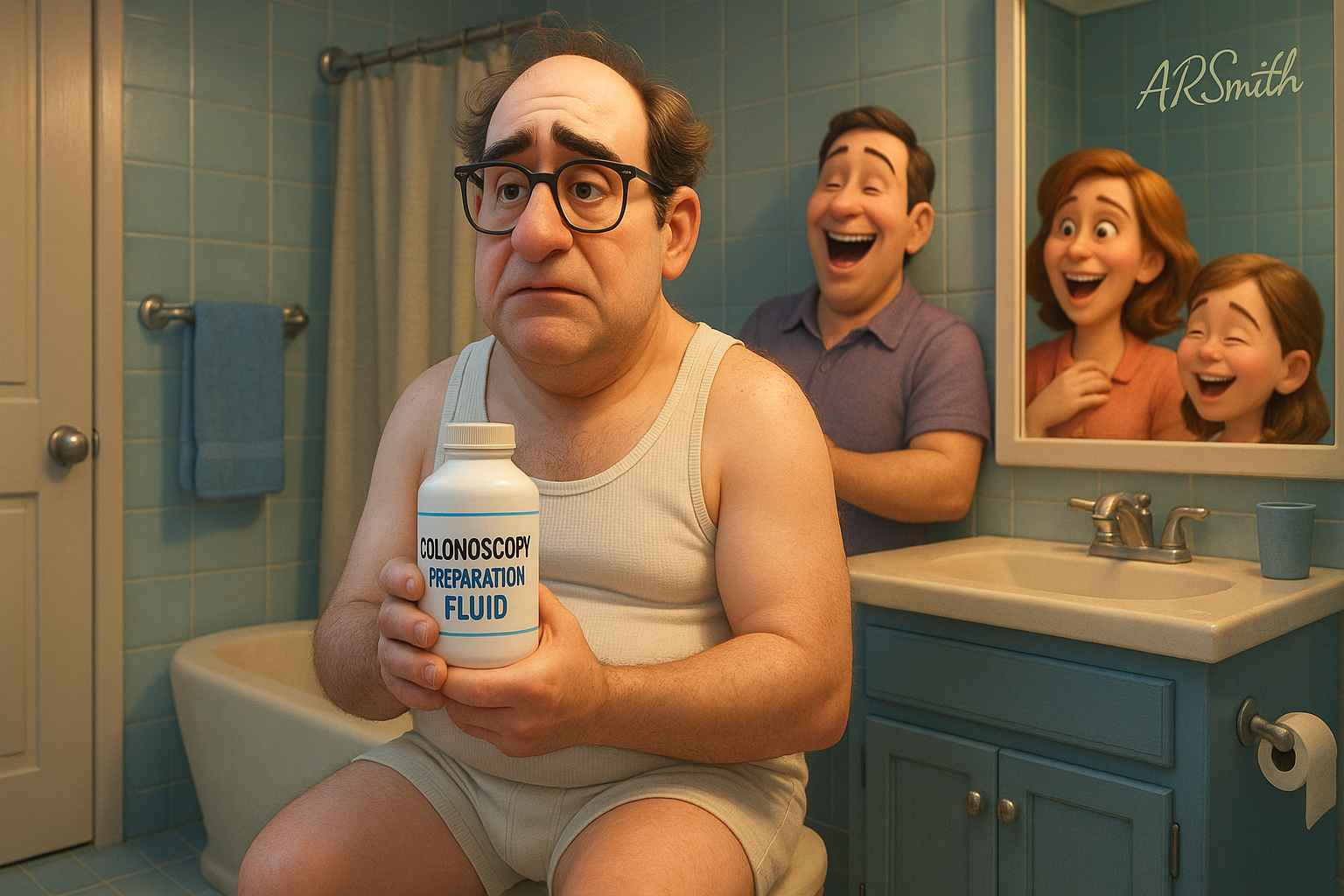
The morning of my first colonoscopy began like any other government-sanctioned medical ritual — earnest, sterile, and slightly damp with anxiety. I’d spent the previous twenty-four hours fasting, purging, and pacing my kitchen like a monk who’d misplaced his enlightenment. The instructions had been clear:
“Consume only clear liquids.” Which, I realized by hour six, eliminated just about everything that made life worth living.
By dawn, my bowels were as vacant as an abandoned strip mall. I shuffled to the mirror, pale and hollow-eyed, and whispered, “You’re ready.” It sounded noble, cinematic — like I was embarking on a pilgrimage through my own digestive tract.
Then came the text from the clinic: “Your appointment has been canceled.”
Cancelled. Just like that.
I stood in the kitchen, clutching a mug of tepid broth, realizing the rest of the world was busy eating omelets, sipping coffee, living normal gastrointestinal lives. The neighbors across the street were laughing over pancakes. My mailman chewed on a donut. Even the dog walkers looked smugly hydrated. None of them was hollowed out like an overzealous jack-o’-lantern.
At first, I thought it was a clerical error. I called the clinic. The receptionist sounded cheerful, bordering on chipper.
“Oh, yes,” she said. “All procedures are proceeding as scheduled except for yours. It’s just you.”
“It’s just me?” I asked.
“Yes. Just you. Seems you’ve been… postponed indefinitely.”
There was a pause long enough to hear the hum of my refrigerator, which I now resented for being full of things I couldn’t eat.
“So, everyone else gets scoped today but me?”
“Correct,” she said brightly. “Isn’t that wonderful?”
I hung up slowly, and stood there — an unexamined man in a world moving forward.
By midmorning, my body felt betrayed. I had trained for this. Fasted, flushed, prayed to the porcelain gods. My digestive system was a cathedral of cleanliness. And now, it had no purpose.
Outside, people sipped lattes and chewed bagels without consequence. I joined them, hoping to rejoin humanity. But when I tried to sip coffee, my stomach clenched in protest, like it had unionized overnight. My body had forgotten how to digest. It was as if I’d crossed some invisible line between citizen and specimen.
At the office, coworkers chatted about meetings and weekend plans while I sat silently, sipping water like a penitent. My supervisor stopped by, holding an Apple Fritter.
“Rough morning?”
“Canceled,” I said.
“What was?”
“My colonoscopy.”
He blinked. “Oh. Condolences.” He took a thoughtful bite, crumbs falling like confetti over his tie. “You, uh, gonna reschedule?”
“I don’t think it’s up to me anymore,” I said. “It’s… cosmic.”
The day unfolded with the dull ache of anti-climax. I watched people eat sandwiches, sip sodas, live their lives unscathed by the specter of gastrointestinal neglect. I tried to rejoin society by eating a cracker, but it felt wrong — like defiling a temple I’d just built.
After work, my girlfriend, Laura, met me for dinner. She ordered pasta. I ordered nothing.
“You’re still not eating?” she asked.
“I’m not sure I’m allowed.”
“Allowed? By who?”
“The universe, apparently.”
She twirled her fork thoughtfully. “You know, most people just get rescheduled.”
“Do they?” I said. “Because I’ve never heard from anyone else who’s been medically ghosted.”
Later that night, she invited me to a movie. I agreed, though the idea of sitting for two hours made me nervous — the body remembers trauma. In the dark theater, surrounded by popcorn’s buttery perfume, I felt like an imposter among the digestively privileged. When the soda straw crackled in her cup, it sounded like mockery.
On screen, the hero faced certain doom and declared, “I’m ready.”
I whispered, “So was I.”
The next morning, I received an email: “Thank you for your patience. Your colonoscopy has been deferred indefinitely.”
Deferred indefinitely.
I stared at the words, unsure if I felt relieved or abandoned. Outside, the neighborhood buzzed — trash trucks rumbling, sprinklers hissing, life recycling itself without pause. I walked to the mailbox, feeling faintly holy. Empty, but pure.
That afternoon, at work, they asked me to give a presentation on “Persistence Through Setbacks.” Standing before the room, stomach humming like a distant engine, I began:
“Sometimes, preparation is the journey.”
They nodded solemnly, unaware I was speaking literally.
By evening, I finally accepted my fate. I poured myself a glass of water — the one thing I still trusted — and toasted to all those who’d never know the quiet dignity of being medically forgotten. My colon would remain a mystery. A sealed chamber of unrealized potential.
And perhaps that was enough.
I Was Eating Just to Be Polite
Trying Aunt Mildred’s Tuna-Egg-Lime Jell-O-Salad Surprise with the enthusiasm of a hostage crisis
It started at 10:14 a.m. on a Saturday when I woke up with the dull thud of obligation pounding behind my eyes. Today was Aunt Mildred’s weekly “Culinary Lunch Social,” which sounded genteel until you remembered that the words tuna, lime, and Jell-O would soon be colliding in a single Pyrex dish.
By the time I finished shaving, I realized something else was off. I couldn’t remember the smell of the remnants of last night’s pizza—the taste of basil. And now, breakfast? Nothing. No flavor, no texture. I spooned in oatmeal, and it slid past my tongue like warm papier-mâché. Even coffee tasted like brown water strained through regret.
I walked outside to try testing the world. A man watering his lawn waved. Harold waved back. The smell of cut grass was as vivid as ever. The sound of sprinklers clicked. But when I bit into a piece of toast from the diner across the street, nothing. The waitress, chewing gum and looking alive, said,
“Tastes good today, huh?” I smiled politely.
“Delicious.” I lied.
By noon, the truth sank in. Nobody else had lost their taste.
It was just me.
My neighbor, Frank, grilled burgers with the enthusiasm of a man auditioning for a condiment commercial. My friends at the bowling alley munched on chili dogs, licking mustard from their fingers. I just stood among them, chewing air.
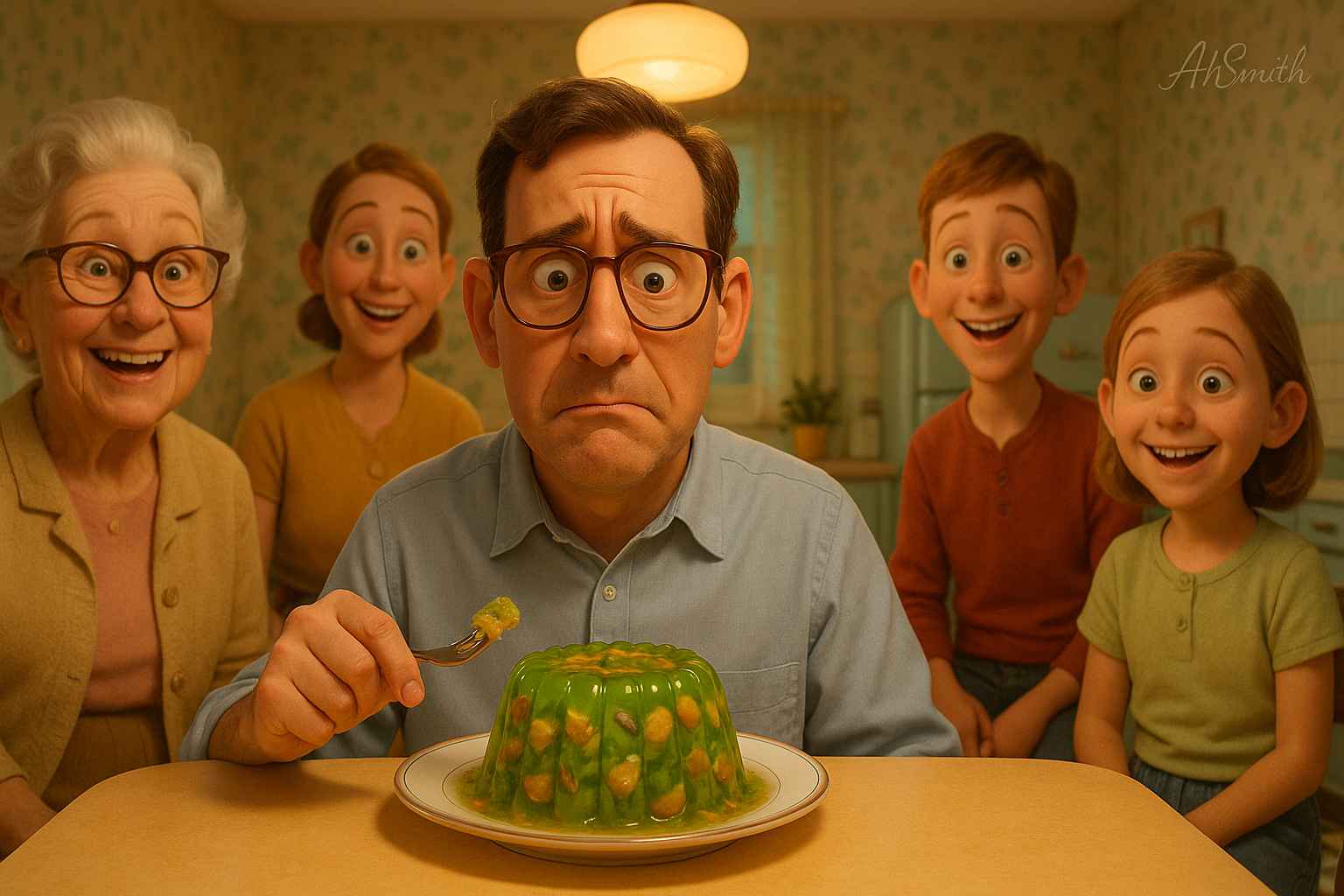
Still, there was Aunt Mildred’s invitation. Family traditions were nonnegotiable. The casserole, after all, was her legacy—a shimmering, greenish dome containing tuna, celery, and what appeared to be a hard-boiled egg suspended in slimy lime Jello. Every bite was an act of diplomacy.
When I arrived, Mildred fluttered like a festive moth. “You came! I made your favorite!” She ushered me toward the table, its surface a pastel battlefield of 1950s salads and molded ambition. The Jell-O glistened, trembling as if it, too, were afraid.
I sat, lifted a fork, and told myself to be brave. My aunt watched, eyes wide with expectation. I speared a chunk of something. Cold, slippery, oddly elastic, and chewed it with the enthusiasm of a hostage trying to negotiate their release terms. Mildred beamed. “Isn’t that marvelous?” I nodded, cheeks working mechanically.
Around the table, cousins murmured appreciation.
“I Love Tang,” one said.
“Sooo refreshing,” said another.
I focused on the texture: the rubbery give of gelatin, the fibrous grit of tuna, the unexpected crunch of celery. Just the way I imagined what it would be like to conduct an autopsy.
I thought: If I can’t taste it, at least, maybe I can survive it. I swallowed, smiled faintly, and said,
“Really brings out the lime.”
After lunch, I helped clear the dishes. The conversation drifted to weather, coupons, and the scandal of the neighbor’s new mailbox. Nobody mentioned my pallor or the beads of sweat collecting like dew on my temple. I felt detached, like an actor playing the “grateful nephew” in a play nobody would ever review.
Driving home, I tried to process the afternoon. Maybe it wasn’t so bad. Food was overrated anyway—half comfort, half performance. After all, I could still smell, still touch, still see. Maybe this was a mercy reprieve from craving.
But that night, when I took my girlfriend, Denise, to dinner at Le Papillon, things fell apart. Denise savored every bite, closing her eyes after each forkful like she was in a commercial for satisfaction itself.
“Try the duck,” she said, nudging a piece toward me.
I tried. The texture was perfect. But the flavor? Absent. My face stayed neutral, my voice polite.
“Incredible,” I murmured.
She looked at me and said, “You’re lying.”
I blinked. “What?”
“You’re eating like someone being interviewed by the FBI.”
I smiled weakly. “I’m just—appreciating.”
By dessert, Denise was quiet. She offered to share her Crème Brulé, but I declined. Outside, we walked past a bakery, and I inhaled deeply, searching for something—anything—to spark pleasure. Nothing. I wondered if this was how monks felt: detached, pure, and punished.
The next day, I was scheduled to give a TED Talk on “The Art of Saying Yes: Politeness in a Disagreeable World.” Standing on stage, lights glaring, my mouth dry. I bragged about civility and endurance.
“Sometimes,” I told the audience, “kindness isn’t in what we say, but in what we swallow.” The crowd laughed, not knowing how literal it was.
Afterward, during my book signing, Aunt Mildred approached, holding a foil-covered plate. “For you, dear. Just a little something left over from yesterday.”
I accepted it with both hands. “You shouldn’t have.”
“I insist,” she said, pressing it against my chest like a blessing.
I carried it home, set it on the counter, and peeled back the foil. The casserole shimmered in the light: innocent and yet at the same time, still menacing.
I lifted an obligatory forkful. And I could taste it. For the first time, I didn’t have to pretend. The world, for all its strangeness, had finally gone quiet.
I chewed, swallowed, and smiled faintly.
It was—against all odds—delicious.
Enduring the Obligatory Family Photo
Standing in the blistering sun while everyone accused me of being the one who blinked
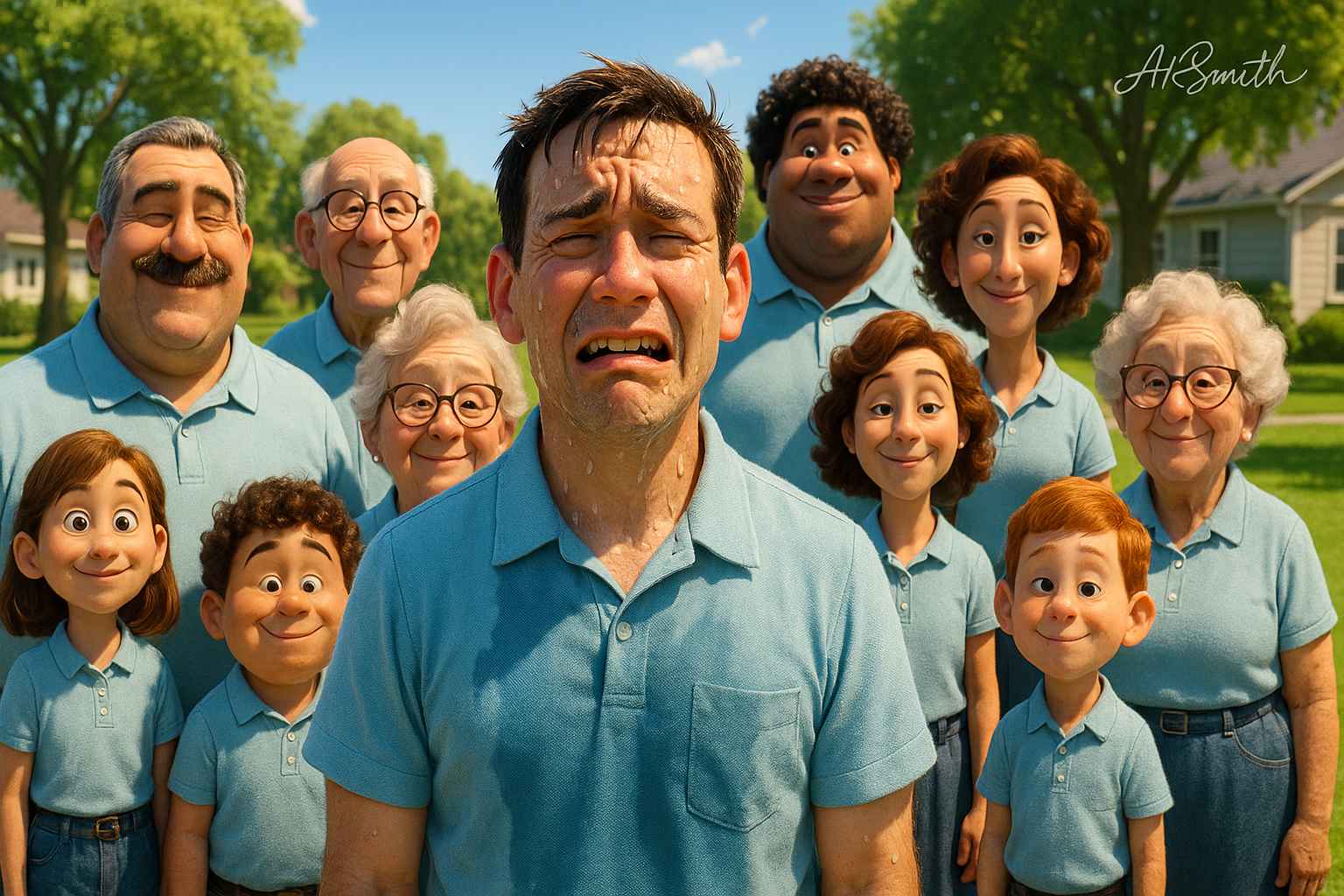
The morning started with dread disguised as brunch. It was Grandma’s birthday, which meant every member of the extended family—blood, in-laws, and even those on the verge of divorce—would converge on my parents’ lawn to “capture memories.” My mother called it “our legacy.” My father called it “a hostage situation.”
By 10 a.m., folding chairs multiplied like rabbits. Cousins emerged from minivans clutching coffee and resentment. The camera tripod stood in the grass like a silent executioner. I thought it was a normal family gathering until I noticed something strange: everyone else seemed… fine. Comfortable. Immune.
The sun beat down like it had a personal grudge, but no one else squinted. No one else dripped buckets of sweat.
It was just me.
I wiped my forehead for the fifth time and realized I was the only one melting. My sister’s mascara didn’t even smudge. My uncle wore a wool vest like he’d been airbrushed into the weather.
“Let’s do one with everyone smiling!” Mom said cheerfully, though her tone suggested this was both optional and mandatory.
The photographer, a neighbor who owed my father money, adjusted the lens.
“Okay,” he said, “everyone, squeeze in! Shoulders touching! Perfect.”
We squeezed. The contact was human, clammy, and sticky. I was wedged between Cousin Lila’s sequined blouse and Uncle Dan’s elbow. Someone’s hair product fused to my arm. A fly landed on my nose and refused to leave.
“Hold still!” shouted Mom. “Just a few seconds!”
It wasn’t.
It was twenty minutes of repositioning, blinking, and accusations.
“You blinked,” said Lila.
“No, you blinked,” said Aunt Patty.
“Someone’s aura feels off,” announced my cousin Sierra, who teaches yoga to poodles in Los Angeles.
I tried to smile, but it was the kind you give to a dentist—tight, terrified, and full of suppressed anxiety. The photographer clicked again.
“Almost perfect,” he said. “But let’s take another one just to be sure.”
Time slowed. Sweat rolled down my temples, tickling like guilt. My shirt clung to my back like a desperate lover. I looked out at the neighborhood, expecting to see sympathy from the Johnsons across the street. They were barbecuing, laughing easily, their family glowing in the natural shade. None of them was sweating. Not one glistened. It wasn’t happening to anyone.
It was just me.
After the forty-seventh shot, Mom insisted on “one candid snapshot.”
Everyone froze into poses so artificial they could’ve been on a Hallmark greeting card titled The Joy of Forced Togetherness. Grandma’s smile trembled like she knew this was her final portrait.
When it finally ended, I staggered inside, shirt translucent, hair wilted, dignity gone. My family moved effortlessly into air conditioning as if they hadn’t been subjected to an existential meltdown in 90-degree heat.
“Great photos!” said Mom, scrolling through the digital camera. Turning to me, she said,
“You look… shiny.”
That evening, I met friends for drinks. They were crisp, dry, unslick humans. When I told them about the photo, they laughed kindly.
“Everyone hates family photos,” said Ben.
But as I dabbed my forehead with a napkin that instantly soaked through, I realized—no, not everyone gets boiled alive during them.
At home, I tried to take a selfie, just to test it. The second I smiled, my phone fogged with condensation. My reflection blurred in a haze of humidity, like the universe was censoring me.
The next day, my girlfriend invited me to a picnic. I brought sunscreen, towels, and the futile optimism of a man who hadn’t learned his lesson. When we tried to take a couple’s picture by the lake, she glowed like a model, and I looked like a cautionary tale about hydration.
“You’re sweating through the filter,” she said gently.
By afternoon, I’d stopped resisting. I accepted it. Some people just exist at a higher moisture level. I was one of them—a humid being in a dry world.
Later, scrolling through Mom’s group text, I saw the final photo. Everyone looked radiant, sunlit, blessed. I looked like I’d been baptized in regret. But I noticed something else. In the middle of all that composure, my face—shiny, weary, alive—looked real.
And maybe that’s the point. Family photos aren’t about perfection. They’re about survival.
So, the next time Mom calls for a picture, I’ll stand tall in the glare, sweat rolling, smile trembling.
My aura might be off, but at least it’s honest.
Succumbing to the Airport Security Shuffle
My dignity beeped in protest while standing there shirtless, pantless, holding my laptop
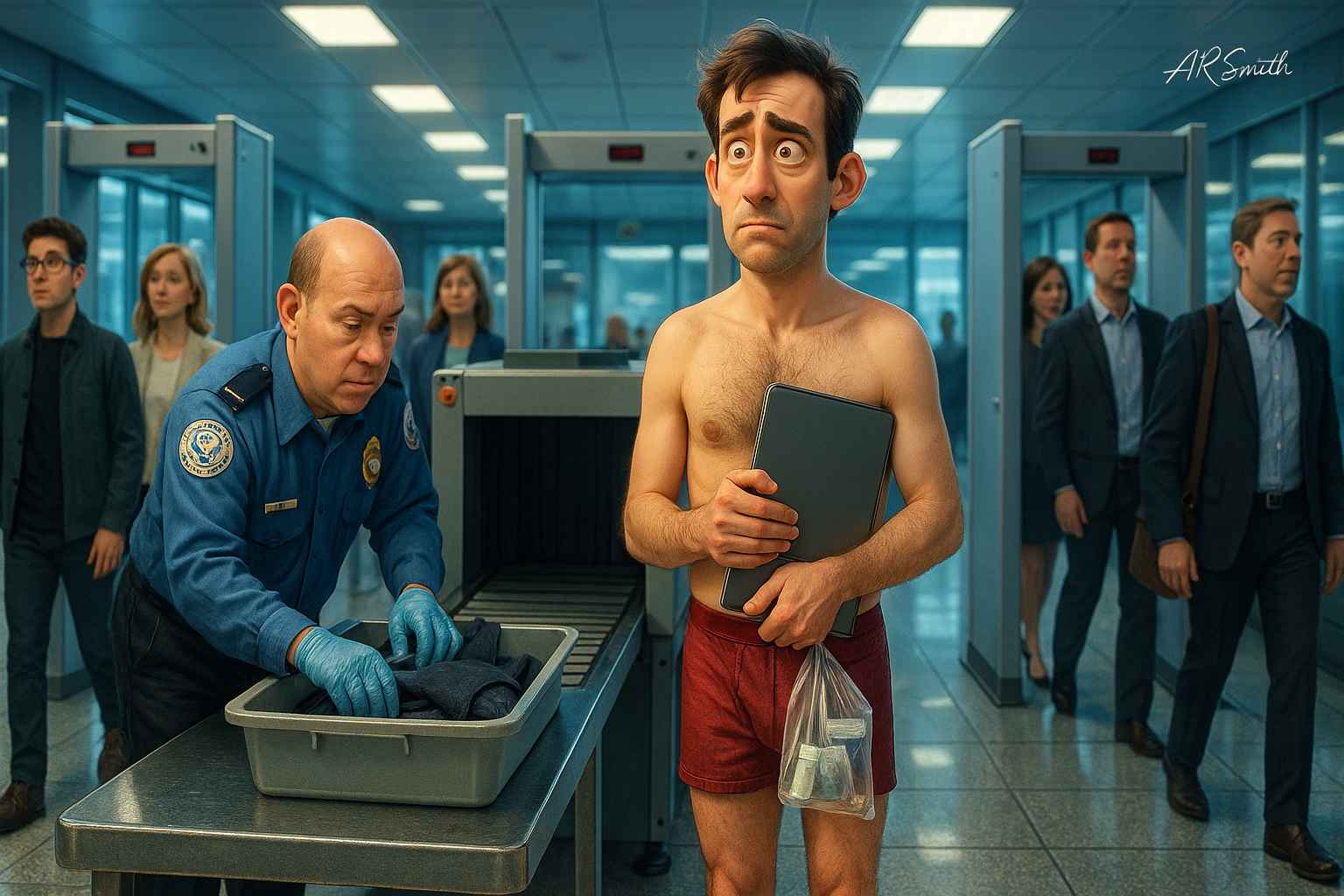
The day began with optimism. A morning flight, coffee that didn’t taste like punishment, and the illusion that air travel still held onto the remnants of dignity. I even wore my respectable traveler’s outfit: loafers, button-down shirt, and slacks without wrinkles. I was the picture of mild competence.
By 7:32 a.m., I was standing in the TSA line at Terminal C, shoes in hand, belt coiled like a dead python, and my laptop balanced on top of a sad plastic bin. The air conditioning hummed at interrogation-room intensity. My bag had already been pulled aside “for further screening,” which I took as a personal insult.
Then the agent looked up.
“Sir, you’re going to need to remove your jacket. And your shirt.”
“My shirt?”
“Yes, sir.”
I glanced around. No one else was being asked to strip down to their existential transparency. A man in front of me walked through wearing a hoodie the size of a tent. The woman behind me wore half the contents of a Macy’s. Yet here I was — the TSA’s chosen one.
I tried to act casual, unbuttoning slowly, as though I were participating in some kind of bureaucratic burlesque. My undershirt came next. Cold air grazed my skin.
“Now your pants, please.”
The words stung like an unpaid bill.
I complied because that’s what you do at airports — you obey. You don’t argue with TSA agents holding scanners. I stepped out of my slacks, folded them neatly—as if tidiness would have saved me—and placed them in another bin. The conveyor belt hummed ominously.
Then came the metal detector.
It beeped.
“Sir,” said the agent, with the solemnity of a priest,
“I’m going to have to ask you to step aside.”
Barefoot. Shirtless. Pantless. Juggling a laptop and a plastic quart bag of toiletries that suddenly looked accusatory.
Other passengers shuffled past — fully clothed, unbothered, still human. No one else had been reduced to this elemental state. It wasn’t happening to everyone.
It was just me.
I stood there, half-naked in a line of wool coats and carry-ons, watching people glide through security like divine beings. Children pointed. A businessman pretended to text. Somewhere, a woman coughed to cover a laugh.
“Sir,” the agent said, “do you have anything metallic in your possession?”
Only my shame, I thought.
They scanned me again. Beep. Louder this time. I swear the machine sounded judgmental.
“I think it’s your aura,” said the agent finally. “It’s reading… suspicious.”
I nodded politely. “I’ve been told that before.”
Eventually, they waved me through — a victory so hollow it whistled. I gathered my things at the end of the conveyor belt, fumbling to reassemble my life. Laptop. Shoes. Watch. Belt. The slacks refused to cooperate, clinging stubbornly to my damp anxiety.
And the floor — the cold, industrial tile — became a mirror for my humiliation. I dressed slowly, carefully, as if redressing could somehow erase what had just happened.
People around me resumed their normal lives — responding to boarding calls, coffee runs, loud FaceTime arguments. I sat at Gate 24 B, trying to pretend my dignity hadn’t just been x-rayed, scanned, and flagged for secondary inspection.
When my friend Mark texted, “How’s the airport?” I replied,
Liberating.
That evening, I landed in Denver, emotionally jet-lagged. My girlfriend picked me up.
“Rough flight?” she asked.
“Let’s just say I’ve achieved a new level of transparency.”
Later, over dinner, I tried to describe it — the sensation of vulnerability, the quiet betrayal of fabric, the way security had become both literal and philosophical.
“It’s not about clothes,” I said finally. “It’s about exposure. Once you’ve stood naked in front of strangers, positioning your laptop like a fig leaf, you realize how fragile civilization really is.”
She smiled. “At least you didn’t miss your flight.”
“True,” I said. “But I definitely missed something.”
By the next morning, I’d accepted it. Maybe I was meant to be that person — the one who took airport indignity personally enough to find meaning in it. After all, someone has to represent the human condition at Gate 24 B.
Singing Birthday Songs in the Workplace
Forced to sing Happy Birthday to someone I didn’t even know
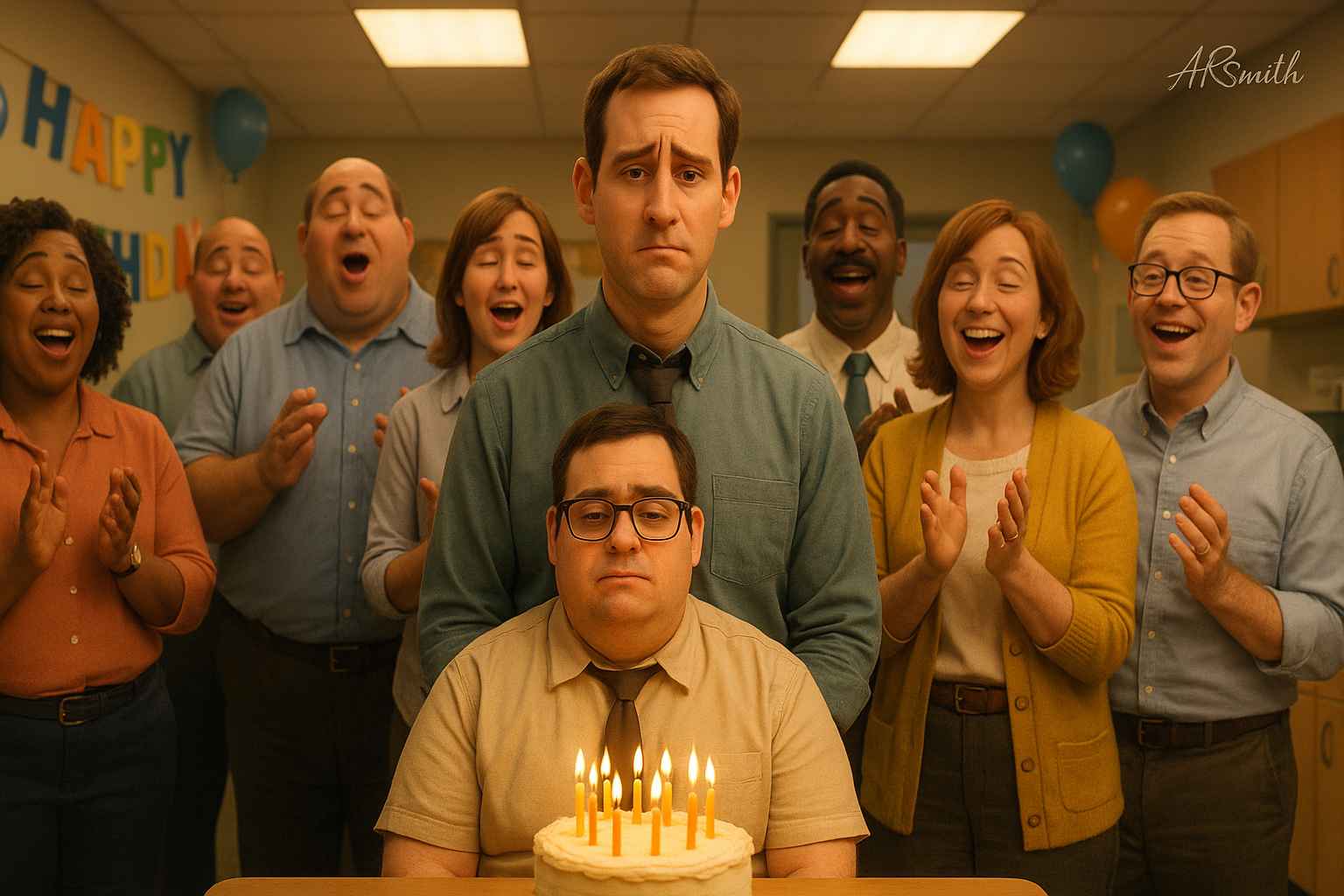
It started, as these things often do, with cake. Monday morning. A fluorescent-lit break room. The smell of coffee that had given up on life hours ago. Someone taped an old spreadsheet to the fridge emblazoned with:
Happy Birthday, Craig!
I barely knew Craig. We’d exchanged maybe three words in two years, and one of them was “printer.” I can’t repeat the other two. Still, when the office manager clapped her hands and said,
“Everyone, gather round!” The gravitational pull of social obligation dragged me from my desk like a reluctant moon.
We circled the table. A cake the size of a spare tire sat in the middle, covered in white and red frosting that screamed “last-minute grocery run.” Someone handed out cheap paper plates and plastic forks that bent like moral principles.
Then came the inevitable.
“Okay, everyone!” said Marcy, our self-appointed morale officer. “Let’s sing happy birthday!”
The first note came out weak—uncertain, like a question no one wanted to ask.
“Happy…”
My voice joined in, low, tentative, the sound of someone pretending to care. Halfway through the second line, I noticed something odd.
No one else looked uncomfortable. They sang freely—joyfully, unbothered, eyes bright with fake enthusiasm. No darting glances, no self-consciousness. Just unearned sincerity. It was happening to everyone.
But not to me.
I looked at Craig, smiling modestly in the glow of his disposable candles, and wondered if he could sense my spiritual collapse. The word “birthday” came out of my mouth like a sigh from another dimension. By “dear Craig,” I was questioning the nature of the human connection.
When the song ended, everyone clapped—loud, rhythmic, confident. I clapped too, late and arrhythmic, like a newborn baby who had just learned what their hands were for.
Craig cut the cake. Everyone cheered. I stood there, holding my flimsy plate, watching frosting spread like guilt.
Back at my desk, I tried to shake it off. But the feeling lingered—like a kind of social residue. The performance of collective cheerfulness, the chorus of forced togetherness. It wasn’t the song. It was the ceremony.
At lunch, I asked my coworker, Jenna,
“Doesn’t it feel weird to sing for someone you barely know?”
She shrugged. “Not really. I think it’s nice.”
I stared at her, stunned by her innocence. Maybe I was broken. Maybe sincerity had been scrubbed out of me by too many corporate icebreakers.
Later, my phone buzzed with a last-minute invite:
Team Celebration – Today at 3:00. Erica’s Birthday!
The compassion was spreading faster than herpes.
But at 3:00, there I was—in the break room again, half-heartedly harmonizing. My voice hovered just below an audible range—a stealth hum. People smiled. Cameras clicked. Someone recorded a video for Instagram. I stood behind the group, my lips artificially moving like a ventriloquist’s dummy, pretending to participate in the joy.
That evening, I met friends at a bar. They laughed easily, loudly, the way normal people do when they’re tipsy. I told them about the singing.
“Oh God,” said Ben. “The office birthday thing? That’s the worst.”
Finally, validation.
“Except,” he added, “I kind of like it. It’s sweet.”
I stared at him. The betrayal was immediate and complete.
At home, I lay in bed thinking about the ritual—the awkward starts, the collective key changes, the resigned clapping at the end. Why did we keep doing it? Out of kindness? Obligation? Fear?
Maybe all three.
The next morning, it happened again. A small crowd gathered near Accounting. Balloons. Laughter. Cheap store bought cake. That familiar rising hum of forced melody.
I didn’t resist. I joined in. My voice cracked on “you.” I smiled politely. It felt… inevitable.
By afternoon, I’d made peace with it. Maybe life was just a series of awkward songs we sing because silence is worse. Maybe pretending to care is its own form of compassion.
As I walked past Craig’s desk, I saw the remnants of a half-eaten pastry, now drying under the hum of the air conditioner. He looked up and nodded.
“Thanks for singing yesterday,” he said.
“Of course,” I replied, meaning it more than I expected.
And for a moment, I almost felt sincere.
Enduring the Dreaded Middle Seat During a Long Flight
While being wedged between a snorer and a smelly armrest thief
The day began with misplaced optimism — the kind that only strikes at dawn, before airports have the chance to ruin it. I arrived early, coffee in hand, smug with the illusion of control. The check-in kiosk even smiled at me, asking, “Would you like to upgrade to a window seat?”
I declined. Foolishly. Confidently. The middle seat couldn’t be that bad, I thought. How much difference could a few inches of personal space really make?
By boarding time, my faith unzipped and emptied like a carry-on at security.
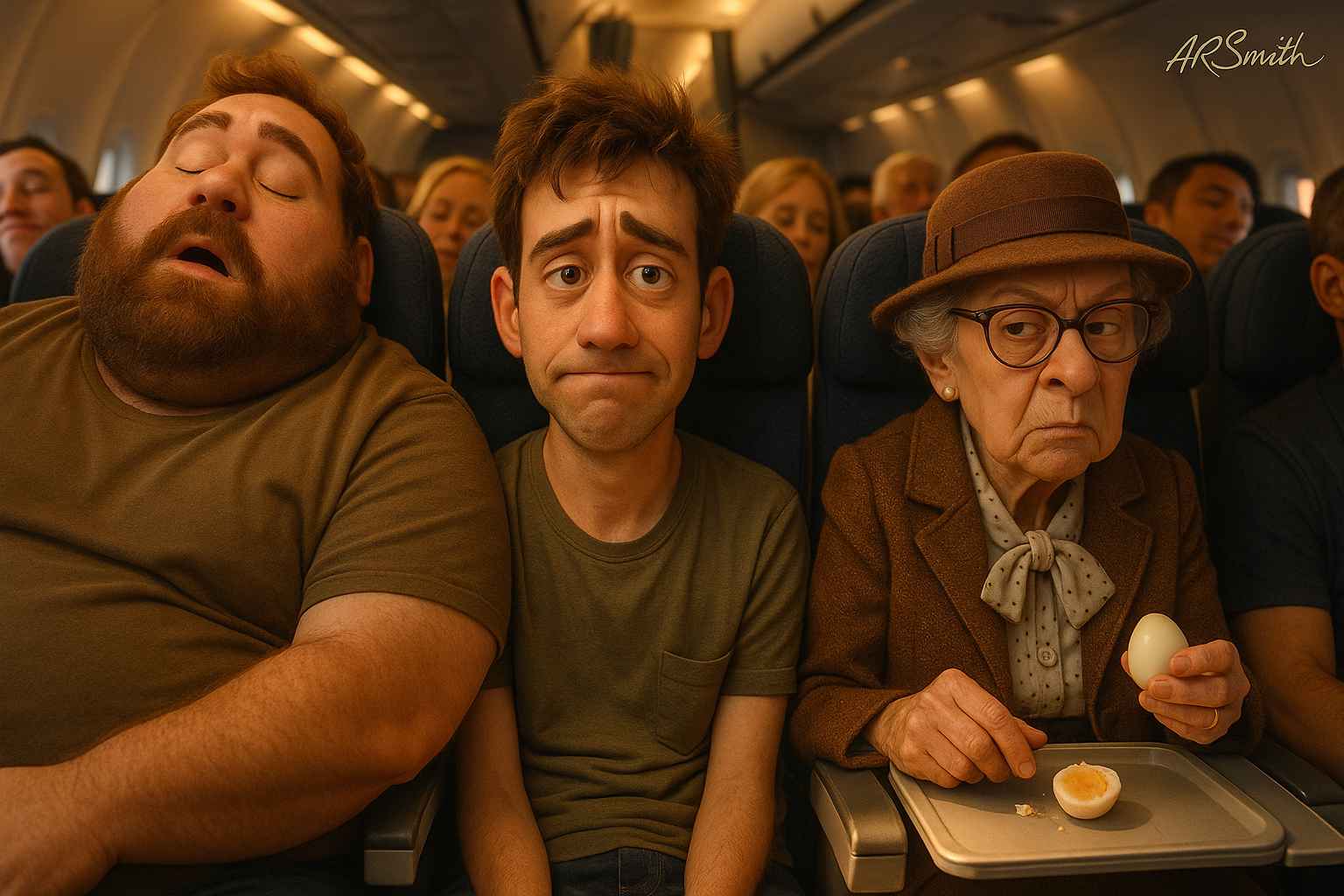
Seat 24 B. Center of a human sandwich. I squeezed in, knees grazing the seat in front like an apology, as the window passenger — a bearded man with the lung capacity of a hibernating bear — fell asleep before takeoff. His snoring started somewhere during the safety demonstration, deep and resonant, like a washing machine full of gravel.
To my left sat a woman who smelled faintly of garlic, despair, and what I can only describe as rotting mothballs. Even before take-off, she took the opportunity to eat what must have been hard-boiled eggs smuggled inside her purse. The smell hit me like an insult.
Her elbow claimed the armrest even before I sat down, and her body heat radiated with the slow persistence of a microwave.
I smiled politely. “Excuse me, I think that’s—”
She didn’t move. She just nodded once, firmly, as if to confirm ownership.
I looked down the aisle — people stretching, reclining, basking in the freedom of breathable air. They looked content. Comfortable. Loved. It wasn’t happening to everyone.
It was just me.
I tried reading my copy of SkyMall magazine. Every headline felt like a mockery. “Transform Your Backyard into a Personal Oasis!” as if taunting me from another world. My knees ached, my dignity condensed, and we hadn’t even lifted off yet.
I pressed the flight attendant call button.
“Could I get some water?” I asked, parched and hopeful.
She nodded, then forgot about me completely.
An hour later, she returned with a Dixie cup’s worth.
I savored it like holy communion.
Once the flight took off, I lost track of time, moisture, and purpose. My spine folded into Origami. My left leg went numb somewhere over Kansas. I considered joining the snorer’s rhythm just to feel part of something.
Across the aisle, a businessman reclined luxuriously, sipping tomato juice and watching a movie on his iPad. His laughter rang out—clear, confident, hydrated.
When the snack cart finally arrived, the egg woman leaned forward to order two packs of almonds and a Bloody Mary. I reached for a ginger ale, but the cart rolled past before I could grab it.
I finally just adjusted to what was going on. Some people are born for comfort. Others are born for seat 24 B.
Four hours in, I began to hallucinate kindness. The snorer stopped briefly, gasping like a man surfacing from an underwater cave. For a moment, I thought he’d died. Then he exhaled and started snoring again, only deeper this time. The egg woman sneezed into her elbow, then reclaimed the armrest with new vigor.
I thought about all the choices that led me here — declining the upgrade, trusting humanity, drinking airport coffee. Each one felt like a small betrayal.
When the plane finally landed, the crowd applauded. I couldn’t join. Applause felt too hopeful, too loud for what I’d endured. I waited as everyone else escaped into the sunlight, then carefully unfolded myself from the seat, my legs tingling from punishment.
Outside, my friends greeted me at the curb—obviously people who had never flown commercially.
“How was your flight?” one asked.
“Transformative,” I muttered quietly.
Later, I tried to tell my girlfriend about it — the snoring, the smell, the territorial elbows, the slow dehydration of the human soul. She listened kindly, patting my hand.
“You always exaggerate,” she said.
I didn’t argue. Some traumas just don’t translate.
That night, lying in bed, I heard phantom snores echoing in my head. I could still feel the pressure of shared armrests, the stale air of economy class pressing down. But beneath it, a strange peace settled.
There was something oddly comforting in having survived it. I knew I’d been pressed, tested, reduced, and yet, still made it to baggage claim.
Maybe the middle seat wasn’t punishment. Maybe it was perspective.
I drifted off imagining a future flight, a window seat on a private jet, fresh air, my arms finally free. I didn’t believe it, but I let myself buy into it anyway.
Oh No! Not Another Group Hug
When one person leans in, everyone else feels compelled to follow
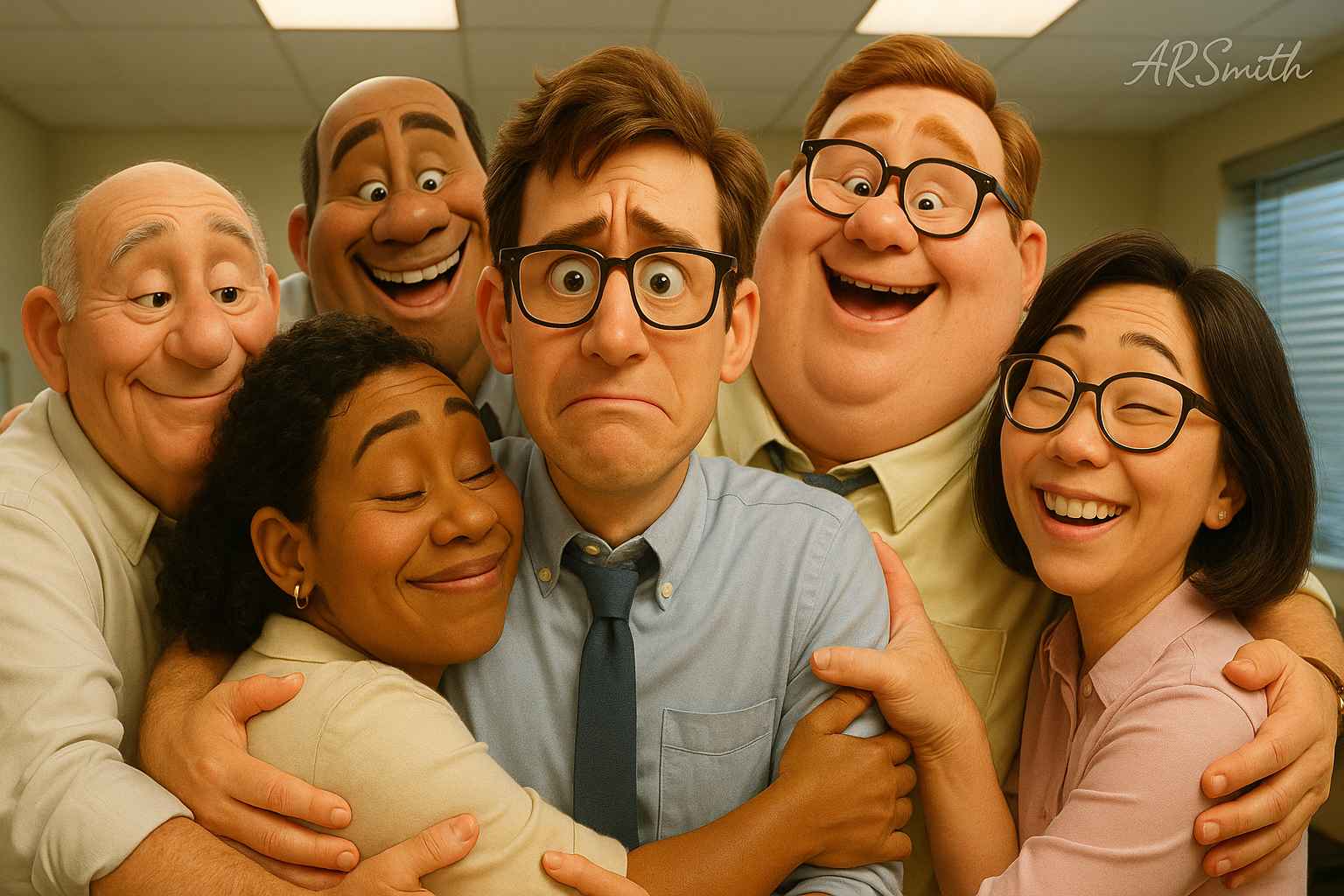
The day began like most others—quietly hopeful, caffeine-fueled, and blissfully un-hugged. The sky was polite, my toast stayed within acceptable levels of brown, and nothing in the air hinted at the disaster of human proximity that awaited me at work.
By 9:03 a.m., the office was already in full swing. I’d barely hung up my jacket before Sharon, the department’s resident morale officer, appeared at my desk with a grin too wide to trust.
“Big day!” she chirped. “Team synergy exercise!”
Her words struck fear into my soul.
At 9:15, we were all herded into the conference room, a space designed for ten but hosting twenty, with the air quality of a damp sock. There was a whiteboard that said,
“Together, everyone achieves more!” in dry-erase optimism. Sharon clapped her hands.
“Okay, everyone! Let’s start with something simple—group hug!”
I laughed, assuming she was joking. She wasn’t.
The first person leaned in—then another, and another. Suddenly, I was totally engulfed. Limbs everywhere. Someone’s chin rested on my shoulder. I could smell three distinct types of cheap aftershave, all doing battle with one another, underlying a note of pure panic. The air grew humid with warmth and regret.
It wasn’t happening to everyone, though. That was the strange part. While I flailed in the human pile, others stood on the outskirts—calm, composed, even amused. No one else was being swallowed by humanity.
It was just me.
“Breathe through it,” whispered Sharon, as if she were coaching us through a live childbirth.
I tried to, but the oxygen was scarce. Someone’s ponytail lodged against my lip. A coworker’s laugh vibrated through my rib cage. My hands hovered awkwardly, unsure of the proper hug protocol when you’re surrounded on all sides by torsos and the Corporate Code of Conduct.
And then came the worst part—the release. Not everyone disengaged at the same time. Some peeled away immediately. Others lingered.
One person patted my back like a malfunctioning drum machine.
When it was over, I stood there, limp, smelling faintly of Axe body spray and existential dread. Everyone else looked refreshed, and rejuvenated, like they’d just watched a TED Talk on YouTube.
“Didn’t that feel good?” Sharon beamed.
I nodded. “Like exfoliating my soul with a Home Depot belt sander.”
Throughout the day, the sensation lingered. My personal space felt haunted. Passing someone in the hallway triggered flashbacks—the brush of a sleeve, the phantom warmth of an armpit.
At lunch, my friend Trevor plopped down beside me.
“You okay, man? You look… compressed.”
“I’m fine,” I said. “Just… over-saturated with human contact.”
He laughed. “You’re sooo dramatic.”
After work, I picked up my girlfriend, Emma, for dinner. When she leaned in for a hello hug, I recoiled like a spooked cat.
“Whoa,” she said. “You okay?”
“Yeah,” I lied. “Just a little… over-hugged.”
During dinner, I tried to explain, but it sounded ridiculous.
“It’s like… every time someone suggests closeness, I become diamagnetic. Physically. Emotionally. Moistly.”
She blinked. “That’s not a thing.”
“Oh, it’s a thing, baby. It’s a thing!”
Later that night, she tried to reassure me with another hug. I froze like a deer in the headlights. Then, like a curse, her roommate appeared. Then, her roommate’s boyfriend. Before I knew it, six people had somehow drifted toward me in concentric circles of empathy.
There I was, buried again—breathing in deodorant, fabric softener, and fear.
When it ended, I stepped outside into the cold night air, alone, but still feeling the echo of it. My body retained the warmth like trauma.
The next day, I decided to embrace my fate—no pun intended. If I were destined to be a human hug magnet, I might as well control it. I began initiating group hugs everywhere, all the time—at the start of every meeting, in the middle of conversations, and outdoor hot tubs during parties. People started calling me “The Hugging Guy.”
By the time our company held its quarterly retreat, I was a pro. I led the morning icebreaker with a deep breath and said,
“Okay, everyone, bring it in.”
Dozens of arms wrapped around each other. I inhaled the familiar cocktail of fabric softener, body odor, and misplaced emotions. For the first time, it didn’t feel suffocating. It felt… inevitable.
Maybe that’s the lesson here. You can resist connecting all you want, but life will find a way to wrap itself around you—tight, sweaty, and smelling faintly of Old Spice.
He Had a Glob of Spinach Lodged in His Front Teeth
But it’s past the Statute of Limitations to say anything now
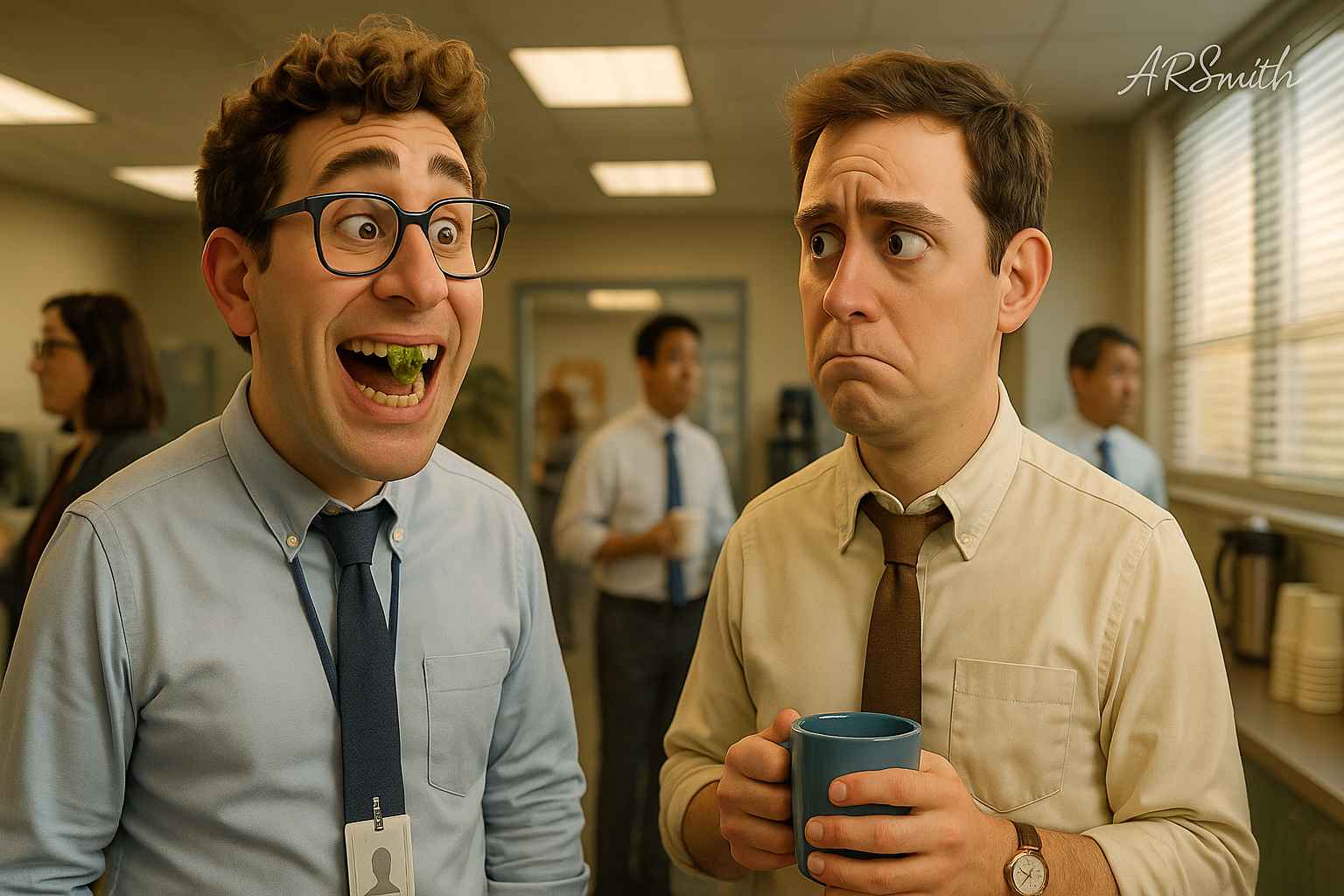
It started at 8:47 a.m., just before the staff meeting, when I realized I’d entered a moral hostage crisis.
I was standing in front of Brian from HR, a man who prided himself on eye contact, posture, and pronouncing “synergy” like he invented the term. He was explaining the new benefits package to me with all the enthusiasm of a televangelist, when I noticed it — a dark green triangle lodged defiantly between his upper left incisor and canine.
Spinach.
Big. Cooked. Triumphant.
It pulsed when he talked, vibrating slightly with every syllable like a flag in a moral storm.
I froze.
At first, I assumed someone else would have already said something. Surely this wasn’t my burden alone. But one by one, people filed into the meeting, and no one mentioned it. They just smiled politely, nodding along as he spoke about dental coverage, apparently unbothered by the irony. It wasn’t happening to everyone.
It was just me.
No one else seemed to notice it. I checked their faces for signs of discomfort, for the flicker of recognition that comes with shared horror. Nothing. They were all serene. Zen monks of indifference.
I tried to focus on what he was saying.
“Team cohesion,” “positive engagement,” “streamlining accountability.”
But my brain refused to translate anything that wasn’t associated with cooked spinach.
He smiled widely. The spinach lodged deeper.
I considered three options:
- Interrupt him, “Hey Brian, you’ve got a little something…”
- Casually run my tongue over my own teeth and hope he’d follow suit.
- Wait it out, praying for divine floss intervention.
But every second that passed made the first option more inaccessible. The statute of limitations on spinach disclosure had already expired. Bringing it up now would make me a villain — the guy who waited until it became embarrassing.
After ten minutes, I was sweating bullets. My own mouth felt dirty by association. I could even taste phantom spinach.
“Are you okay?” whispered Tina beside me.
“Yes,” I said. “Just… morally compromised.”
At lunch, I couldn’t eat. Every bite of my spinach salad felt like betrayal. I ordered soup and stirred it without purpose, wondering if I’d entered some kind of social punishment loop. When I looked around, people ate freely, oblivious, spinachless.
That evening, I met my girlfriend, Lauren, for dinner. Halfway through, I realized she had something too — not spinach this time, but a tiny fleck of pepper stuck on her front tooth.
I froze again. The curse had followed me!
“Everything okay?” she asked, smiling that pepper-flecked smile.
I hesitated. Too late to mention it now. “Perfect,” I said.
She kept talking, and I kept nodding, eyes locked in a hostage negotiation between love and politeness. I could hear my internal voice narrating:
If you truly cared for her, you’d tell her. But if you tell her now, she’ll know you waited. You’ll become the spinach guy. Forever.
By dessert, I was dizzy with repression.
Later that night, lying awake, I thought about all the times I’d stayed silent in life—tiny courtesies that grew into moral tumors. Maybe this was about more than just spinach. Maybe it was about my inability to confront anything unpleasant. Maybe politeness was the real curse.
The next morning, Brian appeared again in the break room. Clean teeth. Radiant. Redeemed.
“Hey,” he said cheerfully, “great meeting yesterday.”
I nodded. “Yeah,” I said softly. “It was… something.”
He smiled. I smiled. For a fleeting moment, I felt free.
Then, as he poured his coffee, I saw it — a crumb of blueberry muffin clinging to his lower lip.
Then I realized, some battles aren’t meant to be fought. They’re meant to be silently endured, like bad cologne or corporate emails marked “urgent.”
Maybe dignity isn’t in trying to fix people. Maybe it’s in surviving them — one crumb, one leaf, one awkward pause at a time.
I Wrestled with an Uncooperative Zipper
And suddenly realized that I’d been flying free all day
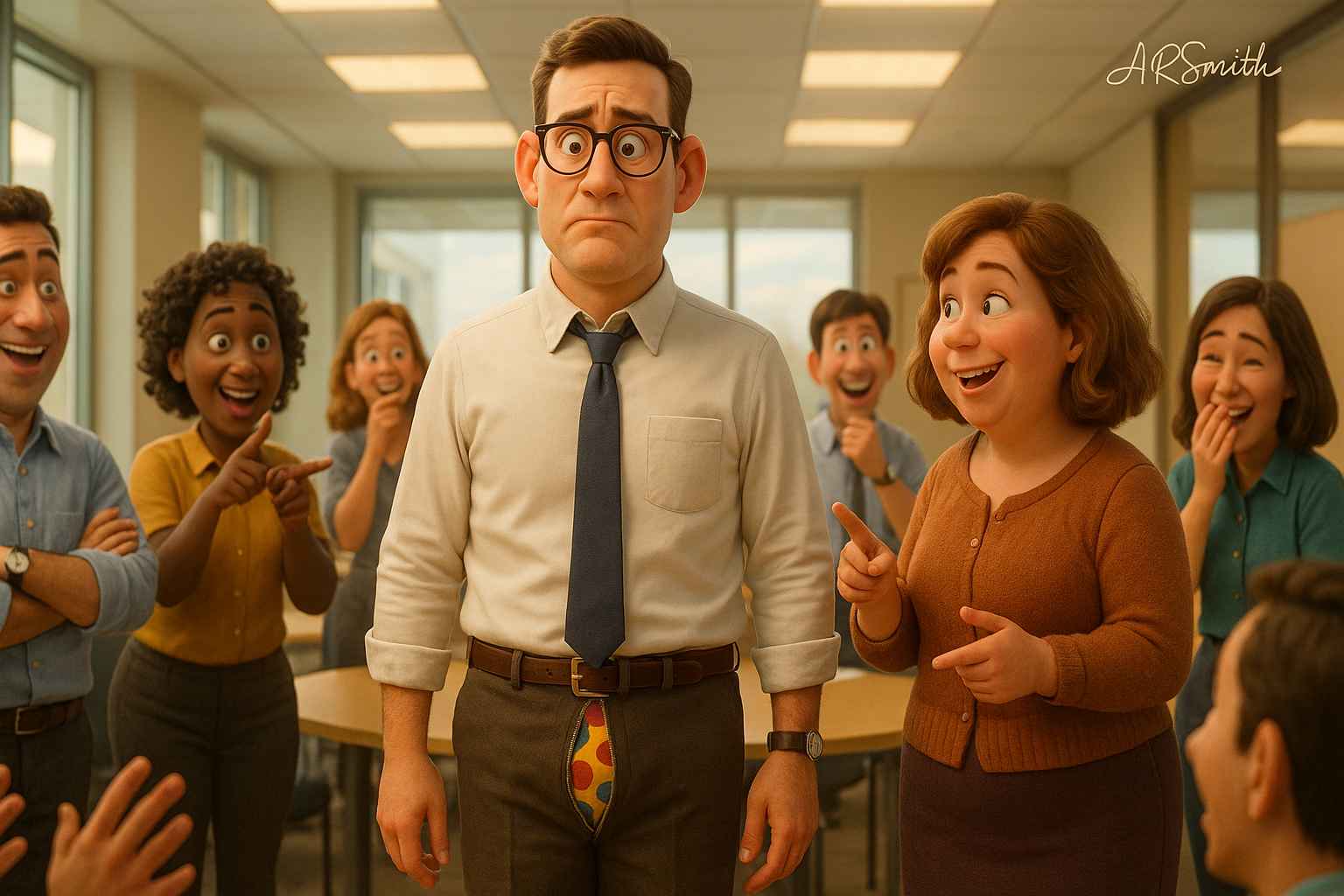
The morning started clean enough—coffee, toast, optimism. The kind of day that felt quietly neutral, like the world was willing to meet me halfway if I didn’t ask too much of it.
I got dressed mechanically: shirt tucked, slacks pressed, confidence borrowed. The zipper resisted slightly when I pulled it up, but I chalked it up to a cheap metal tooth, a hiccup in my daily uniform. It rose halfway, then stuck, like a nervous elevator between floors. I tugged harder. It moved—but not far enough.
That’s fine, I thought. It’s fine. I’ll fix it at work.
It wasn’t fine.
By 9:15 a.m., halfway through my first meeting, I noticed a draft. Not an obvious one—just enough to remind me that I was one poorly timed stretch away from scandal. I looked down. The zipper had given up entirely, hanging open like a sinner’s confession.
I crossed my legs. Adjusted my shirt. Pretended to look thoughtful.
“Allen, what do you think about the proposal?” someone asked.
“I… think it’s open to interpretation,” I said, too quickly.
People nodded, misreading my terror for insight. The zipper gleamed in silent rebellion.
At first, I thought it was just bad luck. But then I noticed something strange. No one else had this problem. The room was full of functioning zippers—secure, obedient, smug. Everyone’s pants were perfectly sealed fortresses of modesty. It wasn’t happening to them.
Just me.
After the meeting, I ducked into the restroom to wage war. I tugged, coaxed, whispered promises to the zipper like a hostage negotiator. It moved an inch, then stuck again. I tried from below—no luck. The pull tab came off in my hand.
I stared at it, dangling between my fingers like a torn ripcord on a parachute.
For the rest of the morning, I walked like a man guarding state secrets. Slow, careful, hands casually pocketed to disguise the structural failure happening below. Conversations became minefields. Every laugh, every lean forward, risked exposure.
At lunch, I ran into my boss in the hallway. She smiled.
“How’s your day going?”
“Breezy,” I said before I could stop myself.
She laughed politely, unaware of how accurate that really was.
After work, I met my friends for drinks. I thought maybe the zipper would have mercy by then, but no. It remained stubbornly ajar, like a metaphor for all my unresolved issues. I sat at the bar, trying to look casual, but every time I adjusted my jacket, it looked like I was re-enacting a crime scene. My friend Jamie leaned over.
“You’re fidgety. Everything okay?”
“Wardrobe malfunction,” I said quietly.
She grinned. “You mean like a button?”
“No,” I said. “Lower.”
She blinked, then took a sip of her drink.
“You’re kidding.”
“I wish.”
Her laugh came out too loud. Heads turned. I felt heat crawling up my neck. Someone slapped me on the back.
“We’ve all been there, buddy!” said a stranger, which somehow made it worse.
By the time I picked up my girlfriend for dinner, I’d developed an entire choreography of concealment—strategic briefcase placement, angled stance, coat strategically draped like a curtain. She greeted me with a hug and stepped back.
“Something wrong?” she asked.
“Nothing,” I said. “Just… airflow.”
Halfway through dinner, I excused myself and went to the restroom again. I stood there, staring down at the small silver teeth mocking me. I thought about all the mornings I’d taken closure for granted. How easy it had been to believe the world would keep me covered.
Back at the table, she looked at me, smiling.
“You’re acting weird.”
“Do you ever feel,” I said, “like your life just… opened up unexpectedly?”
She frowned. “Are you okay?”
“I’m learning to be.”
Later that night, when I got home, I finally surrendered. I hung the pants over a chair and tried to zip them one last time. They stayed open, defiant to the end.
Standing there in my boxers, I felt oddly peaceful. Sometimes, life exposes you. Sometimes, you fix it. And sometimes, you just accept that a zipper’s got other plans.
I Forgot What I Was Supposed to Say at My Best Friend’s Wedding
Zoning out mid-sentence, and muttering something about “eternal stuff”
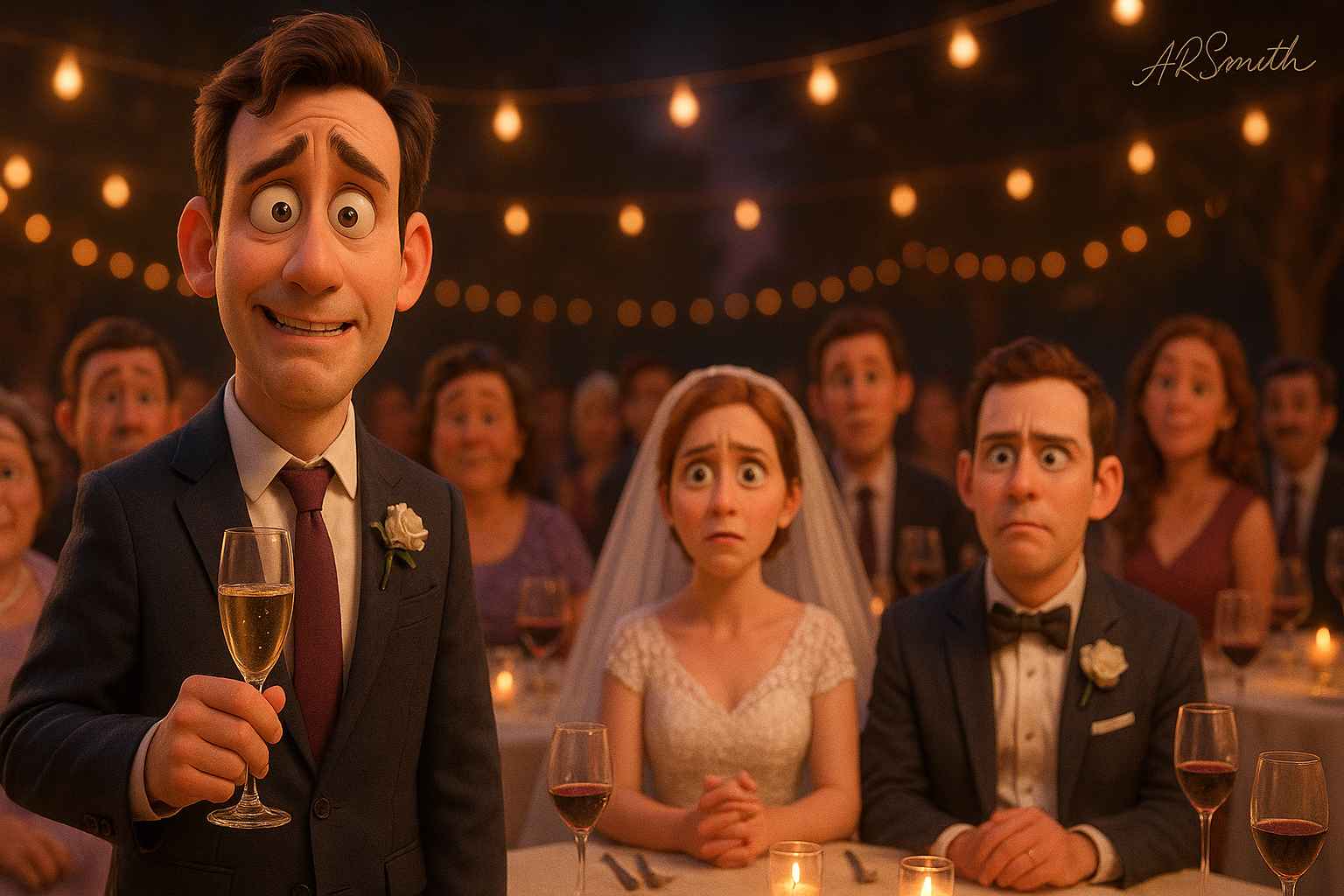
It started innocently enough. A morning like any other, except I’d been asked to perform emotional labor in front of two hundred people. My best friend, Danny, was getting married, and I’d been honored with delivering the best man’s toast.
I practiced all week: pacing the kitchen, whispering to my coffee mug, even reciting to my cat, who blinked slowly, unimpressed by both love and comedy. I had rhythm, timing, and one good joke about Danny’s haircut in 2003. I was ready.
By noon, I was in my tux, hair gelled, sweating slightly under the collar. I looked in the mirror and gave myself a pep talk. “You’re calm. You’re funny. You’re… probably fine.”
At the church, everything felt cinematic. Soft light through stained glass, guests glowing in pastel optimism. People hugged, posed, and catching up on old times. I envied their confidence.
But something shifted during the ceremony. A strange fog crept over my head — not nerves exactly, but something heavier. Words that had been crisp all week suddenly evaporated. Poof! I tried to shake it off. Surely it was nothing.
At the reception, the champagne loosened up everyone but me. Danny and his new wife floated through the room like royalty. I sat at the head table, heart thumping like a drum roll that refused to stop.
Then I heard it:
“And now, the best man will say a few words.”
Applause. Expectant faces. My cue.
I stood, glass in hand, smile pre-installed. The first line came out perfectly. Then the second. People laughed in all the right places. I felt the rush: that fleeting illusion of mastery.
And then it happened.
Mid-sentence, somewhere between “love is patient” and “Danny has always been the kind of guy who…” my brain shut down like a computer losing Wi-Fi. Blank. Absolute white-out.
I smiled. They smiled back, waiting.
“Love is…” I started again. My voice cracked.
“Love is… you know… eternal stuff.”
A ripple of nervous laughter.
“Yes,” I added, nodding wisely,
“the… kind that lasts forever, and, uh… multiplies.”
Danny’s mother tilted her head. His new bride looked at me with the polite horror reserved for minor car crashes and public meltdowns.
I took a sip of champagne — a bad idea. It magnified the silence. Someone coughed.
“I think what I’m trying to say,” I continued bravely, “is that love… well… it’s like a… refrigerator. It… hums softly, and… keeps things fresh.”
Gasps, laughter, confusion — the holy trinity of social death.
I finished quickly and raised my glass.
“To love, eternal stuff, and refrigeration.”
Applause. Pity applause.
I sat down, my cheeks burning. The DJ saved me by starting the music early. Danny patted my shoulder, laughing.
“Classic you,” he said, which somehow made it worse.
I don’t know what happened. Sure, I’ve heard about flubbed speeches before.
But this was me.
Then something strange happened. As the night went on, people approached me — not with mockery, but affection.
“That was the most honest toast I’ve ever heard,” said one guest.
“You really captured the… chaos of love,” said another.
“You’re brave,” said an elderly aunt, holding my arm like a war widow.
By the end of the evening, my humiliation had transformed into legend. I hadn’t delivered the perfect toast. I’d delivered something real, painful, and absurdly human.
Later, back home, I poured myself a stiff drink. The words I’d meant to say came rushing back — eloquent, heartfelt, but too late. I dunno. Maybe they didn’t matter anymore.
Love isn’t about perfect speeches or practiced metaphors. It’s about showing up, forgetting your lines, and being forgiven anyway.
I smiled, lifted my glass to the empty room, and whispered,
“To eternal stuff.”
My Middle School Class Demonstration
The teacher picked me to demonstrate the proper way to put on a condom
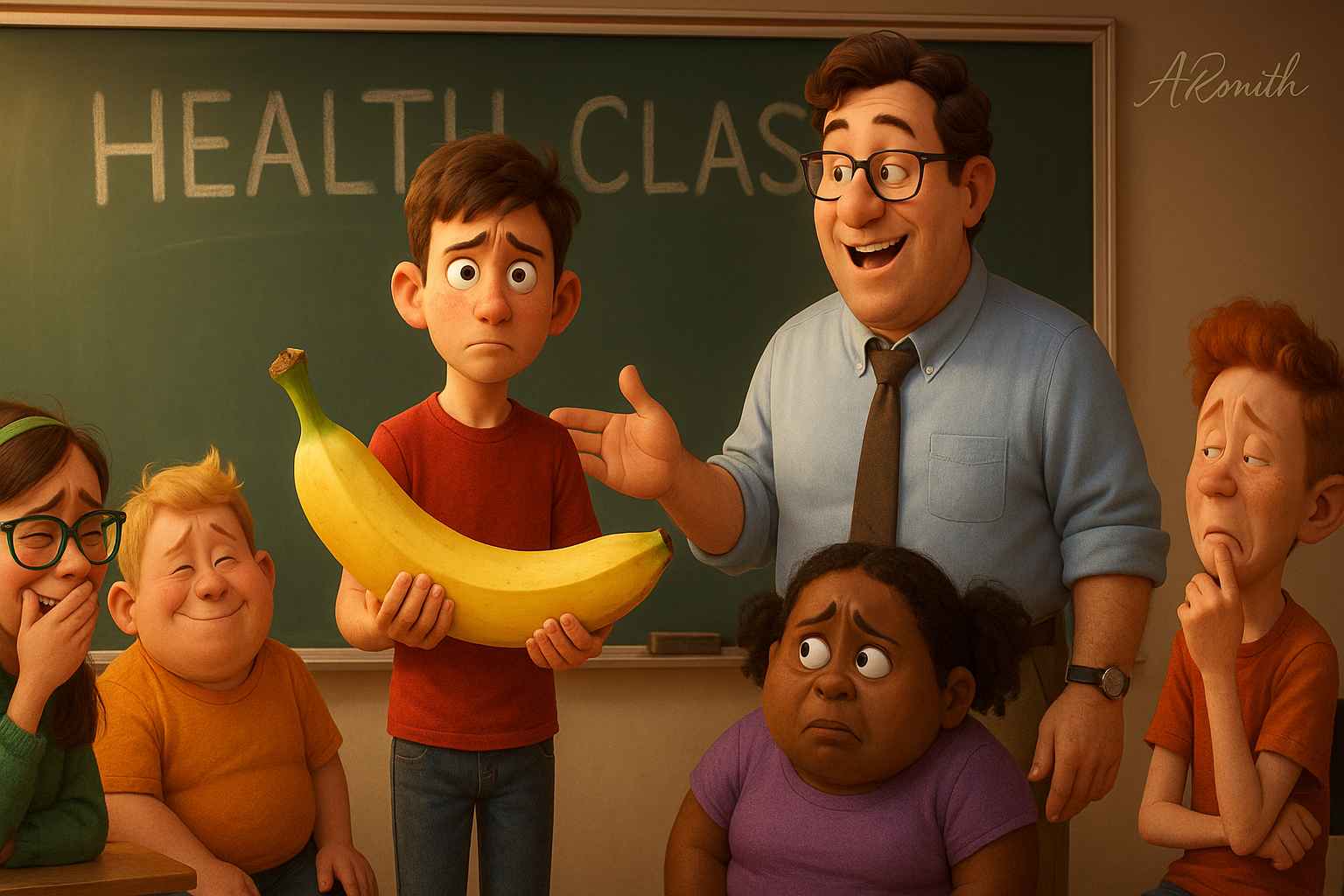
When I woke up that morning, I had no idea I’d become the face of contraceptive education at Magnolia Middle School. I brushed my teeth, ate my Cheerios, and tied my sneakers, blissfully unaware that by second period I’d be holding a banana the size of a Louisville Slugger while thirty of my peers analyzed my technique.
In Health Class, Mr. Dobson was already setting up his props like a magician before a trick: a humongous industrial hose, a flip chart labeled “Responsible Choices,” and a bright yellow banana that looked like it had been genetically engineered just to shame adolescents learning about contraception. He scanned the room with his usual predator calm.
“I need a volunteer,” he said. His eyes landed on me before I could fake a nosebleed.
“Allen,” he smiled. “You seem confident.”
I wasn’t. But confidence, it turns out, can be assigned without consent.
The class watched as he handed me a banana roughly the length of my forearm.
“This morning,” he said, “we’re going to demonstrate how to correctly apply a condom.” The word “demonstrate” did a lot of heavy lifting there, like we were about to send the banana to college.
I froze. My mind tried to rationalize it. Maybe everyone has this happen to them. Maybe he’s picking students alphabetically? But as I looked around, no one else was being called. Nobody else was holding a banana.
It was only me.
The air in the room grew thick with anticipation and sweat. Somewhere in the back, Tyler Mayfield whispered, “That’s one lucky banana.” The laughter spread like a virus.
I peeled open a foil packet with the delicacy of a bomb technician. The latex gleamed under the fluorescent lights like a transparent halo. Mr. Dobson nodded.
“Now pinch the tip. We don’t want any air pockets.”
My hand trembled as twenty middle-schoolers leaned forward, captivated by my fumbling mortality. I pinched. I rolled. The rubber squeaked in protest. For a moment, I thought I’d done it — until the condom snapped and flew across the room onto Sarah’s shoulder.
The class erupted. Everyone clapped. Someone yelled, “He killed it!” Mr. Dobson maintained his professional composure, but I could tell he was fighting a smirk.
“That’s why we practice,” he said, reclaiming the banana, the used condom, and my dignity in one swift motion.
After class, I walked through the hall feeling radioactive. No one else carried the invisible sting of demonstration-day humiliation. My best friend, Joey, grinned as he passed me.
“You gonna list that on your résumé?”
At lunch, I tried to act normal, but the cafeteria felt like a football stadium. I could sense people whispering over the smell of tater tots. Later, at basketball practice, Coach handed me a water bottle and said,
“Nice form, son,” then winked. I wasn’t sure if he’d heard or not. No matter. I was already permanently scarred.
By the time I picked up my girlfriend, Jenny, for the Friday night movie, I’d half convinced myself it was over. But as we sat in the dark, the pre-show trivia flashed on the screen:
True or False: Condoms are 98% effective when used correctly.
Jenny snorted. I died quietly in my seat.
Afterward, at the diner, she tried to be kind.
“It’s good you did it,” she said, sipping her milkshake. “Shows responsibility.”
“Yeah,” I muttered. “Next week, maybe I’ll volunteer for a hemorrhoid examination.”
Later that night, lying in bed, I replayed the moment in my head — the laughter, the snap, the projectile. It felt both catastrophic and absurd. I wondered if, decades from now, anyone would remember it. Probably not. But I would.
By Monday, and thanks to social media, the story had already devolved into an active lava flow. In some versions, I’d put the condom on backward. In others, the banana exploded. Rumor moves faster than latex.
Still, something shifted. People started nodding at me in the hallway. A kind of reluctant respect. Maybe I’d accidentally performed a public service—a small, mortifying act of communal education—but still, a public service.
That afternoon, I walked past Mr. Dobson’s class and saw another batch of kids hunched over their desks. On his desk sat a similar banana, but smaller this time, more innocent. For a second, I almost felt proud — like a Marine veteran watching the next batch of recruits march into the skirmish of adulthood.
I realized then, humiliation—like education—is a public utility. You just have to hope that someone learns something from it before you’re excommunicated from middle school.

