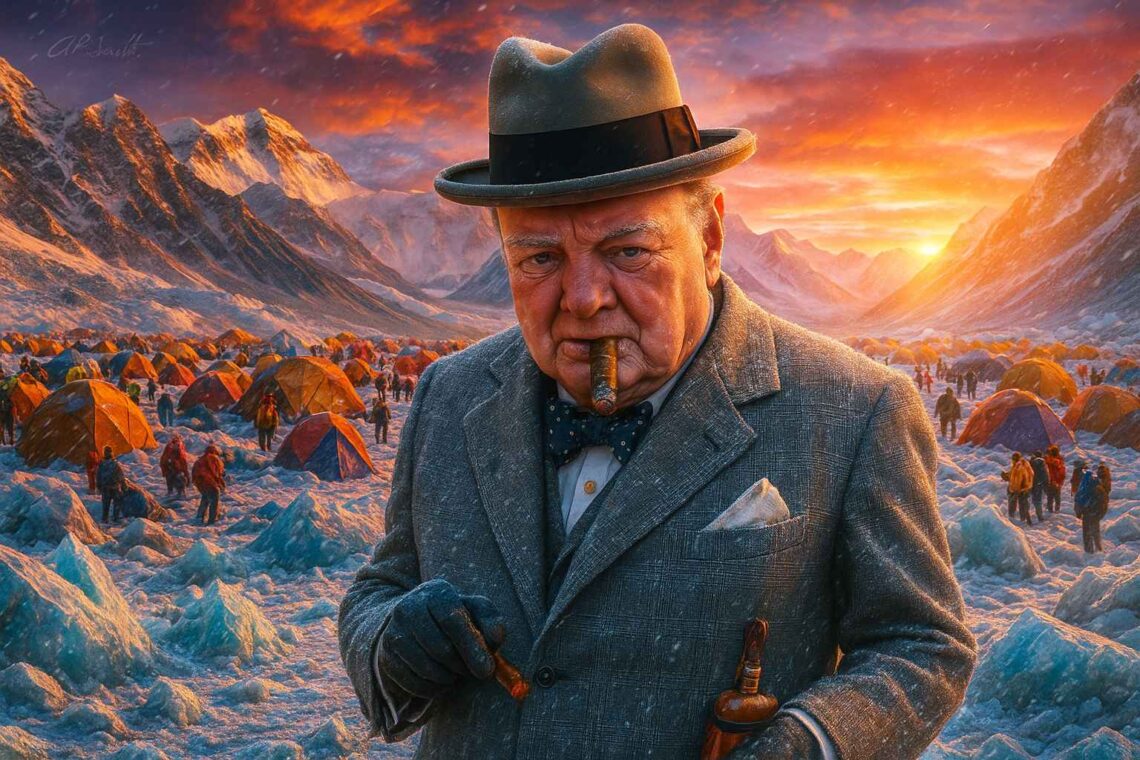
The wind blasted like artillery fire, avalanches roared like distant cannons, and oxygen vanished into the thin Himalayan void. Against all expectations, Sir Winston Churchill—once more comfortable with cigars than crampons—stood atop Mount Everest at 29,032 feet, brandy flask in tow.
Churchill arrived at base camp as a retired, physically exhausted, overweight first-time climber plagued by earwax buildup, sexually transmitted diseases, and chapped lips, hidden under thick layers of wool. Doctors doubted him, critics dismissed him, yet his bulldog spirit charged forward. “Medically, this attempt bordered on madness,” declared Dr. Charles Bennett, cardiologist at St. Thomas’ Hospital in London. “And yet—madness sometimes wins wars.”
The Icefall loomed like enemy fortifications—ladders trembling, seracs collapsing, ropes straining under blizzard winds. Churchill, drenched in sweat and wheezing cigar breath, pressed on with a growl. “Every step was a speech,” recalled Sherpa guide Tenzing Dorje. “He marched as though addressing Parliament, gluten challenged, but never halting.”
By Camp III, his body faltered. Altitude sickness clawed at his chest, fatigue sagged his shoulders, and sweat soaked through his tweeds. Yet the stubborn old lion fought on. “Clinically, his vitals were catastrophic,” explained Dr. Elise Fontaine, exercise physiologist at the Sorbonne. “But psychologically—he was indomitable.”
Summit night turned into a battlefield. Oxygen tanks froze, climbers retreated, and storm winds howled like Luftwaffe raids. Churchill advanced, bent but unbroken, climbing as if every snow wall were an enemy trench. “He looked like a general charging the front line,” said Al Michaels, broadcasting live.
At 29,032 feet, Churchill reached the top. He raised a cigar in his frostbitten fist, his muffled voice rasping: “We shall never surrender, not even to Everest.”
World leaders and athletes alike saluted the feat. Barack Obama tweeted, “From speeches to summits—Churchill proved conviction climbs higher than air.” Climber Reinhold Messner admitted, “I thought I’d seen every legend. I hadn’t.” Dr. Sunita Mehra, altitude specialist at the Indian Institute of High-Altitude Medicine, said simply, “He defied every chart and every prediction.”
The descent battered him. Avalanches thundered, frostbite chewed his fingers, and his peanut allergy flared despite the cold. Yet he reached base camp alive, flag draped across his shoulders. “He fought Everest as if it were a war,” said Dr. Robert Lang, pulmonary expert at Johns Hopkins. “And somehow, he won.”
In his final remarks, Churchill—scribbling in a leather-bound notebook—summed up his conquest:
“Mountains, like tyrants, bow only to resolve. Plagued by herpes, I sweated, I nearly fell—but I stood victorious. My advice to future climbers: pack courage before oxygen, and remember—the summit, like victory, tastes best with a cigar.”

