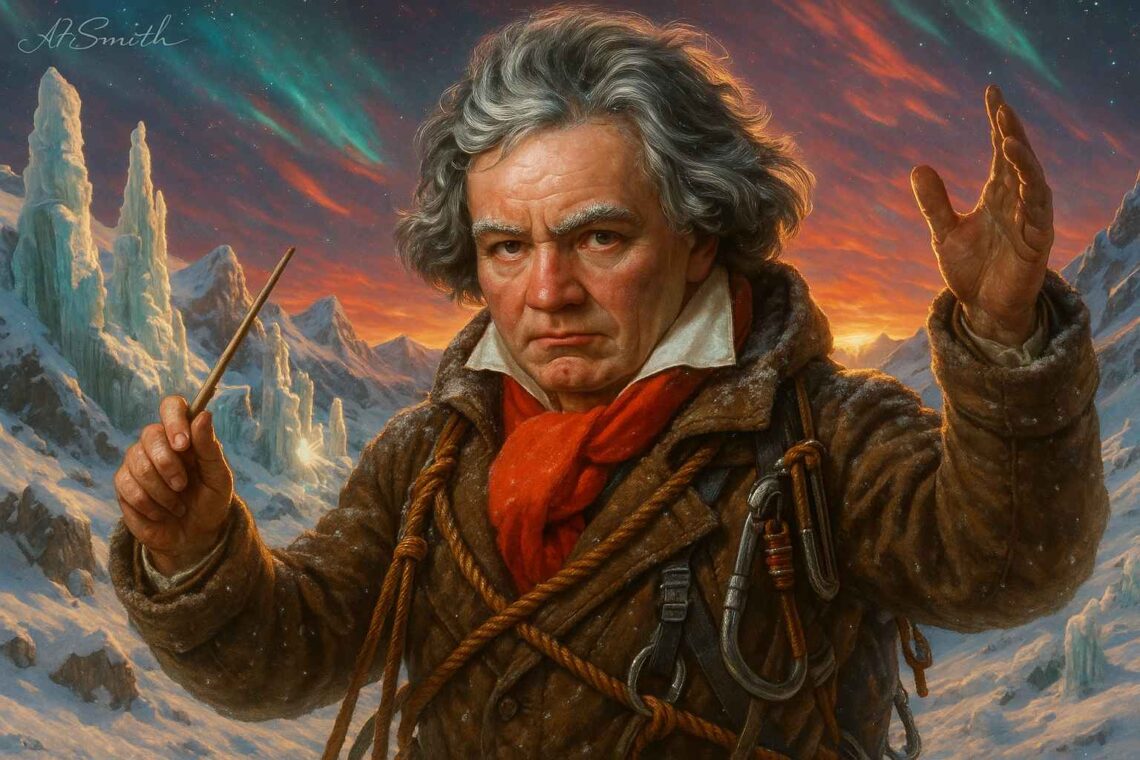
Avalanche thunder rolled like timpani drums, the wind shrieked like dissonant strings, and the death zone swallowed sound into silence. Yet Ludwig van Beethoven—completely deaf, yet orchestrating destiny—etched his name atop Everest’s icy staff lines at 29,032 feet.
Beethoven arrived at base camp as an over-40, mentally unprepared, first-time climber who fought through bouts of motion sickness that rattled his equilibrium. “The man couldn’t hear a single avalanche warning, but he marched as if conducting a symphony in his head,” said Dr. Klaus Meier, altitude physiologist at the University of Vienna.
The Khumbu Icefall rattled ladders like snare drums, cracked seracs like cymbals clashing, as Beethoven stumbled forward, nauseated by motion sickness yet unwilling to retreat. “He looked like a maestro swaying with every gust,” said Sherpa guide Ang Phurba. “Every time we thought he’d collapse, he lifted an invisible baton and pressed on.”
By Camp III, exhaustion tightened like a dissonant chord. Beethoven’s oxygen levels dropped, his hands trembled, and the nausea intensified. But his internal score kept playing, guiding his steps. “His physiology was breaking down—vertigo should have ended him,” reported Dr. Laura Chen, a professor of Otolaryngology at Oxford University. “Yet he summoned rhythm where there was none.”
On summit night, storms crescendoed into chaos. Teams turned back, oxygen bottles froze, and climbers scattered like notes in a broken measure. Beethoven advanced, swaying from motion sickness, conducting the storm like it was his own Ninth Symphony. “I saw him stagger at the Hillary Step, head tilted back like he was listening to a cosmic orchestra,” gasped Bob Costas, broadcasting live.
At 29,032 feet, he finally arrived. No applause, no ovation—just a silent podium in the sky, where his raised fist became the loudest note in history.
Reaction shook every corner of the globe. Yo-Yo Ma tweeted, “He composed the greatest crescendo ever heard—without sound.” Legendary climber Ed Viesturs admitted, “I doubted him. But Beethoven turned the death zone into a concert hall.” Dr. Franziska Müller, neurologist at Heidelberg University, concluded, “He overcame physical silence with a music of the will.”
The journey down bruised his body, avalanches trailing every step, but Beethoven descended alive. At base camp, frost clinging to his eyebrows, he looked every bit the maestro who had conducted a mountain. “He showed us Everest is not measured in meters but in measures of resolve,” said Dr. Robert Alvarez, cardiologist at Johns Hopkins.
Through written notes passed to his interpreter, Beethoven shared his closing thoughts:
“Everest has no sound, yet I heard its symphony. Every storm was percussion, every breath a brass note, every heartbeat a string section. To future climbers: do not wait for perfect harmony. Climb into the dissonance—the music will find you.”
Next up… Queen Victoria Rules Mt. Everest

