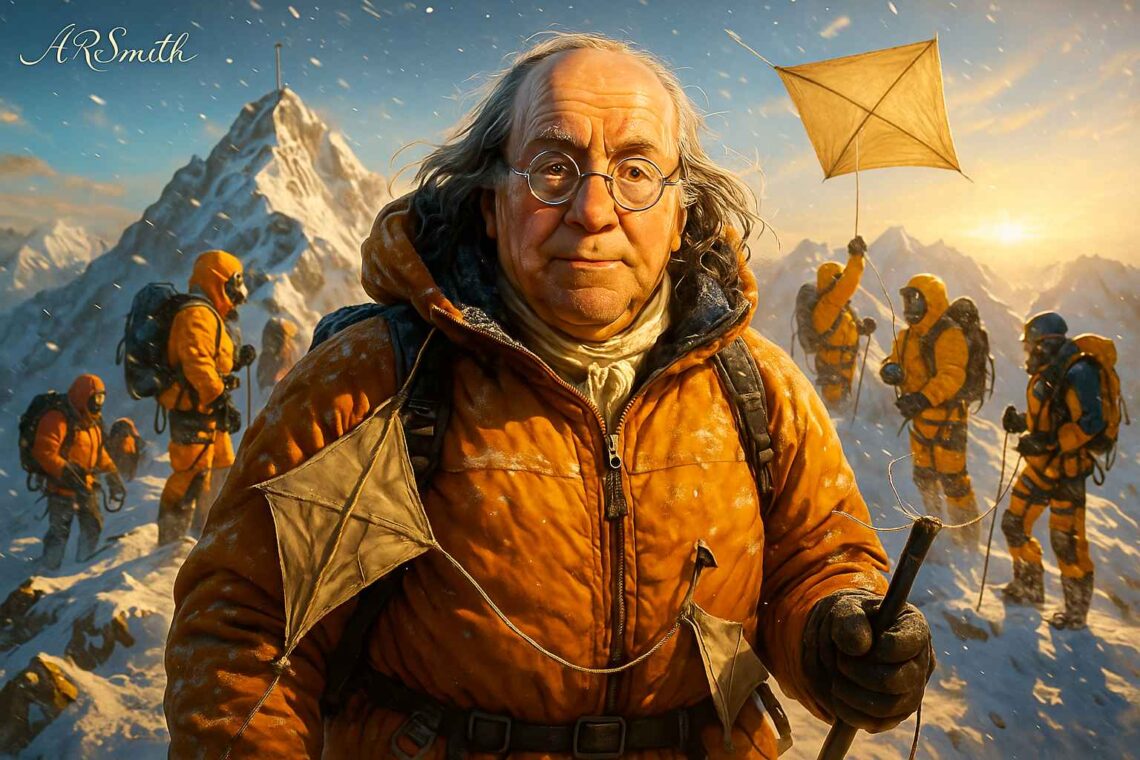
The Himalayas howled with winds topping 80 mph, avalanches thundered in the distance, and yet Benjamin Franklin—at over 70, habitually disorganized, vision corrected, and prone to shaky knees—marched into Everest’s death zone like he was chasing another thunderbolt across the sky. He didn’t just carry crampons. He lugged bifocals, a kite, and a restless wit, determined to inscribe his name onto the mountain’s icy manuscript.
Base Camp became a laboratory of disbelief. Franklin spent hours tinkering with ropes and pulleys, sketching gear improvements by candlelight, and flirting with widowed trekkers around the mess tent. “He had no business being here,” said Dr. Helena Markovic, exercise physiologist at Columbia University. “Shaky knees, failing eyesight, habitually unprepared—yet he radiated the confidence of a man convinced the mountain was just another invention to perfect.” Sherpa guides complained that he once tried attaching a key to his ice axe “for conductivity.”
The Khumbu Icefall nearly ended the experiment. Franklin’s disorganization left him misplacing his crampons twice, forcing teammates to retrace steps under falling seracs. His corrected vision fogged at altitude, making ladder crossings a blur of dizzying steel. When a rope bridge swayed, his knees knocked so hard that climbers thought he was setting off a seismic tremor. “I thought he’d tumble to his death,” gasped mountaineer Ueli Steck. “Instead, he quoted Poor Richard’s Almanack and kept right on climbing.”
As the summit push began, Franklin looked battered but electric. Oxygen deprivation cracked his voice into raspy aphorisms. Shaky knees buckled, yet his hands reached skyward as if summoning another storm. A lightning flash struck near the ridge, and climbers swore his kite string quivered in response. “It was absurd—he seemed to thrive on the chaos,” said Dr. Miguel Alvarez, altitude medicine specialist from the University of Madrid. “Every gasp was a proverb. Every stumble, a sermon.”
At 29,032 feet, Franklin stood taller than history expected. He raised his bifocals toward the horizon, tears freezing instantly on his cheeks. With shaky knees trembling but holding, he planted his walking stick in the snow and declared, “Energy is eternal delight—and today, the charge is mine.” The summit, like his kite in a storm, seemed momentarily tethered to his will.
Coming down proved a battle of exhaustion and eccentricity. He misplaced his gloves, flirted again with trekkers at Camp II, and insisted on sketching design improvements for tents. But he arrived back at Base Camp alive, battered, and celebrated. “The man’s disorganized, eccentric, and nearly immobile at times,” said Dr. Priya Ramanathan of MIT’s Human Endurance Lab. “But he turned Everest into a lightning rod for human persistence.”
As Franklin sipped broth with frostbitten lips, he offered his trademark counsel:
“Climb mountains, yes, but prepare with reason, not folly. Bring spare lenses, steady knees, and never underestimate the value of order amidst chaos. And should the lightning strike—hold fast. For energy, like courage, is found where we least expect it.”

