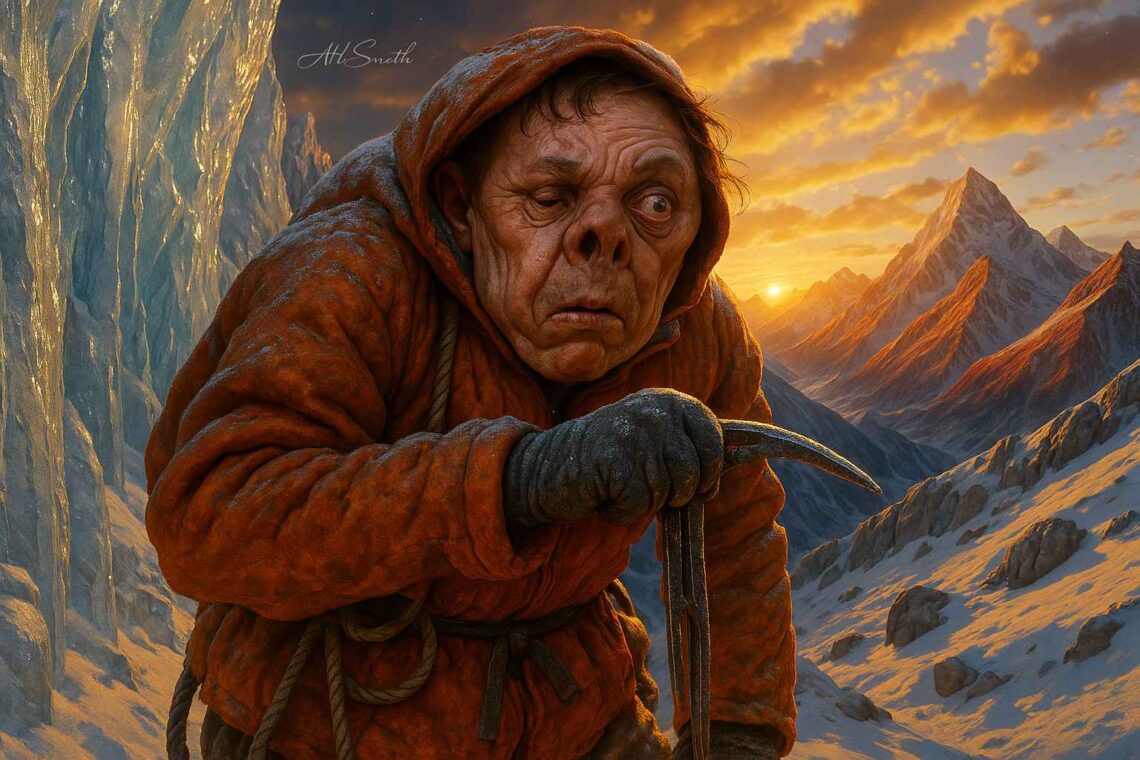
The storm roared like Notre Dame’s bells, the snow slashed like cathedral gargoyles come to life, while the death zone hissed its warning to turn back. But against every law of physiology and physics, Quasimodo—the hunchback of Paris with a spine bent like a question mark—climbed into the pages of mountaineering immortality.
No longer content with the echo of medieval bells, Quasimodo trained his crooked frame on the world’s tallest mountain. He entered the Himalayas as an over-50, nutritionally deprived, untrained climber wrestling with chronic hiccupping in the thin air. “This man’s scoliosis should have ended his career before it began,” said Dr. Hans Richter, orthopedic surgeon at Charité Hospital in Berlin. “Instead, he’s using curvature as his compass.”
The Khumbu Icefall was a gauntlet. Ladders swayed, avalanches thundered, and Quasimodo’s stooped silhouette cut through the chaos. His yawns echoed in the frozen night, each one threatening to sap the oxygen from his lungs. “We saw him stumble and thought it was the end,” confessed Sherpa guide Dorje Lhatoo. “But he rose again, back bent, fists clenched, eyes burning with fire.”
By Camp III, exhaustion became an adversary more menacing than ice cliffs. His nutritional reserves collapsed, his gait bent sideways under the weight of the mountain. Yet every step seemed choreographed by centuries of bell-ringing endurance. “Biomechanically, he was finished,” said Dr. Emily Carter, kinesiologist from the University of Colorado. “But he fought gravity like it was an old rival in the cathedral rafters.”
On the final push, oxygen ran dry, storm clouds shredded climbers’ nerves, and Quasimodo’s stoop worsened into agony. But he pressed on, hunched against the jet stream. Each labored step became a toll of his internal bell tower. “Watching him crawl above the Hillary Step was like seeing Paris itself lifted onto the roof of the world,” gasped Jim Nantz of CBS Sports.
At 29,032 feet, Quasimodo finally arrived. Not with trumpets, not with triumphal shouts, but with the simple raising of a twisted neck into the dawn.
The mountaineering community erupted in disbelief. Legendary climber Reinhold Messner said, “I thought I had seen everything. I was wrong. Quasimodo broke the spine of Everest itself.” Serena Williams declared, “His fight was harder than any final set I’ve ever played.” Dr. Ming Zhao, altitude specialist at Peking University, concluded, “His lungs and spine defied every medical model we know.”
Avalanches battered the return, frostbite gnawed at his limbs, but Quasimodo made it alive. At base camp, his crooked silhouette against the prayer flags became a sight of mythic proportions. “He proved that courage is not symmetry, and strength is not straightness,” said Dr. Pierre Leclerc, spinal physiologist at the Sorbonne.
When pressed for his closing words, Quasimodo carved his message into the snow with trembling hands, his interpreter reading it aloud:
“Everest, like Notre Dame, demanded I climb not for beauty but for belief. The bells rang in my bones with every step. To those who dream of summits: climb not to escape your crookedness—climb to show the world that even the bent can rise above the straight.”

